
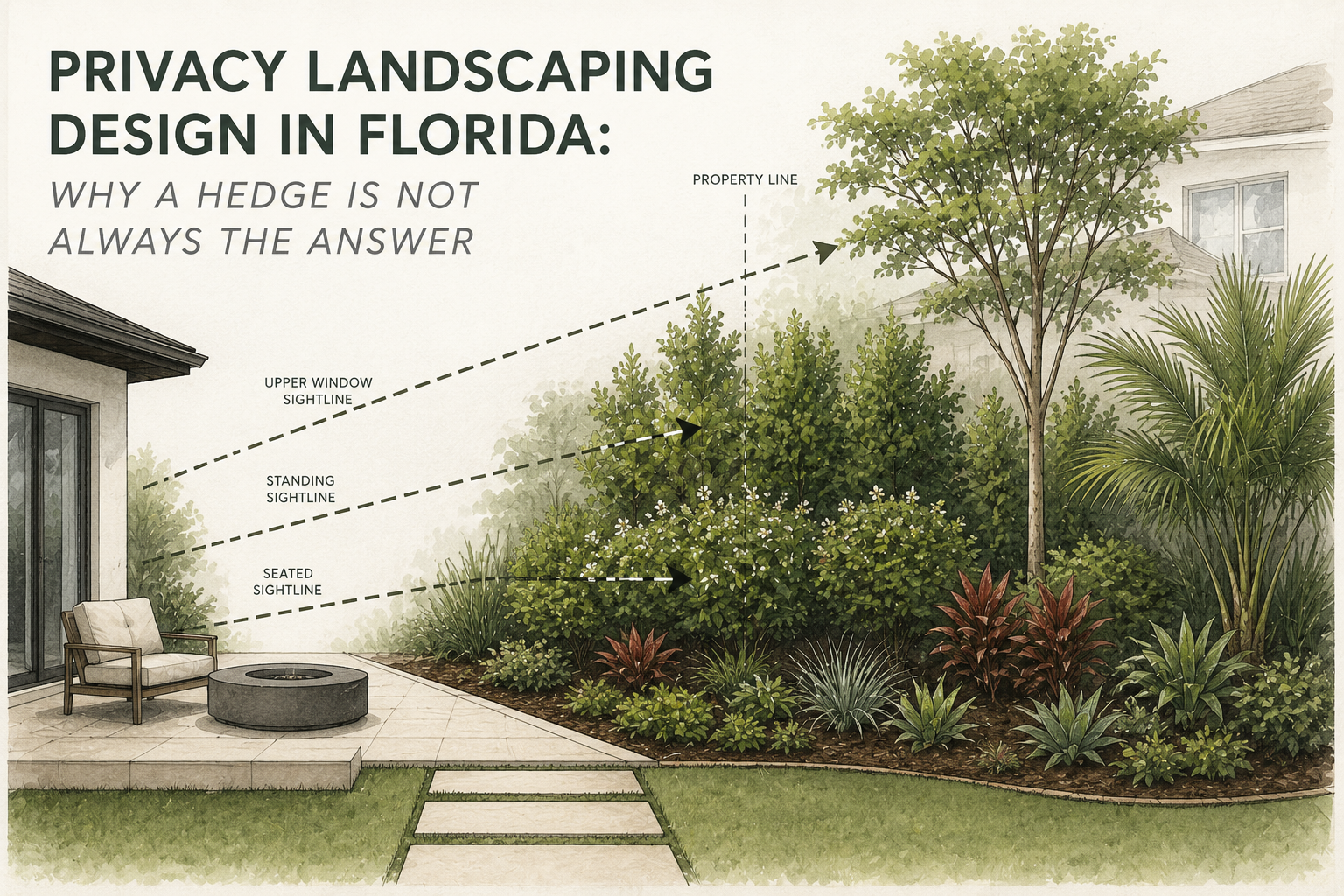
Privacy Landscaping Design in Florida: Why a Hedge Is Not Always the Answer
Most privacy landscape mistakes start before anyone buys a plant. The wrong question is usually asked first: “What should I plant along the fence?” In Florida, privacy landscaping design needs to start with the actual sightline, the usable space, the mature size of the plants, and the amount of maintenance the property can realistically handle. A hedge may be the answer. It may also be the beginning of a long, expensive pruning relationship.
Most privacy landscape projects start with a plant question: “What should I plant along the fence?” “What grows fast?” “What blocks the neighbor?” “What can go around the pool?” Those are normal questions, but they are usually too early.
Privacy landscaping design is not just about finding a tall plant and putting it in a row. That is how people end up with hedges that get too wide, palms that screen nothing below the crown, bamboo decisions that become neighborhood diplomacy problems, or a row of shrubs that looked great for one season and then opened up right where the view mattered.
In Florida, privacy needs to be designed around the actual problem, not guessed from a plant list. A neighbor’s second-story window is not the same design problem as a road. A pool patio is not the same as a side yard. A dining area may only need one view blocked, while a property-line buffer may need depth, structure, and long-term maintenance access. That distinction is where the money gets saved or wasted. For a deeper breakdown of the main privacy planting systems, see our full guide to Privacy Planting Strategies in Florida.
Start With the Sightline
The first question should not be “what plant?” The first question should be “what view are we actually trying to interrupt?”
That sounds obvious, but it is where many privacy projects go sideways. A person standing on a sidewalk sees the yard differently than someone sitting on a patio. A neighbor looking down from a second-story window creates a different angle than someone walking along a fence. Headlights from a road are different from a fixed view into a pool cage.
Privacy is visual. The property line is legal. Those are not always the same thing. A hedge planted directly on the property line may still fail if the view passes over it, around it, or through seasonal gaps. In some yards, a smaller screen placed closer to the patio or pool blocks the important view better than a taller planting at the edge of the property.
That is not overcomplicating the project. That is avoiding the wrong project.
The Property Line Is Not Always Where the Solution Belongs
One of the most common homeowner assumptions is that a privacy problem should be solved by planting along the fence. Sometimes that works, but sometimes it creates a long, expensive green wall in the wrong place.
If the problem is a neighbor’s window looking into a seating area, the best screen may belong near the seating area. If the issue is road exposure, the solution may need depth and staggered planting instead of one rigid row. If the problem is an upper-floor view into a pool area, a hedge at the property line may need to become much taller than the space can reasonably support.
The goal is not to block the entire outside world. The goal is to protect the experience of the space. That might mean screening one angle, softening one edge, interrupting one upper view, or making one outdoor room feel less exposed. The more specific the problem, the cleaner the solution can be.
Fast-Growing Privacy Plants Come With a Bill
Fast growth is attractive because privacy problems usually feel urgent. A neighbor clears their yard, a new house goes up, a fence comes down, or a pool suddenly feels like a public performance venue. So the obvious search begins: fast-growing privacy plants in Florida.
The problem is that “fast” is not the same thing as “good.” The plant that closes a gap quickly may also be the plant that gets too wide, needs constant pruning, thins at the base, catches wind, competes with itself, or becomes difficult to remove later.
Florida growth can hide bad decisions for a while. Then the landscape matures, and the invoice shows up as pruning, replacement, root conflicts, or a screen that no longer fits the bed. A slower plant with the right mature size often beats a fast plant that has to be fought forever.
The better question is not “what grows fast?” It is “what still makes sense here in five years?” Fast growth is one way people try to solve the pressure. Another is buying the privacy all at once.
What About an Instant Hedge?
An instant hedge can make sense when immediate privacy matters and the site can support larger material, but “instant” does not remove the design problem. It usually makes the design problem more expensive.
Larger plants cost more, weigh more, need better access, require more careful installation, and are less forgiving if the spacing or species choice is wrong. They also need consistent irrigation during establishment. A large hedge planted in the wrong place is not a better solution. It is just a more expensive mistake.
Instant hedges are most useful when the sightline is clear, the bed has enough width, the plant choice fits the mature space, and the maintenance expectations are understood before installation. If the goal is immediate privacy, the better question is not “how big can we buy it?” The better question is “where does the screen actually need to be, and what size plant gives us the best result without creating a future problem?”
A Hedge Can Work, But It Needs a Job Description
Hedges are not bad. A good hedge can be clean, effective, and appropriate, but it needs a realistic job description before the first plant goes in the ground.
Is it supposed to stay narrow, stay dense at the base, grow quickly, handle reflected heat, stay below a certain height, avoid pool debris, survive low irrigation, take regular pruning, look formal, look natural, block one view, or define an entire boundary? Most hedge failures come from asking one plant to do too many of those things at once.
Formal hedges are useful when the landscape needs a controlled, architectural edge, but they require regular pruning. Once a hedge becomes formal, every weakness becomes visible: uneven irrigation, pest pressure, spacing mistakes, light differences, dead spots, and plants that do not respond well to shearing.
Informal hedges can be more forgiving, but they usually need more width. They may flower better, look more natural, and require less shaping, but they are not usually the answer in a narrow bed where someone wants a tight green wall forever.
Layered Privacy Usually Performs Better Than One Perfect Row
When the space allows it, layered privacy is usually stronger than a single row of plants because it does not rely on one line of shrubs to behave perfectly. A layered buffer uses staggered plants at different heights and widths to interrupt the view in more than one place.
That redundancy matters. If one plant thins, another layer may still help. If one species struggles, the entire screen does not visually collapse. A layered planting can also look more natural along roads, rear property edges, larger side yards, and outdoor living areas where the goal is not just to block something, but to make the space feel settled.
The warning is that layering needs room. Low shrubs, medium shrubs, small trees, palms, vines, and groundcovers can all play a role, but only if they are arranged with control. If the bed is too narrow, “layered” becomes “crowded.” That is not design. That is plant hoarding with mulch.
Palms Are Not Walls
Palms are useful in Florida privacy design, but they are often misunderstood. They can interrupt upper sightlines, add vertical rhythm, create canopy, and help break up views, especially when used in clusters or layered with other planting.
But most palms do not provide dense privacy from the ground up. Once the trunk clears eye level, the lower view is open. That does not make palms wrong. It means palms usually need support from shrubs, understory planting, vines, panels, or other lower screening elements.
Palms can be part of a privacy system, especially when the privacy problem is mostly above eye level. They should not be asked to do the whole job by themselves.
Second-Story Windows Need Geometry, Not Panic
Second-story privacy is where a lot of bad design decisions start because the angle of view is different. Someone sees an upstairs window looking into the backyard and assumes the answer is a very tall hedge, but trying to block an elevated view from the property line can require a screen that becomes too tall, too heavy, too maintenance-dependent, or too exposed to storms.
A better solution may be to interrupt the angle closer to the space being used. That could mean a smaller planting near the pool, a canopy tree, a palm grouping, a pergola, a trellis, or a privacy panel combined with planting. The objective is not always to build a green wall at the edge of the yard. The objective is to make the pool, patio, or outdoor room feel private.
Sometimes Plants Need Help
Plant-only screening is not always the smartest answer. Fences, walls, trellises, panels, pergolas, and other built elements can reduce the burden placed on the plants, especially when privacy is needed quickly, the space is narrow, or the sightline is too high for planting alone.
A trellis with vines may solve a side-yard problem where shrubs would get too wide. A fence softened with layered planting may provide immediate structure while the plants mature. A panel near a patio may block the one view that matters without requiring a hedge across the whole property.
A trellis may also be treated differently than a fence under some HOA or community rules. That should never be assumed, but it is worth checking before the design is finalized. In some cases, a plant-support structure can solve a privacy problem with less approval friction than a full fence or wall.
Plants and structures should be treated as one privacy system, not separate decisions. Built elements provide stable interruption while planting adds softness, shade, texture, and life.
Maintenance Is Part of the Design
Privacy landscapes do not freeze in place after installation. They grow, thin, lean, crowd, and respond to pruning, irrigation, shade, heat, pests, wind, and soil conditions. That means maintenance is not a separate issue to think about later. It is part of the design.
A privacy screen that only works when trimmed every few weeks is not low maintenance. It is a maintenance subscription with roots.
The design needs to account for how the planting will actually be managed. Can the hedge be reached? Can the plants mature without blocking access? Is the bed wide enough for the selected species? Does the irrigation actually cover the full row? Will the plants hold foliage at the base? Is one species carrying the entire privacy function? What happens if one plant dies?
These questions are not glamorous, but they are where most privacy projects succeed or fail. Good privacy design is not just about the installation photo. It is about what the planting becomes.
Privacy Design Is Really About Control
The best privacy landscape does more than block a view. It controls the experience of the yard.
A good privacy layout can make a patio feel less exposed, make a pool feel more comfortable, soften a road edge, and interrupt the view that actually matters without turning the property into a green bunker.
That usually requires more than one plant name. It requires the actual sightline, the mature plant size, the available depth, the maintenance tolerance, the exposure, the irrigation reality, and the long-term behavior of the plants being used.
A privacy planting can be simple. It should not be simplistic.
Need a Privacy Landscape Plan That Actually Fits the Site?
Need a Privacy Landscape Plan That Actually Fits the Site?
Pennate designs Florida-specific privacy planting strategies for homeowners who want the screen to work after the first install photo. A privacy landscape design review can identify the actual sightlines, determine whether the right answer is a hedge, layered buffer, palm grouping, trellis, panel, or mixed planting system, and help avoid common mistakes before money goes into plants.
For Florida yards, that matters. The wrong plant can still grow. Sometimes that is the problem.
Before installing a privacy screen, get the layout right. It is cheaper to move lines on a plan than remove the wrong hedge later.

