

Clusia in Florida: Privacy Hedges, Growth, Spacing & Care Guide
Few plants have become as closely associated with modern Florida landscaping as Clusia.
Drive through a newer neighborhood, a waterfront community, a commercial property, or pretty much any recently landscaped backyard, and you will probably find it somewhere. In many parts of Florida, Clusia has become the default answer when someone wants privacy, screening, and something green enough to soften the feeling that the neighbor’s pool cage is now part of their living room.
Its popularity is not an accident.
Clusia has dense evergreen foliage, strong salt tolerance, good wind resistance, and a growth habit that responds well to pruning when the right species is planted in the right place. It can be used as a formal hedge, an informal screen, a property buffer, or even a specimen plant, depending on how it is selected and maintained.
But here is the problem: Clusia is often sold like it is magic.
It is not.
Homeowners are told it grows fast, stays green, blocks views, handles salt, and needs very little maintenance. Some of that is true. Some of it depends. Some of it becomes painfully false when the plant is installed too close together, too close to a structure, too close to a fence, or handed over to someone with dull hedge trimmers and a dream.
This article walks through Clusia the way it actually behaves in Florida landscapes. Whether you are planning a new hedge, replacing a failing screen, or trying to figure out why your existing Clusia suddenly looks terrible, you will find the answers here.
Quick Facts About Clusia
| Botanical Genus | Clusia |
|---|---|
| Common Florida Species | Clusia guttifera, Clusia rosea, and selected variegated forms |
| Common Names | Clusia, Small Leaf Clusia, Autograph Tree, Pitch Apple |
| Primary Florida Use | Privacy hedges, property buffers, pool screening, coastal landscapes, and specimen plants |
| Best Known Feature | Dense evergreen foliage and thick leaves that can be scratched or “autographed” on some types |
| USDA Zones | Commonly grown throughout Zones 9B–11, though freeze damage can occur during significant cold events, particularly in inland locations.s |
| Cold Tolerance | Damage can occur near freezing, especially during frost events or repeated cold nights |
| Sun Exposure | Full sun to partial shade |
| Salt Tolerance | Excellent |
| Drought Tolerance | Moderate to high once established |
| Growth Rate | Moderate, faster with good irrigation, fertility, sunlight, and spacing |
| Typical Hedge Height | Commonly maintained around 6–15 feet, depending on site and maintenance goals |
| Mature Size | Can range from large shrub to 40+ foot tree depending on species |
| Evergreen | Yes |
| Root Aggressiveness | Generally low to moderate when properly sited, but mature size still matters |
| Maintenance Level | Moderate; not maintenance-free |
| Common Problems | Improper spacing, over-pruning, freeze damage, yellowing leaves, thin hedges, and poor drainage |
| Toxicity | Not considered highly toxic, but ingestion may cause irritation; not intended for consumption |
| Best Fit | Sunny, well-drained Florida landscapes where long-term size and maintenance are planned in advance |
| Poor Fit | Tight spaces, deep shade, cold inland sites, or places where regular pruning will be neglected |
Table of Contents
- Quick Facts About Clusia
- Meet the Clusia: Florida’s Privacy Workhorse
- Clusia rosea vs Clusia guttifera
- Why Is Clusia Called the Autograph Tree?
- Where Does Clusia Come From?
- Why Homeowners Choose Clusia for Privacy
- How Fast Does Clusia Grow?
- Clusia Spacing Guide
- Growing Healthy Clusia in Florida
- Clusia Root Systems Explained
- Clusia Around Pools, Seawalls, and Waterfront Properties
- How to Prune Clusia Properly
- Why Hedge Trimmers Ruin Clusia
- Common Clusia Problems
- Cold Damage and Freeze Recovery
- Hurricane Performance
- Clusia and Wildlife
- Common Clusia Myths
- What Clusia Looks Like After 10 Years
- When Clusia Is the Wrong Plant
- How Much Does Clusia Cost?
- Clusia Alternatives
- Why Clusia Is So Polarizing
- Clusia Facts You Probably Didn’t Know
- Before You Plant Clusia
- Frequently Asked Questions
Meet the Clusia: Florida’s Privacy Workhorse
If Florida had an official privacy plant, Clusia would be a strong contender.
Over the past few decades, it has gone from a relatively uncommon tropical plant to one of the most widely planted screening species in the state. Developers use it. HOAs use it. Landscape architects use it. Homeowners use it. In some neighborhoods, it seems like every third property line is lined with Clusia.
There is a reason for that.
Florida homeowners tend to want the same few things from a privacy plant. They want something evergreen. They want something that can tolerate heat, humidity, wind, salt, sandy soil, and the occasional period of neglect. They want it to block views without looking like a concrete wall. Most importantly, they want it to survive in a climate that can swing from tropical storms to drought and, every once in a while, a surprise freeze.
Clusia checks many of those boxes. Its thick, leathery leaves help it tolerate challenging conditions that can stress other plants. It handles coastal environments surprisingly well, recovers from pruning better than many alternatives, and can create a dense living screen capable of providing privacy throughout the year.
Of course, popularity comes with consequences.
Because Clusia is so commonly recommended, many homeowners assume it is a one-size-fits-all solution. It is not uncommon to hear someone say they want “a Clusia hedge” without knowing which species they are buying, how large it will become, or what kind of maintenance it will require ten years down the road.
That is where many problems begin. A properly planned Clusia installation can provide decades of privacy and structure. A poorly planned installation can become an expensive trimming project that never seems to end.
Part of the confusion comes from the fact that “Clusia” is not a single plant. The name is commonly used to describe multiple species that behave very differently in the landscape. Some are better suited for privacy hedges. Others eventually become substantial trees. Some are valued primarily for screening, while others are grown as ornamental specimen plants.
Before discussing growth rates, spacing, maintenance, and common problems, it helps to understand exactly what Clusia is and why it became such a dominant part of Florida landscaping.
Clusia rosea vs Clusia guttifera
Most homeowners do not need to become botanists before buying Clusia. In many Florida garden centers and big box stores, the Clusia being sold for hedges is usually the common green hedge type. For most privacy applications, that is the plant people are looking for. The goal here is not to make the process sound complicated or scary.
But it is still worth understanding that “Clusia” is a broad name.
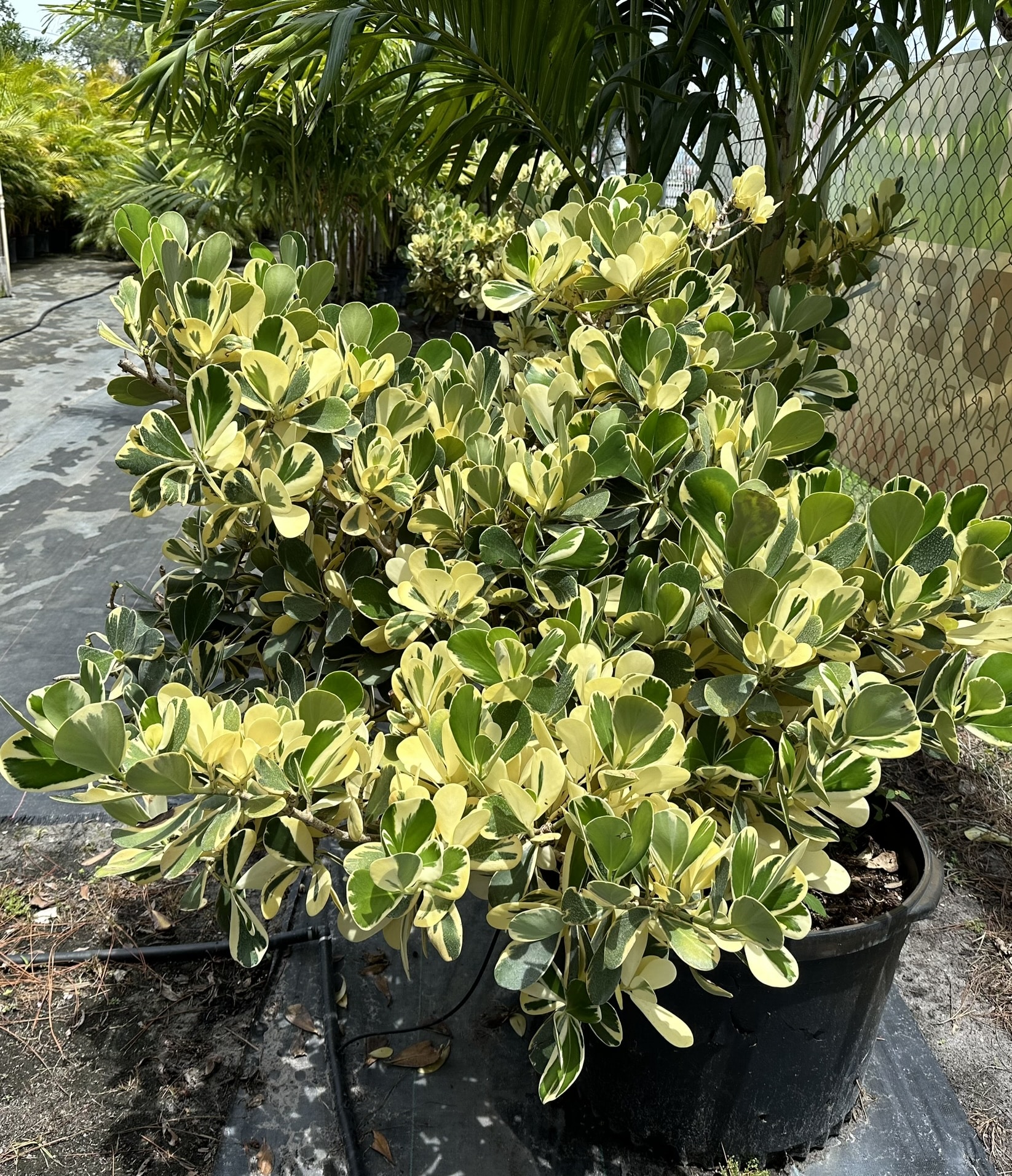
The two names you are most likely to encounter are Clusia guttifera and Clusia rosea. You may also run across variegated forms, especially variegated Clusia rosea, which have cream, yellow, or white markings on the leaves. These can be beautiful plants, but they are usually better treated as accents or specimens rather than the default choice for a long privacy hedge.
This matters most when you are buying larger material, working with a nursery, planting near structures, or planning a hedge that you expect to manage for many years. A small difference at the nursery can become a much bigger difference once the plant has been in the ground for five, ten, or fifteen years.
So no, you do not need to panic over every plant tag.
You should, however, know what you are planting and why it fits the space.
The table below compares the Clusia types most commonly encountered in Florida landscapes.
| Characteristic | Clusia guttifera | Clusia rosea | Clusia rosea ‘Variegata’ |
|---|---|---|---|
| Common Name | Small Leaf Clusia | Autograph Tree / Pitch Apple | Variegated Autograph Tree |
| Primary Landscape Use | Privacy hedge | Specimen tree or large screen | Accent plant or specimen |
| Mature Height | 10–20+ ft | 25–40+ ft | Typically 6–15+ ft |
| Mature Width | 8–15+ ft | 20–30+ ft | 6–12+ ft |
| Leaf Size | Small to medium | Large | Large |
| Leaf Color | Dark green | Dark green | Green with cream, yellow, or white variegation |
| Growth Rate | Moderate | Moderate to fast | Moderate to slow |
| Privacy Screening | Excellent | Good | Fair to good |
| Formal Hedge Potential | Excellent | Fair | Fair |
| Specimen Value | Moderate | Excellent | Excellent |
| Salt Tolerance | Excellent | Excellent | Good to excellent |
| Wind Tolerance | Excellent | Excellent | Good to excellent |
| Cold Tolerance | Moderate | Moderate | Slightly less tolerant due to reduced chlorophyll |
| Drought Tolerance | High once established | High once established | Moderate to high |
| Root System | Moderate | Larger and more extensive | Moderate to large depending on age |
| Maintenance Requirements | Moderate | Moderate | Moderate to high |
| Best Location | Property lines, privacy screens, HOA landscapes | Large yards, parks, specimen locations | Feature beds, entrances, pool landscapes |
| Most Common Mistake | Planting too close together | Treating it like a hedge instead of a tree | Using it as a mass screening plant |
| Pennate Verdict | Best overall privacy hedge Clusia | Best specimen Clusia | Most visually interesting Clusia |
Why Is Clusia Called the Autograph Tree?
Most landscape plants are remembered for their flowers, foliage color, or growth habit.
Clusia managed to earn its nickname because people started writing on it.
The common name “Autograph Tree” comes from the thick, leathery leaves found on Clusia rosea. The leaves are so durable that a fingernail, coin, or other pointed object can be used to scratch words, names, or drawings directly into the leaf surface. As the leaf continues to grow, the markings remain visible, sometimes for years.
For many Floridians, this is their first memory of Clusia. Children discover the plant and immediately start carving initials, drawing pictures, or leaving messages on the leaves. Unlike many plants, the leaf is thick enough that the markings do not disappear after a few days.
The same characteristic that makes autographing possible also helps explain why Clusia performs so well in Florida landscapes. Those thick leaves are designed to conserve moisture, tolerate salt exposure, and withstand challenging environmental conditions. What many people see as a novelty is actually part of the plant’s natural adaptation to tropical and coastal environments.
Modern technology has expanded the concept even further.
Some growers, event companies, and specialty nurseries use laser engraving equipment to place names, logos, dates, and custom artwork directly onto Clusia leaves. Weddings, corporate events, and promotional displays occasionally use engraved leaves as a unique alternative to traditional signage or favors.
Fortunately, light scratching or engraving typically causes little long-term harm to a healthy leaf. The mark remains because the leaf tissue has been permanently altered, not because the plant is being actively damaged. Of course, repeatedly damaging large numbers of leaves serves little purpose, but the occasional autograph is unlikely to create a serious health issue for an established plant.
The nickname may sound like a marketing invention, but it is one of the few plant nicknames that is completely deserved. If you place a mature Autograph Tree in front of a group of curious children, there is a good chance somebody will test the theory before the day is over.
Where Does Clusia Come From?
Most homeowners encounter Clusia as a neatly trimmed hedge, but its natural history is far more interesting.
The genus Clusia contains hundreds of species native to tropical and subtropical regions of the Americas. Depending on the species, natural populations occur throughout South Florida, the Bahamas, the Caribbean, Central America, and portions of northern South America.
Many Clusia species evolved in environments that would challenge other landscape plants.
Natural habitats include:
- Coastal hammocks
- Limestone outcrops
- Rocky shorelines
- Tropical forests
- Coastal transition zones
These environments help explain many of the traits that made Clusia successful in Florida landscapes.
The thick, leathery leaves help reduce moisture loss during dry periods. Strong root systems help anchor plants in windy conditions. Salt tolerance allows survival in coastal environments where many landscape plants struggle.
Some species are even capable of beginning life high in the branches of other trees. Birds consume the fruit and distribute seeds throughout the landscape. Occasionally, those seeds germinate in pockets of organic matter trapped within a tree canopy before eventually sending roots toward the ground.
While most homeowners simply know Clusia as a privacy hedge, its success in Florida landscapes is largely a result of adaptations that evolved long before anyone planted it along a property line.
Why Homeowners Choose Clusia for Privacy
If there is one reason Clusia dominates Florida landscapes, it is privacy.
As homes continue to be built closer together, outdoor living spaces have become increasingly important. Pools, lanais, outdoor kitchens, fire pits, and patios have effectively become extensions of the home. Unfortunately, so have neighboring second-story windows, pool cages, and backyard gathering spaces.
Many homeowners want privacy, but they do not necessarily want a tall fence.
That is where Clusia excels.
When properly spaced and maintained, Clusia in Florida can create a dense evergreen screen that remains attractive throughout the year. Unlike many deciduous plants, it does not disappear during the winter. Unlike some tropical screening plants, it generally tolerates wind, salt, and pruning without constant drama. The result is a living wall that often feels softer and more natural than a fence while still providing meaningful visual separation.
There is also a practical reason homeowners often choose hedges over fences.
In many Florida municipalities, fence height is limited by zoning regulations and property location. Hillsborough County, for example, has historically limited fences in required front yards to 4 feet and side or rear yard fences to 6 feet, though homeowners should always verify current zoning requirements, HOA restrictions, easements, and sight-line regulations before building.
A Clusia hedge can provide additional privacy, visual screening, and landscape interest without making a property feel enclosed by walls and fencing.
Another advantage is flexibility.
A Clusia hedge can be maintained as a formal hedge with crisp lines, allowed to grow into a more natural buffer, or combined with other plants to create layered privacy. Depending on the design goals, it can help hide pool equipment, soften property lines, reduce visual clutter, or create a sense of enclosure around outdoor living areas.
Unlike a fence, a living screen also changes over time. As Clusia matures, it can create a more tropical appearance, support wildlife, soften harsh property boundaries, and integrate naturally into the surrounding landscape. Many homeowners find that a well-maintained hedge feels less imposing than a solid wall while still accomplishing the same privacy goals.
Of course, no privacy plant is perfect.
Clusia will not instantly create a ten-foot-tall screen. It still requires proper spacing, irrigation during establishment, and occasional maintenance. Many of the privacy problems homeowners experience can be traced back to unrealistic expectations, poor installation practices, or selecting the wrong plant for the location.
For homeowners willing to think long-term, Clusia remains one of the most effective privacy plants available in Florida landscapes.
Interested in privacy plant design beyond Clusia? See our complete guide to Florida privacy hedges and screening strategies.

How Fast Does Clusia Grow?
One of the most common questions homeowners ask is how fast Clusia grows.
Unfortunately, there is no single answer.
Growth rate depends on the species, plant size at installation, irrigation, soil conditions, fertility, sunlight, spacing, and even the time of year. A Clusia planted in full sun with regular irrigation will often grow much faster than one planted in poor soil or heavy shade.
That said, most homeowners can think of Clusia as a moderately fast-growing plant rather than an instant privacy solution.
A newly installed hedge often spends much of its first year doing something that is not very exciting: growing roots. While some top growth occurs, much of the plant’s energy is focused below ground as it establishes itself in its new environment.
This stage can be frustrating for homeowners who expect dramatic growth immediately after installation. The hedge may appear to do very little during the first several months, especially if the plants were recently transplanted or installed during cooler weather.
The second and third years are usually when things become more interesting.
Once established, Clusia in Florida often begins producing significantly more top growth. Plants start filling gaps between one another, screening improves, and the hedge begins taking on the appearance most homeowners envisioned when they first planted it.
By year five, many properly maintained hedges have become substantial landscape features. Depending on spacing, irrigation, and pruning practices, they may already be providing meaningful privacy and structure to the property.
Of course, there is a downside to vigorous growth.
Many homeowners spend the first few years wishing their Clusia would grow faster. Several years later, they are often asking how to slow it down. A healthy Clusia hedge can require regular maintenance to keep it within the desired height and width.
This is one reason spacing is so important. A hedge that appears sparse during its first year may become overcrowded five years later if the plants were installed too closely together.
As a general rule, homeowners should focus less on how fast Clusia grows and more on where it will eventually end up. The long-term size of the hedge is usually more important than the first year’s growth rate.
The good news is that Clusia tends to reward patience. It may not create instant privacy, but when properly installed and maintained, it can provide decades of evergreen screening in Florida landscapes.
Clusia Spacing Guide
Improper spacing is one of the most common Clusia mistakes in Florida landscapes.
Many homeowners focus entirely on the size of the plant they are purchasing rather than the size of the hedge they are trying to create. A newly installed Clusia may only be a few feet wide, but the mature hedge can eventually occupy significantly more space.
The goal should not be determining how far apart plants can be placed.
The goal should be determining how quickly you want privacy, how much space the hedge has available to mature, and how much maintenance you are willing to accept in the future.
A hedge planted too far apart may take years longer to provide meaningful screening. A hedge planted too closely may eventually require more pruning, more maintenance, and more corrective work than necessary. Fortunately, there are some practical guidelines that work well for most Florida landscapes.
Understanding Clusia Spacing
When discussing spacing, landscape professionals usually refer to plants being installed “on center.” This means the measurement is taken from the center of one plant to the center of the next plant.
For example, 3-foot spacing means each plant is positioned 3 feet from the center of the neighboring plant. Four-foot spacing means each plant is positioned 4 feet from the center of the neighboring plant. This method provides a more accurate way to plan hedge installations than measuring between branch tips or container edges.
The appropriate spacing depends largely on plant size and how quickly you want the hedge to fill in.

Recommended Spacing by Plant Size
Plant Size Typical Spacing
3 Gallon Clusia 30–36 inches on center
7 Gallon Clusia 36–48 inches on center
15 Gallon Clusia 48–60 inches on center
These are not absolute rules. They are practical ranges that balance privacy, growth potential, installation cost, and long-term maintenance.
Three-gallon material is often chosen when budget is the primary concern and the homeowner is willing to wait for the hedge to mature. Seven-gallon material is frequently considered the sweet spot because it provides a stronger initial appearance without the cost of larger specimens. Fifteen-gallon material is commonly used when immediate screening is important and the budget allows for it.
Privacy Hedge Spacing
For most residential privacy hedges, Clusia performs best at roughly 3 to 4 feet on center.
This spacing generally creates a dense screen without causing excessive long-term crowding. It is one of the most commonly used spacing ranges throughout Florida and works well for most Small Leaf Clusia installations.
Homeowners are often tempted to plant much closer because the hedge appears sparse during the first year. That reaction is understandable, but it is often unnecessary. A hedge that looks slightly open at installation may look ideal several years later.
Faster Privacy vs. Better Long-Term Structure
There is always a tradeoff between immediate appearance and future maintenance.
Closer spacing typically provides:
- Faster screening
- Fewer visible gaps
- Greater privacy early on
- Wider spacing typically provides:
- More room for growth
- Reduced competition
- Easier long-term maintenance
- Lower installation cost
Neither approach is automatically correct. The best choice depends on the goals of the project.
Special Spacing Situations
Property Lines
Property line installations require more thought than simple hedge spacing.
The question is not whether the hedge fits today. The question is whether it still fits ten years from now.
Before planting directly along a property boundary, consider:
- Mature hedge width
- Pruning access
- Utility easements
- Neighbor relationships
- Future fence repairs or replacement
A hedge that requires access from the neighboring property to maintain was probably planted too close to the property line.
Foundations
Clusia should not be installed directly against structures.
Adequate separation allows room for future growth, maintenance access, air circulation, and routine building maintenance. Most foundation concerns attributed to Clusia are actually placement problems rather than root problems.
Pools
Clusia performs well around pools, but mature size still matters.
A hedge installed directly against a pool deck may eventually create maintenance challenges, reduce access, increase shade, and complicate future repairs. Allowing room for both the hedge and the people using the space generally produces a better long-term result.
Utilities
Before planting, identify:
- Water lines
- Sewer lines
- Septic systems
- Drainage infrastructure
- Electrical services
Although Clusia is not generally considered one of Florida’s most aggressive root systems, future access often becomes more important than the roots themselves. A hedge planted directly over critical infrastructure may eventually create unnecessary complications.
The Most Common Spacing Mistake
The most common mistake is planting for appearance on installation day.
A sparse-looking hedge during the first year is normal. Many homeowners become uncomfortable with the initial gaps and attempt to compensate by installing plants extremely close together.
Five or ten years later, those same plants may be competing for space and requiring substantially more maintenance.
A properly spaced hedge often looks slightly underwhelming at first. Patience is usually rewarded.
The best Clusia hedge is rarely the one that looks perfect on planting day. It is the one that still functions well a decade later.
Growing Healthy Clusia in Florida
One reason Clusia became so popular is that it tolerates conditions that challenge many other landscape plants.
Florida’s climate is not always easy on landscapes. Heat, humidity, sandy soils, salt exposure, heavy rainfall, periodic drought, and occasional cold snaps all place stress on plants. Clusia is not immune to these conditions, but it generally handles them better than many common privacy hedge alternatives.
That does not mean it can be planted anywhere and expected to thrive.
Like every plant, Clusia has preferred growing conditions. Understanding those conditions before installation often prevents many of the problems homeowners experience later.
Sunlight Requirements
Clusia performs best in full sun to partial shade.
In full sun, plants typically develop denser growth, stronger branching, and more vigorous screening. This is where most homeowners achieve the thick hedge they envision when planning a privacy screen.
Partial shade is usually acceptable, particularly during the hottest portions of the day. Many established Clusia hedges perform well with a combination of morning sun and afternoon shade.
Deep shade is a different story.
While Clusia may survive in heavily shaded conditions, survival and performance are not the same thing. Hedges growing beneath dense tree canopies often become thinner, leggier, and less effective as privacy screens over time. Homeowners frequently attempt to correct this with fertilizer when the real problem is insufficient light.
No amount of fertilizer can compensate for a lack of sunlight.
Florida Soils
One of Clusia’s strengths is its ability to adapt to a wide range of Florida soils.
Many residential landscapes consist primarily of sandy soil with relatively low organic matter. While some plants struggle in these conditions, Clusia generally adapts well once established.
Problems are more likely to occur when soil drainage is poor.
Many newer developments contain varying layers of builder fill, construction debris, buried organic material, or compacted soils left behind during construction. A hedge may perform exceptionally well in one area of the yard and struggle only a few feet away because conditions below ground are different.
When growth appears uneven, the answer is often in the soil rather than the plant itself.
Irrigation During Establishment
The first year is the most important period in a Clusia hedge’s life.
Newly installed plants spend much of their energy developing root systems. During this time, consistent moisture is important because the roots have not yet expanded into the surrounding soil.
This is where many homeowners become frustrated. The hedge may not appear to be doing much above ground, but significant development is occurring below the surface.
Proper irrigation during establishment encourages roots to expand outward and downward rather than remaining dependent on the original root ball.
Patience during this stage is often rewarded later.
Mature Water Requirements
Once established, Clusia becomes considerably more forgiving.
Healthy plants are generally capable of tolerating normal dry periods and often require less supplemental irrigation than many homeowners expect. This is one reason Clusia performs well in many Florida landscapes after the establishment period has passed.
That does not mean irrigation should be ignored entirely. Extended drought, sandy soils, and coastal conditions can still create stress. The difference is that established plants typically have a much larger root system available to help them cope with those challenges.
The Overwatering Problem
Many declining Clusia hedges are not suffering from too little water.
They are suffering from too much.
Homeowners often assume yellow leaves, slow growth, or poor appearance indicate drought stress. The natural response is to increase irrigation. Unfortunately, excess water can create many of the same symptoms as insufficient water.
Roots require oxygen to function properly. Constantly saturated soil reduces oxygen availability and places stress on the root system. In severe cases, prolonged wet conditions can contribute to root decline and secondary problems that are far more difficult to correct than simple drought stress.
Before adjusting irrigation, it is worth determining whether the plant is actually dry.
The answer is not always what people expect.
Growing Clusia Successfully
Most successful Clusia hedges are not the result of special fertilizers, secret products, or complicated maintenance programs.
They are the result of getting a few fundamentals right:
- Adequate sunlight
- Reasonable drainage
- Consistent establishment irrigation
- Proper spacing
- Realistic expectations
When those conditions are present, Clusia often proves to be one of the most reliable screening plants available for Florida landscapes.
Many of the problems discussed later in this article can be traced back to one or more of these fundamentals being overlooked during installation or establishment.
Clusia Root Systems Explained
One of the most common concerns homeowners have about Clusia is what happens below ground.
Questions about roots usually arise when someone is planting near a house, pool, sidewalk, seawall, or utility line. Some people are told Clusia roots are completely harmless. Others are warned they will eventually damage everything nearby.
The reality is somewhere in between.
Like any large landscape plant, Clusia develops an extensive root system as it matures. Understanding how those roots behave helps determine where Clusia should and should not be planted.
How Clusia Roots Grow
Clusia typically develops a broad, spreading root system rather than a deep taproot.
Most roots occupy the upper portion of the soil where oxygen, moisture, and nutrients are most available. This is common among landscape plants growing in Florida’s sandy soils.
As the plant matures, roots usually extend beyond the visible canopy. This is normal and should be expected.
A large root system does not necessarily mean an aggressive root system. The two are often confused.
Are Clusia Roots Invasive?
Generally speaking, Clusia is not considered one of Florida’s most aggressive-rooted landscape plants.
Compared to species such as large Ficus trees, Clusia is usually much less likely to create significant structural conflicts. However, that does not mean roots stop growing where convenient.
Roots naturally grow toward favorable conditions. Water, oxygen, and loose soil attract roots regardless of the plant species.
The best way to avoid future problems is proper placement, not assuming any plant has “safe” roots.
Can Clusia Damage Foundations?
Foundation damage is not a common concern when Clusia is planted with reasonable setbacks and maintained appropriately.
Most foundation-related complaints occur when:
- Plants are installed directly against structures
- Mature size was never considered
- Existing structural or drainage issues are present
In many cases, what appears to be a root problem is actually a planting-distance problem.
Can Clusia Damage Sidewalks or Driveways?
Any large plant can eventually contribute to hardscape conflicts if it is planted too close.
Clusia is generally not considered one of the highest-risk species for sidewalk displacement, but mature size still matters.
A small hedge installed today may eventually become a substantial landscape feature. Planning for that future growth is usually more effective than trying to manage conflicts after they develop.
Clusia Near Pools
Clusia is commonly used around pools because it provides excellent privacy, tolerates salt exposure, and generally produces less litter than many shade trees.
When problems occur, they are usually related to placement rather than root aggression.
A hedge planted too close to the pool deck may eventually create:
- Access issues
- Pruning challenges
- Excessive shade
- Maintenance conflicts
Allowing adequate space for both the hedge and the people using the space often prevents these issues.
Clusia Near Seawalls
Clusia performs exceptionally well in many waterfront environments, which is one reason it is frequently used near seawalls and coastal properties.
That does not mean it should be planted without planning.
Future seawall repairs, maintenance access, drainage improvements, and utility work should all be considered before installation. A mature hedge can become much more difficult to relocate than it is to plant.
Clusia and Underground Utilities
Before planting any hedge, it is worth identifying the location of:
- Water lines
- Sewer lines
- Septic components
- Drainage infrastructure
- Electrical services
In many cases, future access becomes a larger concern than the roots themselves.
Even when roots are not causing damage, a mature hedge planted directly over critical infrastructure can significantly complicate future repairs.
The Real Root Problem
Most Clusia root complaints are not actually root problems.
They are planning problems.
The hedge was planted too close to a house, too close to a pool, too close to a sidewalk, or too close to a property line. Years later, the plant gets blamed for doing exactly what plants naturally do: grow.
When mature size is considered from the beginning, Clusia roots are usually far less problematic than issues involving spacing, pruning, irrigation, and long-term maintenance.
Like many aspects of landscape design, the right plant in the right place solves most of the problem before it ever begins.
Clusia Around Pools, Seawalls, and Waterfront Properties
Clusia is one of the most useful screening plants for difficult Florida locations, especially around pools, seawalls, and coastal properties.
These areas expose plants to conditions that many common hedge species dislike: reflected heat, salt exposure, wind, sandy soils, and limited planting space. Clusia handles many of those pressures well, but placement still matters. A plant that tolerates harsh conditions can still become a problem if it is installed too close to hardscape, utilities, or areas that need future access.
Clusia Around Pools
Clusia is commonly used around pools because it provides dense evergreen privacy without the heavy leaf drop associated with many shade trees.
A well-placed Clusia hedge can help screen neighboring houses, pool cages, equipment areas, and outdoor living spaces. It also tolerates occasional salt exposure better than many landscape plants, which makes it useful around pools and coastal yards.
The main concern is not usually whether Clusia can grow near a pool. It usually can.
The concern is whether it has enough room to mature without making the pool area harder to use.
A hedge planted too close to the pool deck may eventually create access issues, pruning conflicts, excessive shade, or a narrow maintenance corridor that nobody enjoys dealing with.
The best pool plantings leave enough space for the hedge to grow, for people to move comfortably, and for future repairs to be completed without destroying the landscape.
Clusia for Pool Equipment Screening
Clusia can also work well for screening pool equipment, pumps, heaters, and utility areas.
This is one of the places where homeowners often make spacing mistakes. The hedge looks perfect when newly planted, then several years later the equipment becomes difficult to service.
When using Clusia for equipment screening, leave practical access for:
- Pool service
- Filter cleaning
- Pump replacement
- Heater repair
- Irrigation and electrical work
The hedge should hide the equipment, not trap it.
Clusia Near Seawalls
Clusia is frequently planted near seawalls because it tolerates salt, wind, and coastal exposure better than many common screening plants.
That makes it especially useful for waterfront properties where plant choices are limited. Salt spray, reflected heat, and dry sandy soils can weaken plants that perform well farther inland. Clusia is better suited to those conditions, especially once established.
Still, seawall plantings require planning. A seawall is not just a backdrop. It is infrastructure that may need inspection, drainage work, cap repair, tie-back work, or eventual replacement.
A mature hedge planted too close to the seawall can make those projects more difficult.
Before planting Clusia near a seawall, consider future access, mature hedge width, drainage pathways, irrigation layout, and whether equipment may need to reach the wall later. In many cases, the best design keeps the hedge far enough back to preserve a working edge while still providing privacy and softening the waterfront view.
Clusia on Waterfront Properties
Waterfront landscapes place unusual demands on plants.
They often combine several stresses at once: salt exposure, wind, sandy soil, reflected light, and periodic storm impacts. This is where Clusia often performs better than more delicate hedge species.
On waterfront properties, Clusia can be used to screen neighbors, soften seawalls, protect outdoor living spaces from wind, and create a greener transition between hardscape and water views.
The key is not overusing it.
A solid wall of Clusia may provide privacy, but it can also block views, airflow, and access if handled carelessly. In many waterfront landscapes, Clusia works best as part of a layered planting strategy rather than as the only plant in the design.
Salt Tolerance
Clusia has excellent salt tolerance compared to many common landscape shrubs.
This is one reason it became so common in coastal Florida. It can tolerate windborne salt and occasional salt spray better than many traditional hedge plants.
Salt tolerance does not mean salt immunity.
After severe storms or unusual exposure, Clusia may still show leaf burn, spotting, browning, or temporary defoliation. Healthy established plants often recover, but newly installed plants or stressed hedges may take longer.
In exposed coastal locations, establishment irrigation and proper spacing become especially important because salt, wind, and dry soils can combine to stress the plant.
Wind Exposure
Clusia generally performs well in windy locations.
Its thick leaves, flexible branching, and strong recovery ability make it useful where wind would shred or weaken more delicate plants. This is especially valuable around waterfront homes, open pool decks, and barrier island properties.
Even so, wind exposure affects growth. A hedge in a protected backyard may grow faster and fuller than one facing constant coastal wind. In exposed locations, expect slower establishment, more leaf wear, and occasional pruning adjustments as the hedge adapts to the site.
When Clusia Is Not Enough
Clusia is useful, but it should not be expected to solve every waterfront or poolside problem by itself.
If the goal is security, a fence may still be required. If the goal is erosion control, drainage correction, or seawall stabilization, those issues need proper site design and construction solutions. If the goal is ecological restoration, native alternatives or mixed plantings may be more appropriate.
Clusia is best understood as a durable privacy and screening plant. It is not a substitute for structural design, drainage planning, or code-compliant safety barriers.
Best Use Around Pools and Waterfronts
Clusia works best around pools, seawalls, and waterfront properties when it is given enough room to become a mature hedge without blocking access or creating future maintenance problems.
It is especially useful where privacy, salt tolerance, wind resistance, and evergreen screening are all priorities. The strongest designs usually treat Clusia as one part of the landscape system rather than the entire solution.
Used thoughtfully, Clusia can soften hard edges, protect outdoor living areas, and create privacy in places where many other plants struggle. Used carelessly, it can become another oversized hedge squeezed into a space that was never large enough.
How to Prune Clusia Properly
Clusia responds well to pruning, which is one reason it became so popular as a Florida privacy hedge. That does not mean every pruning method produces the same result.
A well-pruned Clusia hedge should look dense, intentional, and healthy. A poorly pruned hedge may look thin, chopped, brown-edged, or hollow inside. In many cases, the difference is not the plant. It is the pruning method.
The goal with Clusia is not simply to cut it back whenever it gets large. The goal is to guide the hedge into the shape, height, and density you want while preserving enough healthy foliage to support continued growth.
Start Pruning Early
The best Clusia hedges are shaped gradually.
Many homeowners wait until the hedge is already too tall or too wide before pruning. At that point, the work becomes more aggressive, more visible, and more stressful to the plant. Light, consistent shaping usually produces a better result than occasional severe cutbacks.
Young hedges should be encouraged to branch and fill in from the base. This does not mean repeatedly shaving the plant into a hard box. It means lightly guiding the sides and top so the plant becomes denser without losing its natural vigor.
Keep the Base Wider Than the Top
A Clusia hedge should generally be slightly wider at the bottom than at the top.
This is one of the most important pruning principles for any formal hedge. When the top becomes wider than the base, it shades the lower foliage. Over time, the hedge can become thin, open, and bare near the ground. UF/IFAS makes the same point for hedges generally: a hedge should be pruned so the top is narrower than the bottom, allowing sunlight to reach all leaves and keeping the hedge full lower down.
The taper does not need to be dramatic. Even a subtle inward slope from bottom to top can improve light penetration and help preserve lower growth.
This matters especially for Clusia because homeowners usually plant it for privacy. A hedge that is full at the top but open at the bottom is failing at the job it was planted to do.
Formal Hedge vs. Natural Screen
Clusia can be maintained as either a formal hedge or a more natural screen.
A formal hedge has cleaner lines and a more architectural appearance. It works well around modern homes, pool areas, property lines, and commercial landscapes. The tradeoff is that formal hedges require more regular pruning and more skill to maintain cleanly.
A natural screen is less rigid. It allows the plant to keep more of its natural branching structure while still controlling height and width. This approach can look softer, age better, and reduce the amount of visible pruning damage.
Neither style is automatically better. The correct approach depends on the property, the surrounding architecture, and the level of maintenance the homeowner is willing to support.
Use Selective Pruning When Possible
Selective pruning usually produces a better long-term Clusia hedge than repeated surface shearing.
Instead of cutting every leaf and stem along the outside surface, selective pruning removes or shortens specific branches to control size, improve structure, and encourage density. This helps avoid creating a thin outer shell with a bare interior.
General pruning guidance from extension sources distinguishes between cuts that remove or reduce branches and repeated heading cuts that stimulate dense growth only near the cut surface. That principle matters with hedges because over time, surface-only pruning can reduce light penetration into the interior of the plant.
For Clusia, selective pruning is especially useful because the leaves are large, thick, and slow to visually recover when torn. Cleaner cuts on stems usually look better than thousands of ragged cuts across individual leaves.
Do Not Let the Hedge Get Away From You
A Clusia hedge that is maintained at 8 feet is usually easier to manage than one allowed to grow to 14 feet and then cut back hard.
Large reductions are sometimes necessary, especially on older hedges, but they are rarely the ideal maintenance strategy. Severe cutbacks can expose woody interiors, remove too much foliage at once, and leave the hedge looking rough for an extended period.
The better approach is to decide the intended height and width early, then maintain the hedge close to that size. This keeps pruning lighter, reduces stress, and helps preserve a cleaner appearance.
Timing Matters, But Recovery Matters More
In Florida, Clusia can be pruned during much of the warm growing season because it is an evergreen tropical shrub. The best timing is usually when the plant is actively growing and capable of recovering.
Avoid hard pruning immediately before a forecasted cold event, during severe drought stress, or when the plant is already declining from irrigation or root problems. Pruning removes foliage, and foliage is how the plant produces energy. A stressed hedge has less capacity to recover from aggressive cuts.
Light shaping is usually less risky than heavy reduction. The more severe the pruning, the more important timing becomes.
How Much Can You Remove?
For routine maintenance, remove as little as necessary to maintain the desired shape.
A light trim or selective reduction is usually better than taking off large amounts of foliage at once. If a hedge needs major size reduction, it is often better to correct it gradually rather than trying to solve years of growth in one visit.
A practical rule is simple: if pruning exposes large bare sections or removes most of the green outer canopy, the hedge may look poor until it has time to regrow.
That does not mean the plant is dead or ruined. It means the pruning was visually and biologically significant.
Pruning After Installation
Newly planted Clusia should usually be allowed to establish before heavy shaping begins.
Light corrective pruning is fine if there are broken branches, awkward growth, or obvious structural issues. Heavy pruning immediately after installation is usually unnecessary and can slow establishment.
The first priority is root development. Once the plants are established and producing healthy new growth, shaping can become more intentional.
Rejuvenating an Overgrown Clusia Hedge
Older Clusia hedges can often be improved, but they should be handled carefully.
An overgrown hedge may have thick woody stems, bare interiors, and most foliage concentrated near the outside. Cutting it back hard may be possible, but the hedge may look unattractive for a while before it recovers.
A gradual rejuvenation approach is often better. Reduce height and width in stages, allow new growth to develop, then continue shaping over time. This gives the plant more opportunity to recover without losing all screening value at once.
The Best Pruning Strategy
The best pruning strategy for Clusia is steady, intentional maintenance.
Keep the base slightly wider than the top. Avoid letting the hedge grow far beyond the intended size. Use selective cuts when possible. Preserve enough healthy foliage for recovery. Match the pruning style to the landscape rather than forcing every hedge into the same box shape.
Most importantly, remember that Clusia is planted for long-term privacy. Proper pruning should protect that function, not slowly destroy it.
Why Hedge Trimmers Ruin Clusia
One of the most common reasons homeowners become disappointed with Clusia has nothing to do with irrigation, fertilizer, spacing, or growth rate. It is maintenance.
More specifically, it is how the hedge is trimmed.
Many Clusia hedges are maintained using powered hedge trimmers because they are fast, efficient, and economical. While that approach works reasonably well on plants with small, thin leaves, Clusia presents a unique challenge. The same leaf structure that earned Clusia the nickname Autograph Tree is also the reason pruning damage can remain visible for weeks or even months.
The Autograph Tree Problem
Earlier in this article, we discussed why Clusia is called the Autograph Tree. The thick, leathery leaves can retain scratches, markings, and engravings for extended periods of time. Unlike softer foliage that quickly tears, wilts, or drops, Clusia leaves tend to preserve damage.
That characteristic makes the plant interesting. It also makes poor pruning highly visible.
When a leaf is scratched, torn, or partially cut, the damaged tissue often remains attached to the plant long enough to discolor and become noticeable. The hedge essentially records the injury.
Why Hedge Trimmers Struggle With Clusia
Most powered hedge trimmers cut using rapidly oscillating blades that move back and forth across one another. This system works well when foliage is small and flexible. Clusia leaves are different.
Clusia leaves are different. They are thick, waxy, leathery, and relatively large compared to many hedge plants.
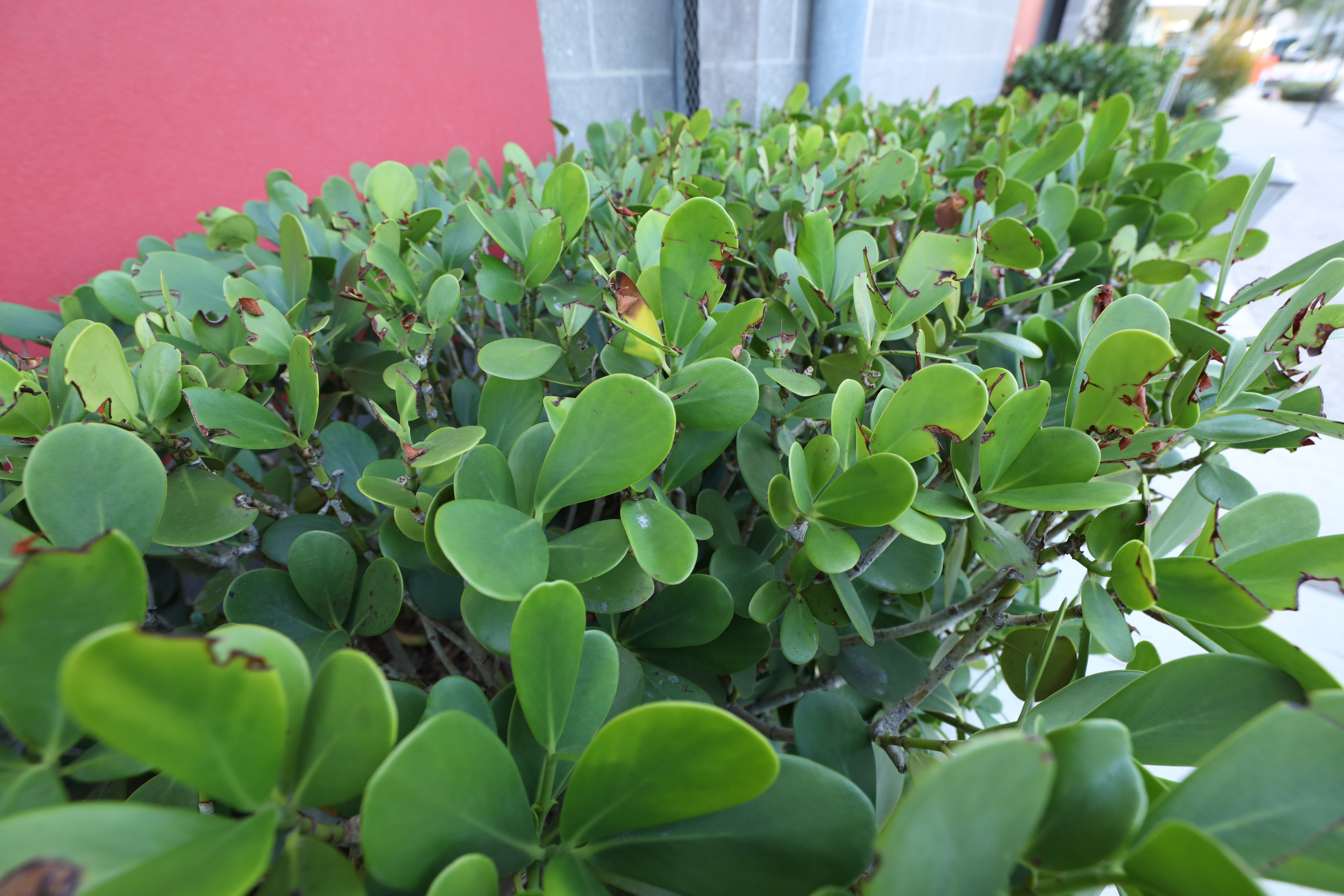
Rather than making a clean cut through a stem, hedge trimmers often encounter the broad surface of a leaf. Depending on blade sharpness, cutting angle, and operator technique, the leaf may be sliced cleanly, partially severed, torn, or crushed before the cut is completed. The result is often thousands of small wounds distributed across the surface of the hedge.
Immediately after trimming, the damage may be difficult to see. Several days later, it becomes much more obvious.
The Brown Edge Effect
One of the most common complaints following a Clusia trimming is the appearance of brown leaf edges.
Homeowners often assume the hedge is suffering from:
- Drought stress
- Disease
- Nutrient deficiency
- Chemical damage
In reality, the hedge may simply be displaying pruning injury.
The damaged portions of the leaves begin to dry out and discolor while the remainder of the leaf stays attached to the plant.
Because Clusia foliage is durable and long-lived, those damaged leaves may remain visible far longer than many homeowners expect. This is one reason a hedge can look worse a week after trimming than it did the day the work was completed.
Speed vs. Appearance
There is a reason hedge trimmers remain popular. They are efficient.
A large hedge that might take hours to selectively prune can often be trimmed much faster with powered equipment. For many commercial landscapes, HOAs, and maintenance contracts, speed matters.
The tradeoff is appearance.
The faster the hedge is trimmed, the more likely it becomes that leaves rather than branches are being cut. For some properties, that compromise is acceptable. For others, particularly high-end residential landscapes, it may not be.
How Professional Growers Often Handle Clusia
Many nursery growers and experienced horticulturists rely more heavily on selective pruning when maintaining specimen-quality Clusia. Instead of repeatedly shearing the outer surface, they remove or shorten specific branches to guide the shape of the plant.
This approach offers several advantages:
- Fewer damaged leaves
- More natural appearance
- Better light penetration
- Improved long-term structure
It is slower and more labor-intensive, but the results are often significantly better.
The Importance of Sharp Blades
Not all hedge trimming is equal.
A sharp blade generally creates less tissue damage than a dull blade. Whether using hedge trimmers, hand shears, loppers, or machetes, the quality of the cut matters. Clean cuts typically heal more effectively and produce less visible damage than cuts that tear, crush, or shred foliage.
This is one reason experienced maintenance crews often place significant emphasis on blade maintenance.
Questions to Ask Before Hiring a Maintenance Company
If Clusia is being installed as a major landscape feature, it is worth understanding how it will be maintained.
Ask:
- How do you normally prune Clusia?
- Do you use selective pruning?
- How often are blades sharpened?
- Can I see examples of mature Clusia hedges you maintain?
The answers often reveal whether the company understands the plant.
A Healthy Hedge Can Still Look Terrible
One of the most frustrating aspects of Clusia maintenance is that a perfectly healthy hedge can appear damaged simply because it was trimmed poorly.
The plant may be growing well. The roots may be healthy. Irrigation may be functioning properly.
Yet the hedge still looks rough because thousands of leaves were cut, torn, or shredded during maintenance.
For this reason, the quality of the maintenance company can be nearly as important as the quality of the installation itself.
A well-maintained Clusia hedge can look refined, dense, and architectural. A poorly maintained hedge can spend much of the year displaying the scars of its last haircut.
Common Clusia Problems
Clusia is often described as a low-maintenance plant, but low maintenance does not mean problem-free. Most Clusia issues are not caused by disease or insects. They are usually the result of environmental conditions, irrigation practices, planting mistakes, or maintenance decisions made months or years earlier.
The good news is that many common problems can be identified once the underlying cause is understood. The challenge is that several different problems can create similar symptoms, so it is important not to diagnose the plant from one leaf alone.
Yellow Leaves
Yellow leaves are one of the most common Clusia concerns, but a few yellow leaves do not automatically indicate a problem. Like all evergreen plants, Clusia continuously sheds older foliage as new growth develops.
When yellowing becomes widespread, the most common causes are overwatering, poor drainage, nutrient deficiencies, root stress, or natural leaf replacement occurring more heavily than usual. The difficulty is that these problems can look similar from a distance. Applying fertilizer to a drainage problem or increasing irrigation on an overwatered plant often makes the situation worse.
Thin or Sparse Hedges
A Clusia hedge that never fully fills in is usually responding to site conditions rather than genetics. The most common causes are insufficient sunlight, excessive spacing, inconsistent irrigation, or improper pruning.
Shade is especially common. Clusia can survive in partial shade, but dense screening requires adequate light. A hedge growing beneath mature trees may remain alive while never developing the density homeowners expect.
Bare Growth Near the Bottom
One of the most frustrating Clusia problems is a hedge that appears full at the top but open near the ground. This is usually a light issue.
When the top of the hedge becomes wider than the bottom, upper foliage shades the lower branches. Over time, the plant abandons growth that is no longer receiving enough sunlight. The result is a hedge that gradually becomes see-through at eye level.
Maintaining a hedge that is slightly wider at the bottom than the top helps prevent this problem and is one of the most important principles of hedge pruning.
Slow Growth
Many homeowners install Clusia expecting immediate privacy. The reality is that newly planted hedges often spend significant energy developing roots before producing dramatic top growth. Slow growth may simply be part of the establishment process.
Unusually slow growth can also indicate poor soil conditions, inadequate irrigation, deep planting, insufficient sunlight, or root stress. Growth expectations should always be viewed in the context of plant size, site conditions, and how long the hedge has been installed.
Leaf Drop
Leaf drop can be alarming, especially when it occurs suddenly. In many cases, some leaf drop is normal.
Clusia regularly sheds older foliage as part of its growth cycle. Problems arise when leaf drop becomes excessive or is accompanied by yellowing, dieback, or declining vigor. Irrigation problems, cold damage, salt stress, root issues, and recent transplanting can all contribute to leaf drop. The surrounding symptoms usually provide more information than the leaf drop itself.
Brown Leaf Edges
Brown leaf margins often lead homeowners to suspect disease, but the cause is usually environmental or mechanical. Salt exposure, drought stress, pruning damage, wind burn, and fertilizer injury can all create brown edges or damaged foliage.
Clusia is especially prone to visible pruning damage because its thick leaves tend to retain scars and torn edges long after trimming. This is one reason hedge-trimmer damage can remain noticeable for weeks or months.
Cold Damage
Although Clusia performs well throughout much of Florida, it is still a tropical plant. Freeze damage may appear as blackened foliage, bronze leaves, sudden leaf drop, or stem dieback.
Many homeowners make the mistake of pruning immediately after a freeze. In most cases, it is better to wait until warmer weather returns and the full extent of the damage can be evaluated. Healthy plants often recover better than expected.
Root Rot
Root rot is usually associated with prolonged wet conditions and poor drainage. Warning signs may include yellow foliage, declining growth, branch dieback, or wilting despite adequate moisture.
Unfortunately, root rot can be difficult to correct once it becomes severe. Prevention through proper drainage and irrigation management is far more effective than treatment.
Hurricane and Storm Damage
One reason Clusia became so popular is its ability to recover from storms. Even so, severe weather can still cause broken branches, salt burn, defoliation, and wind damage.
The best response is often patience. Remove damaged material, correct obvious hazards, and allow the plant time to recover before making major pruning decisions.
Most Problems Start Before Symptoms Appear
One of the most important things to understand about Clusia is that visible symptoms often appear long after the underlying problem began.
A hedge that turns yellow today may have been struggling with drainage issues for months. A sparse hedge may be responding to years of inadequate light. A declining plant may be reacting to planting depth decisions made on installation day.
Successful troubleshooting rarely begins by asking what the leaves are doing. It begins by asking what the roots, soil, water, sunlight, and maintenance practices have been doing.
Cold Damage and Freeze Recovery
One of Clusia’s greatest strengths is its ability to tolerate heat, humidity, wind, salt exposure, and drought once established. Cold weather is different.
Although Clusia is commonly grown throughout much of Florida, it remains a tropical plant. Significant cold events can damage foliage, stems, and in severe cases, entire plants. The extent of the damage depends on the minimum temperature reached, how long the cold lasts, wind exposure, soil moisture, plant health, and the age of the hedge.
Fortunately, Clusia often recovers better than homeowners initially expect.
How Cold Affects Clusia
Cold injury occurs when plant tissues are damaged at the cellular level. The colder the temperature and the longer it remains cold, the greater the potential for injury.
Young plants are generally more vulnerable than established hedges. Recently installed Clusia may experience damage at temperatures that mature plants tolerate with relatively minor injury. Location also matters. A hedge growing near a body of water, a heated structure, or within a protected urban environment may experience less damage than an identical hedge growing in an exposed inland location.
What Freeze Damage Looks Like
Freeze damage does not always appear immediately. A hedge may look relatively normal the morning after a cold night, then show visible damage several days later.
Common symptoms include:
- Bronze or brown foliage
- Blackened leaves
- Water-soaked appearance
- Sudden leaf drop
- Soft or collapsed stem tissue
- Branch dieback
The severity of symptoms does not always indicate whether the plant will recover. Clusia can lose a surprising amount of foliage and still return successfully once temperatures warm.
Do Not Prune Immediately
One of the most common mistakes homeowners make is rushing to prune after a freeze. A damaged hedge often looks terrible, and the natural instinct is to clean it up immediately. In most situations, that is the wrong approach.
Damaged foliage and stems can help protect living tissue beneath them from additional cold events. Removing that material too early may expose healthier growth to further injury if another freeze occurs. It is usually better to wait until warmer weather returns and new growth begins to emerge. At that point, it becomes easier to distinguish living tissue from dead tissue and make informed pruning decisions.
Patience often produces a better outcome.
What Recovery Looks Like
Recovery depends on the severity of the damage. Minor injury may result in little more than cosmetic leaf damage. Moderate injury may cause defoliation and branch dieback but still allow the hedge to recover over the following growing season. Severe freezes can kill large portions of the plant and occasionally entire hedges, particularly in younger installations or colder parts of the state.
In many cases, new growth begins emerging from dormant buds once temperatures stabilize and the plant resumes active growth. This recovery can be slow. A hedge that appears dead in February may look dramatically different by late spring.
Clusia in Zone 9B
Much of Central Florida, including portions of the Tampa Bay and Orlando regions, falls within USDA Zone 9B. Clusia is commonly grown throughout these areas and generally performs well, but homeowners should understand that occasional freeze damage is part of the reality of growing tropical plants near the edge of their preferred range.
Most winters pass without major issues. The concern is not the average winter. It is the unusually cold winter that occurs every few years. Well-established plants often recover from these events, but temporary damage should not be surprising.
Clusia in Coastal Areas
Coastal properties often experience less severe freeze damage than inland locations. Large bodies of water moderate temperature swings and can provide some protection during marginal cold events.
This is one reason Clusia is frequently seen thriving on barrier islands and waterfront properties where inland landscapes may experience greater cold stress. That protection is not unlimited, but it can make a meaningful difference during Florida winters.
When Is a Clusia Actually Dead?
A freeze-damaged Clusia is usually not dead as quickly as it looks. A hedge covered in brown leaves may still have living stems. A plant that has dropped most of its foliage may still have viable buds capable of producing new growth.
Before removing a freeze-damaged hedge, look for signs of recovery such as new shoots emerging from stems, green tissue beneath the bark, swelling buds, or fresh foliage development. Because recovery can be slow, premature removal is a surprisingly common mistake.
Preventing Future Freeze Damage
No landscape plant can be made completely freeze-proof, but healthy plants generally tolerate cold better than stressed plants. Proper irrigation, reasonable fertility, adequate sunlight, and good overall maintenance all contribute to a stronger hedge.
Plant selection matters as well. Homeowners in colder portions of Florida should recognize that every tropical plant carries some level of freeze risk. The goal is not eliminating risk entirely. The goal is understanding it before planting.
Most Freeze Damage Is Temporary
The appearance of a freeze-damaged Clusia can be alarming. Brown leaves, bare branches, and sudden defoliation often make the hedge appear worse than it actually is.
Severe freezes can cause permanent injury, but much of the damage homeowners see after a typical Florida cold event is cosmetic. In many cases, recovery occurs once warm weather returns and the plant begins pushing new growth. The hardest part of freeze recovery is often resisting the urge to make immediate decisions.
Hurricane Performance
One of the primary reasons Clusia became so popular in Florida is its performance during and after tropical storms.
No landscape plant is hurricane-proof. Extreme winds, storm surge, flooding, salt exposure, and flying debris can damage virtually any plant. Even so, Clusia has earned a reputation for recovering from storm events better than many common screening plants. For homeowners investing in a long-term privacy hedge, that resilience is one of Clusia’s most valuable characteristics.
Why Clusia Performs Well in Hurricanes
Several natural characteristics contribute to Clusia’s storm tolerance. The plant develops a broad root system, flexible branching, and thick, leathery foliage that can withstand environmental stress better than many softer landscape shrubs. Unlike some privacy plants that rely on tall, upright stems, Clusia tends to develop a dense, interconnected branching structure that helps distribute wind loads throughout the hedge.
Its leaves are also relatively small compared to the canopy size of the mature plant, reducing the sail effect that can contribute to storm damage. The result is a hedge that often bends and deflects wind rather than resisting it rigidly.
How Clusia Compares to Other Privacy Plants
One reason Clusia gained popularity was the decline of other screening options after major storm events. Areca palms, for example, may lose fronds, snap stems, or develop a permanently uneven appearance following severe weather. Some fast-growing hedge species can experience widespread branch failure or significant defoliation.
Clusia is not immune to damage, but it often maintains its overall structure better than many alternatives. This is especially important because homeowners typically plant privacy hedges to solve a long-term problem. A hedge that takes years to establish but disappears after the first major storm is not a particularly effective investment.
Common Storm Damage
Even healthy Clusia hedges can experience storm-related damage. Typical issues include broken branches, torn foliage, salt burn, defoliation, wind scorch, and occasionally leaning plants in saturated soils. Fortunately, many of these issues are cosmetic rather than structural.
A hedge that looks rough immediately after a storm may recover substantially during the following growing season. In coastal areas, storm-related salt exposure can sometimes cause more visible damage than the wind itself. Salt spray and storm surge may leave foliage looking burned, bronzed, or discolored. While the damage can appear alarming, healthy plants often replace damaged foliage once normal growing conditions return.
Storm Preparation and Recovery
A healthy hedge generally performs better during a hurricane than a neglected hedge. Before storm season, it is worth evaluating overall plant health, irrigation performance, existing structural damage, and dead or weakened branches. Proper pruning can also help reduce storm damage, although severe pruning immediately before hurricane season is usually not recommended. Excessive pruning can stimulate tender new growth and reduce the hedge’s ability to function normally.
After a storm, the first step is assessing the damage rather than immediately reaching for pruning equipment. Remove broken branches, hanging limbs, and obvious hazards first. Beyond that, patience is often beneficial. Many homeowners underestimate how much recovery occurs naturally. New growth frequently emerges from stems that initially appear damaged, and hedges that look devastated immediately after a storm may regain much of their appearance over the following months.
Long-Term Recovery
One of Clusia’s greatest strengths is not necessarily its ability to avoid damage. It is its ability to recover.
A hedge that loses leaves, suffers branch breakage, or experiences temporary salt injury can often rebuild itself over time. This regenerative capacity is one reason Clusia remains a common choice for coastal communities, waterfront properties, and hurricane-prone regions throughout Florida.
Storms are inevitable in Florida. The goal is not finding a plant that never gets damaged. The goal is finding a plant that can continue performing after the storm has passed. That may be Clusia’s most valuable trait.
Clusia and Wildlife
Clusia is typically planted for privacy, not wildlife value. Most homeowners choose it because it grows into a dense, durable hedge capable of screening neighboring properties, roads, equipment, and unwanted views.
That does not mean wildlife ignores it.
Like many evergreen plants, Clusia can provide shelter, nesting opportunities, and cover for a variety of animals. The question is not whether wildlife uses Clusia. The question is how its wildlife value compares to other plants that might serve a similar role in the landscape.
Birds
The greatest wildlife benefit of a mature Clusia hedge is usually the shelter it provides.
Dense branching creates protected spaces where birds can rest, nest, and seek refuge from predators. As hedges mature, they often become far more active than homeowners realize. Small songbirds frequently move through established Clusia screens, particularly when the hedge is part of a larger landscape containing trees, shrubs, and other habitat features.
In urban and suburban environments, dense evergreen hedges can function as important shelter corridors connecting otherwise fragmented habitat.
Pollinators
Clusia flowers can attract pollinating insects, although the plant is generally not considered a major pollinator plant compared to many Florida natives.
Homeowners specifically interested in supporting bees, butterflies, and other pollinators will usually achieve better results by incorporating flowering companion plants nearby. A mixed planting often provides greater ecological value than a single-species hedge.
Fruit and Wildlife Use
Mature Clusia plants can produce fruit, although this is rarely the primary reason they are planted in residential landscapes. Various birds may interact with the fruit and contribute to seed dispersal in natural settings.
Most homeowners never notice this aspect of the plant because privacy hedges are often maintained through regular pruning, which reduces flowering and fruit production.
Wildlife Value Compared to Native Alternatives
This is where the discussion becomes more nuanced.
Clusia can certainly provide wildlife benefits, particularly as shelter and nesting habitat. However, homeowners whose primary goal is supporting native ecosystems may wish to consider species such as Cocoplum, Simpson Stopper, Walter’s Viburnum, or other Florida natives that provide additional food resources for birds, pollinators, and other wildlife.
That does not make Clusia a poor choice. It simply means that privacy screening and ecological value are not always the same objective.
The Best Approach
For many landscapes, the best solution is not choosing between Clusia and wildlife-friendly plants. It is combining them.
A Clusia hedge can provide the privacy and structure homeowners want, while nearby native trees, shrubs, grasses, and flowering plants increase habitat value. This layered approach often creates a landscape that functions better for both people and wildlife.
Like many aspects of landscape design, the strongest results usually come from diversity rather than relying on a single plant to accomplish every goal.
Common Clusia Myths
Clusia is one of the most popular privacy plants in Florida, which means it is also one of the most misunderstood. Over the years, homeowners have been given plenty of advice about Clusia. Some of it is accurate. Some of it is partially true. Some of it is simply wrong.
Most bad Clusia advice is not malicious. It often comes from oversimplification, outdated habits, or field knowledge passed from crew to crew without anyone stopping to ask whether it is actually true. Landscape work has a lot of tribal knowledge, and tribal knowledge is useful until it becomes a shortcut for thinking.
“Clusia Is Maintenance Free”
This is probably the most common myth. Clusia is generally lower maintenance than many privacy plants, but no living hedge is maintenance free. It still requires irrigation during establishment, periodic pruning, occasional fertilization, and monitoring for problems.
The difference is that Clusia often requires less intervention than alternatives. That is not the same thing as requiring none.
“Plant Them Close Together for Faster Privacy”
This advice contains some truth, but it is often taken too far. Closer spacing can produce screening more quickly, but it can also create future maintenance issues if mature size is ignored. Many homeowners plant for what they want next year rather than what the hedge will look like ten years from now.
The best spacing depends on plant size, budget, maintenance expectations, and how quickly privacy is needed.
“Clusia Roots Will Destroy Everything”
This claim is usually exaggerated. Clusia develops a substantial root system, but it is not generally considered one of Florida’s most aggressive landscape plants. Most root-related complaints can be traced back to poor placement rather than unusual root behavior.
A hedge planted too close to a house, sidewalk, pool deck, or utility line may eventually create problems. That does not mean the roots are uniquely destructive.
“Clusia Can Grow Anywhere”
Clusia is adaptable, but it is not magical. It performs best with adequate sunlight, reasonable drainage, and proper establishment. A hedge planted in deep shade, constantly saturated soil, or poor site conditions may survive without ever performing well.
Many disappointing hedges are the result of location rather than species selection.
“More Fertilizer Means Faster Growth”
Homeowners are often tempted to solve every problem with fertilizer. In reality, excessive fertilizer can create weak growth, increased pruning demands, and additional maintenance problems. A healthy hedge depends on proper light, water, soil conditions, and root development. Fertilizer is only one piece of the equation.
A plant cannot be fertilized into overcoming a bad site.
“If the Leaves Turn Yellow, It Needs Fertilizer”
Yellow leaves are one of the most commonly misdiagnosed symptoms in landscaping. Nutrient deficiencies can certainly cause yellowing, but so can overwatering, poor drainage, root stress, transplant shock, cold damage, and natural leaf replacement.
Treating every yellow leaf as a fertilizer problem often delays the discovery of the real issue.
“You Can Shear Clusia Like Any Other Hedge”
This is technically true, but it often produces disappointing results. The thick, leathery leaves that make Clusia durable also make pruning damage highly visible. Poor trimming practices can leave a hedge covered in torn or browned foliage for weeks or months after maintenance.
This is one reason experienced growers and horticulturists often rely more heavily on selective pruning than repeated shearing.
“Once It Fills In, You Never Have to Touch It Again”
Many homeowners imagine a hedge reaching the perfect height and then somehow staying there forever. Plants do not work that way.
The same growth that fills gaps and creates privacy eventually creates additional height, width, and maintenance requirements. A hedge that grows quickly enough to provide screening also grows quickly enough to require management.
“A Bigger Plant Is Always Better”
Larger plants provide more immediate impact, but they are not automatically the best choice. Bigger plants cost more, are more difficult to install, and often require greater attention during establishment. In many situations, a properly installed 7-gallon hedge may outperform a poorly installed hedge made from much larger material.
Plant quality, installation quality, and aftercare often matter more than size alone.
The Truth About Clusia
The truth is that Clusia became popular because it solves several difficult landscape problems at the same time. It can provide privacy, tolerate Florida’s climate, recover from storms, and perform well in locations where many other plants struggle.
At the same time, it is still a plant. It needs sunlight, water, root space, and maintenance. It can be planted incorrectly. It can be pruned poorly. It can be expected to do things it was never designed to do.
Most Clusia disappointments occur when expectations are unrealistic, not because the plant failed to live up to its potential.
What Clusia Looks Like After 10 Years
One of the biggest mistakes homeowners make when selecting a privacy hedge is evaluating the plant they see at the nursery rather than the plant they will own ten years later. A newly installed Clusia is typically a small shrub with flexible stems and open space between plants. A ten-year-old Clusia hedge is an entirely different landscape feature.
Understanding that transformation helps homeowners make better decisions about spacing, maintenance, and long-term expectations.
Year 1: Establishment
During the first year, most of the important growth is happening below ground. Homeowners often become frustrated because the hedge appears to be growing slowly, but the plant is investing significant energy into root development. A healthy root system is what supports future growth, storm resistance, and drought tolerance.
The hedge may still look sparse during this stage, especially when smaller container sizes are used. This is normal.
Year 3: The Hedge Begins to Form
By the third year, most Clusia hedges begin looking like a true privacy screen. Plants start growing into one another, gaps become less noticeable, and the overall hedge takes on a more unified appearance.
Growth rates vary depending on sunlight, irrigation, soil conditions, and maintenance, but this is often the stage where homeowners feel their patience has finally paid off. For many installations, this is when the hedge first begins delivering the level of privacy that motivated the project.
Year 5: Maturity Begins
Around five years after installation, the hedge starts behaving less like a collection of individual plants and more like a single landscape feature. The trunks become thicker, branching becomes denser, and routine pruning becomes more important.
Homeowners who originally wanted a fast-growing hedge sometimes discover an important reality at this stage: anything that grows fast enough to create privacy also grows fast enough to require maintenance. A neglected hedge may begin expanding beyond its intended footprint, while a properly maintained hedge develops a more refined appearance.
Year 10: A Completely Different Plant
A ten-year-old Clusia hedge bears little resemblance to the plants that arrived from the nursery. At this stage, many hedges have developed thick woody trunks, extensive branching, significant height, dense screening, and a substantial root system.
The hedge often becomes one of the dominant structural elements in the landscape. This is also when installation decisions become impossible to hide. Proper spacing, thoughtful pruning, and good site selection tend to produce a mature hedge that looks intentional and well-proportioned. Poor spacing, inadequate light, and years of improper maintenance become increasingly obvious.
What Homeowners Rarely Expect
Many people imagine a privacy hedge reaching the perfect size and remaining there indefinitely. That is not how Clusia works. The same growth that fills gaps and creates screening continues year after year. A hedge that reaches eight feet will attempt to become ten feet. A hedge that reaches ten feet will attempt to become twelve feet.
Without maintenance, Clusia does not stop growing simply because it has achieved the owner’s goal. This is not a flaw. It is the reason the hedge was able to provide privacy in the first place.
The Difference Between Maintained and Unmaintained Hedges
Perhaps the biggest difference after ten years is maintenance. A properly maintained hedge often remains dense, attractive, and functional for decades. An unmaintained hedge may become oversized, tree-like, difficult to manage, or sparse near the bottom due to shading.
Many of the bad Clusia hedges people notice around Florida are not examples of bad plants. They are examples of years of neglected or improper maintenance.
Thinking Beyond Installation Day
The best Clusia projects are designed around the mature hedge, not the nursery plant. Homeowners tend to focus on the first year because that is when the investment is made. Landscape professionals often focus on the tenth year because that is when the consequences of today’s decisions become visible.
A Clusia hedge should not be judged solely by how it looks at installation. It should be judged by how it will perform a decade later.
When Clusia Is the Wrong Plant
After reading this article, it may sound like Clusia is the perfect privacy plant. It is not.
Clusia is an excellent plant for many Florida landscapes, but no plant is ideal for every property, every homeowner, or every design goal. Some of the worst landscape decisions occur when a plant is selected because it is popular rather than because it is appropriate. Understanding where Clusia struggles can be just as important as understanding where it excels.
Deep Shade
Clusia tolerates partial shade reasonably well, but dense shade is often a problem. Homeowners frequently attempt to use Clusia beneath large live oaks, dense tree canopies, or heavily shaded property lines. The plants may survive, but survival is not the same as performance. Over time, hedges in these conditions often become thin, leggy, and less effective as privacy screens. If the site receives very limited sunlight, a different plant may be a better choice.
Extremely Narrow Planting Areas
A small Clusia purchased from a nursery can create the illusion that it belongs almost anywhere. A mature hedge tells a different story.
Clusia develops substantial width over time and requires space to grow, breathe, and be maintained. Extremely narrow planting strips between structures, fences, walkways, or pool decks often create long-term maintenance challenges. The issue is usually not the roots. The issue is that the hedge eventually becomes larger than the space available to it.
Homeowners Who Never Want to Prune
Many people choose Clusia because it grows quickly and creates privacy relatively fast. Those two characteristics are directly connected.
A hedge that grows fast enough to provide screening also grows fast enough to require maintenance. Homeowners looking for a plant that never needs pruning are usually searching for something that does not exist. Clusia may require less maintenance than some alternatives, but it is still a living hedge that will continue growing long after it reaches the desired height.
Wildlife-Focused Landscapes
Clusia provides shelter for birds and other wildlife, but privacy screening is its primary strength. Homeowners whose primary goal is supporting pollinators, birds, or native ecosystems may prefer a more diverse planting strategy that incorporates species such as Cocoplum, Simpson Stopper, Walter’s Viburnum, or other Florida natives.
This does not mean Clusia has no ecological value. It simply means there are plants better suited to that specific objective.
Small Spaces Requiring Delicate Scale
One of Clusia’s strengths is its bold appearance. One of its weaknesses is its bold appearance.
The large leaves, dense structure, and substantial mature size can overwhelm smaller gardens. In compact courtyards, highly detailed planting beds, or spaces where a softer texture is desired, Clusia can sometimes feel heavy compared to finer-textured alternatives. The right plant should fit the scale of the space.
Properties With Exceptional Views
Many homeowners install Clusia to block undesirable views. Others have spent a premium to acquire desirable ones.
Waterfront properties, golf course lots, preserve views, and elevated landscapes sometimes benefit from selective screening rather than complete screening. A mature Clusia hedge can easily become an opaque wall of vegetation if not carefully designed and maintained. Privacy is valuable, but so is preserving what makes a property special.
The Right Plant for the Right Place
Depending on the situation, alternatives such as Podocarpus, Cocoplum, Simpson Stopper, Walter’s Viburnum, or a thoughtfully designed mixed hedge may ultimately be a better choice.
The most successful landscapes rarely begin with the question, “What is the best plant?” They begin with the question, “What problem am I trying to solve?”
Clusia remains one of Florida’s most reliable privacy plants because it solves several common problems exceptionally well. At the same time, it is not the answer to every landscape challenge. The goal is not finding a plant that can survive anywhere. The goal is finding a plant that belongs there.
How Much Does Clusia Cost?
One reason Clusia has become such a popular privacy plant is that it can be installed at almost any budget level. A homeowner looking for long-term value may choose smaller plants and allow the hedge to mature over time. Another homeowner may invest significantly more to achieve near-immediate privacy using larger material. Both approaches can be successful.
The total cost of a Clusia hedge depends on far more than the plant itself.
What Affects the Cost of a Clusia Hedge?
Several factors influence the final project cost:
- Plant size
- Plant quantity
- Hedge length
- Site access
- Delivery requirements
- Irrigation needs
- Installation labor
- Existing landscape removal
In many cases, installation and logistics represent a significant portion of the total project cost. A hedge installed in a narrow backyard with limited access may cost substantially more than the same hedge installed along an open property line.
Plant Size Has the Biggest Impact
The fastest way to increase the cost of a Clusia project is to increase plant size. Smaller container-grown plants are generally the most economical option, but they require patience. Larger plants provide more immediate visual impact and faster screening, but they often cost dramatically more per plant.
Many homeowners are surprised to learn that doubling the size of the plant does not simply double the cost. Larger material is usually more expensive to grow, transport, deliver, and install. This is one reason 7-gallon Clusia is often considered a practical middle ground between budget and immediate results.
Cost vs. Time
Every Clusia project involves a tradeoff between money and time. A smaller hedge usually costs less today but requires more patience. A larger hedge provides privacy sooner but demands a larger upfront investment.
Neither approach is inherently better. The right choice depends on budget, expectations, and how quickly screening is needed.
Installation Costs Matter
Homeowners sometimes focus exclusively on plant pricing while overlooking installation costs. Depending on the project, installation may include:
- Delivery
- Site preparation
- Layout
- Planting
- Irrigation adjustments
- Mulch
- Cleanup
These costs vary significantly from project to project and are often influenced more by site conditions than the plants themselves.
The Cheapest Hedge Is Not Always the Least Expensive
A hedge that is spaced incorrectly, installed poorly, or maintained improperly can become expensive regardless of the original purchase price. Plant quality, installation quality, and proper spacing often have a greater impact on long-term value than simply choosing the lowest-cost option.
A well-installed hedge may provide decades of screening. Viewed over that timeframe, the difference between a good decision and a cheap decision can be substantial.
Think in Terms of Long-Term Value
Most homeowners only install a privacy hedge once. For that reason, it is often helpful to evaluate the project based on long-term performance rather than installation-day cost alone.
The goal is not simply to buy Clusia. The goal is to create a hedge that provides privacy, screening, and landscape value for many years to come.
Clusia Alternatives
Clusia is one of Florida’s most popular privacy plants, but it is not the only option. Depending on the site, design goals, maintenance expectations, and desired appearance, another plant may ultimately be a better fit.
The best privacy hedge is not necessarily the most popular one. It is the one that solves the specific problem in front of you.
Podocarpus
Podocarpus is often considered the most common alternative to Clusia for formal privacy screens. It has a finer texture, a more upright growth habit, and a softer appearance than Clusia’s broad, leathery foliage.
Many homeowners prefer Podocarpus when they want a more refined or traditional look. It can be maintained as a hedge, screen, or small tree and is frequently used around pools, property lines, and high-end residential landscapes.
The tradeoff is that Podocarpus generally grows more slowly than Clusia and may require more patience to achieve full screening.
Cocoplum
Cocoplum is one of Florida’s most valuable native screening plants. It produces dense growth, responds well to pruning, and provides greater wildlife value than many non-native hedge plants.
For homeowners interested in supporting birds and native ecosystems, Cocoplum is often one of the strongest alternatives available.
It tends to have a more natural appearance than a tightly maintained Clusia hedge and may fit particularly well in coastal, Florida-friendly, and native-focused landscapes.
Simpson Stopper
Simpson Stopper is another Florida native frequently used for screening and privacy.
Compared to Clusia, it typically offers:
- Smaller leaves
- Greater wildlife value
- Attractive bark
- Seasonal berries
- A softer overall appearance
Many designers appreciate Simpson Stopper because it functions as both a screening plant and an ornamental landscape feature.
Walter’s Viburnum
Walter’s Viburnum has become increasingly popular as a native hedge option throughout much of Florida.
It responds well to pruning, develops dense growth, and can be used in both formal and informal landscapes. Depending on the cultivar selected, it can function as anything from a low hedge to a substantial privacy screen.
Homeowners seeking a native alternative often place Walter’s Viburnum near the top of their list.
Areca Palm
For years, Areca palms dominated the Florida privacy market.
They remain popular because they create a tropical appearance that few shrubs can replicate. However, nutrient deficiencies, storm damage, maintenance requirements, and long-term appearance issues have led many homeowners to replace aging Areca hedges with Clusia or other alternatives.
In the right location, Areca palms can still be highly effective. They simply solve a different design problem than Clusia.
Mixed Privacy Screens
One of the most overlooked alternatives to Clusia is not a single plant at all.
A mixed privacy screen combines multiple species to create a more diverse and resilient landscape. This approach can improve visual interest, reduce the risk associated with relying on a single species, and often provide greater ecological value.
Mixed screens are especially useful on larger properties where a single-species hedge may feel repetitive or overly formal.
Which Alternative Is Best?
There is no universal answer.
A waterfront property may favor Clusia or Cocoplum. A traditional residential landscape may benefit from Podocarpus. A native-focused design may lean toward Simpson Stopper or Walter’s Viburnum. A tropical landscape may still be best served by Areca palms or a mixed planting strategy.
The goal is not choosing the plant with the best reputation. The goal is choosing the plant that best matches the site, the design, and the homeowner’s expectations.
Why Clusia Is So Polarizing
Few landscape plants generate stronger opinions among Florida homeowners, contractors, designers, and horticulturists than Clusia. Some people love it. Some people avoid it whenever possible. Some consider it one of the most dependable privacy plants available, while others see it as overused and uninspired. The reality is that most of the debate has less to do with the plant itself and more to do with how it is used.
Why People Love Clusia
Clusia became popular for legitimate reasons. It solves several common Florida landscape problems at the same time. A well-maintained Clusia hedge can provide:
- Dense privacy screening
- Year-round evergreen foliage
- Good hurricane recovery
- Salt tolerance
- Relatively predictable performance
- A clean, finished appearance
For many homeowners, that combination is difficult to ignore. The plant works in a wide range of settings, from suburban backyards and pool areas to commercial properties and waterfront landscapes. When properly installed and maintained, Clusia often performs exactly as advertised, which is one reason it became so common throughout Florida.
Why Some People Dislike It
Ironically, many criticisms of Clusia stem from its success. Because the plant became so popular, it began appearing almost everywhere. In some communities, nearly every new privacy hedge seems to be Clusia. For designers who value variety, this can create a sense of repetition.
Some critics argue that Clusia is overused, predictable, monotonous, or chosen by default rather than by design. The criticism is often less about the plant itself and more about how frequently it is specified.
The Maintenance Problem
Many homeowners have never actually seen a properly maintained mature Clusia hedge. Instead, they have seen hedges that have been repeatedly hacked back with hedge trimmers for years. The result can be torn foliage, brown leaf edges, hollow interiors, and oversized masses of vegetation that bear little resemblance to the plant’s natural form.
When people say they dislike Clusia, they are often reacting to poor maintenance rather than poor plant selection. A thoughtfully maintained hedge can look refined and intentional. A neglected hedge can become one of the least attractive elements in a landscape.
The Native Plant Debate
Another source of criticism comes from the growing interest in native landscaping. Homeowners focused on supporting pollinators, birds, and Florida ecosystems sometimes prefer alternatives such as Cocoplum, Simpson Stopper, or Walter’s Viburnum. Compared to these plants, Clusia is often viewed as providing less ecological value.
That does not make Clusia a bad plant. It simply means that privacy screening and ecological restoration are not always the same objective. A homeowner seeking maximum privacy may reach a different conclusion than a homeowner seeking maximum wildlife value.
The Reality
The strongest opinions about Clusia are often the least useful. Clusia is neither a miracle plant nor a mistake. It is simply a tool. Like any tool, its success depends on how and where it is used.
A Clusia hedge planted in the right location, spaced properly, and maintained thoughtfully can provide decades of effective screening. The same plant installed without planning or maintained poorly can become a source of frustration. In many ways, Clusia’s reputation says more about the decisions surrounding the plant than the plant itself.
Clusia Facts You Probably Didn’t Know
If you have made it this far, congratulations. Your thumb is probably cramping from scrolling, your coffee may be cold, and you now know more about Clusia than most people who sell it.
Before we wrap up, here are a few interesting facts that did not fit neatly into the rest of the article.
Clusia Is Called the Autograph Tree for a Reason
Most plants do not allow you to write your name on a leaf and have it remain visible for months. Clusia does. The thick, leathery leaves retain scratches remarkably well, which is why generations of children, gardeners, and bored adults have carved initials, dates, and messages into them.
Some nurseries and specialty vendors even use laser engraving equipment to place names, logos, dates, or custom artwork on Clusia leaves for events, displays, and promotional uses. Whether that is horticulture or graffiti with better branding is up for debate.
Some Clusia Species Start Life in Trees
Certain members of the Clusia genus can begin life as epiphytes, meaning they germinate above the ground in the branches of other trees. Birds eat the fruit and distribute seeds throughout the landscape. If a seed lands in a suitable pocket of organic matter, it may begin growing before eventually sending roots toward the ground.
Most homeowners planting a hedge are not expecting their privacy screen to have a life story that sounds like a tropical survival documentary, but here we are.
Clusia Produces a Milky Sap
Freshly cut Clusia stems may release a milky sap. This is normal and does not mean the plant is dying, although it can surprise homeowners who are not expecting it.
The sap is one more reminder that Clusia is not just a green wall. It is a tropical plant with its own biology, defenses, and adaptations.
Clusia Has Attracted Scientific Interest
Some Clusia species have attracted scientific attention because of how they manage water stress and photosynthesis. Certain species are known for unusual photosynthetic flexibility, which helps explain their ability to survive in dry, exposed, or difficult environments.
The homeowner version is simpler: Clusia is tougher than it looks, and some of that toughness is built into how the plant functions internally.
A Clusia Hedge Can Outlast Ownership
A properly maintained Clusia hedge can remain part of a landscape for decades. Many homeowners think in terms of the next season or the next project, but landscapes often operate on much longer timelines.
The hedge installed today may still be screening the property long after ownership changes. That is one reason spacing, pruning, and placement decisions matter so much.
Clusia Has Serious Staying Power
Many landscape trends come and go. Clusia has survived decades of changing design preferences, hurricanes, freezes, nursery trends, HOA rules, and homeowner opinions. It has been praised, criticized, overused, underappreciated, and occasionally butchered by hedge trimmers.
Yet it remains one of the most widely planted privacy hedges in Florida. That kind of staying power usually happens for a reason.
The Most Important Clusia Fact
After all this discussion about growth rates, spacing, roots, pruning, hurricanes, wildlife, costs, maintenance, myths, and mistakes, the most important fact about Clusia may be the simplest: it is not a miracle plant.
It is not the perfect plant. It is a plant that solves a specific set of problems exceptionally well.
The homeowners who are happiest with Clusia are usually the ones who understand that distinction from the beginning. Everyone else eventually learns it after reading a very, very long article.
Before You Plant Clusia
By now, you know more about Clusia than most homeowners ever will. You know how fast it grows, how large it becomes, how to space it, how to prune it, how it responds to storms, how it handles salt, what can go wrong, and when another plant may be a better choice. The remaining question is whether Clusia is the right plant for your property.
That answer depends less on the plant itself and more on your goals.
Start With the Problem You Are Trying to Solve
Many landscape mistakes begin with plant selection instead of problem definition. Are you trying to block a neighbor’s second-story window? Screen pool equipment? Create separation from a road? Increase privacy around a pool? Improve the appearance of a property line?
Different goals often lead to different solutions. The best landscapes are usually designed around the problem first and the plant second.
Think About the Mature Hedge
The most common Clusia mistakes are rarely visible on installation day. They become visible years later.
A hedge that seems perfectly spaced when the plants are three feet tall may feel overcrowded when they are ten feet tall. A narrow planting bed may seem adequate until maintenance becomes difficult. A beautiful view may disappear behind a hedge that was never intended to become that large.
Try to visualize the mature hedge rather than the nursery plant. Future-you will appreciate the effort.
Be Honest About Maintenance
Clusia is often marketed as low maintenance, and compared to many alternatives, that is generally true. Low maintenance is not the same as no maintenance.
The same growth that creates privacy eventually requires pruning. The same density that blocks unwanted views eventually needs management. A homeowner who understands this from the beginning is far less likely to be disappointed later.
Consider the Entire Landscape
A privacy hedge should not be expected to solve every design challenge on a property. In many cases, the best landscapes use Clusia as one component of a larger system that may include trees, accent plants, native species, groundcovers, lighting, drainage improvements, or architectural features.
The strongest landscapes are rarely built around a single plant.
Understand the Tradeoffs
Every landscape decision involves tradeoffs. A faster hedge often requires more maintenance. A larger installation often costs more. More privacy may mean fewer views. Native plants may provide greater wildlife value. Formal hedges may require more frequent pruning than natural screens.
There is no perfect answer. There is only the answer that best aligns with your priorities.
Clusia Is a Long-Term Decision
Unlike annual flowers or seasonal color, a privacy hedge is not a short-term purchase. A successful Clusia installation may remain part of a property for decades. It may influence maintenance costs, property appearance, privacy, and even how outdoor spaces are used long after the installation crew leaves.
That is why the decisions made before planting are often more important than the planting itself. A well-chosen Clusia hedge can be one of the most effective landscape investments a Florida homeowner makes. A poorly planned hedge can become a source of frustration for years.
The difference is usually not the plant. It is the planning.


You must be logged in to post a comment.