Why AI Landscape Designs Fail in Real Life
AI landscape designs fail for the same reason many real landscapes fail: environmental systems are more complicated than renderings. Homeowners can upload a photo of their yard and generate a fully designed landscape in seconds, and honestly, some of the results are impressive.
The problem is not that AI is bad. Pennate uses AI tools too.
Most AI platforms openly acknowledge that their outputs should be reviewed critically, especially when decisions have real-world consequences. That applies to landscapes too. The value is not blindly accepting AI output. The value is understanding when the tools are useful, when the recommendations stop matching real-world conditions, and when experience says something needs to be challenged.
The problem is that landscapes are not static images.
Sure, you can generate a plant list instantly. But understanding why the shrub you planted last year still has a root ball the exact size of the original 3-gallon pot when you pull it out dead is a different skill entirely.
Most people blame the plant.
In reality, the issue is often drainage, irrigation, soil conditions, planting depth, root competition, or some combination of all of them. The next plant going into that same hole is usually headed toward the exact same outcome.
Florida simply makes those failures easier to see.
Florida Landscapes Are Not Static
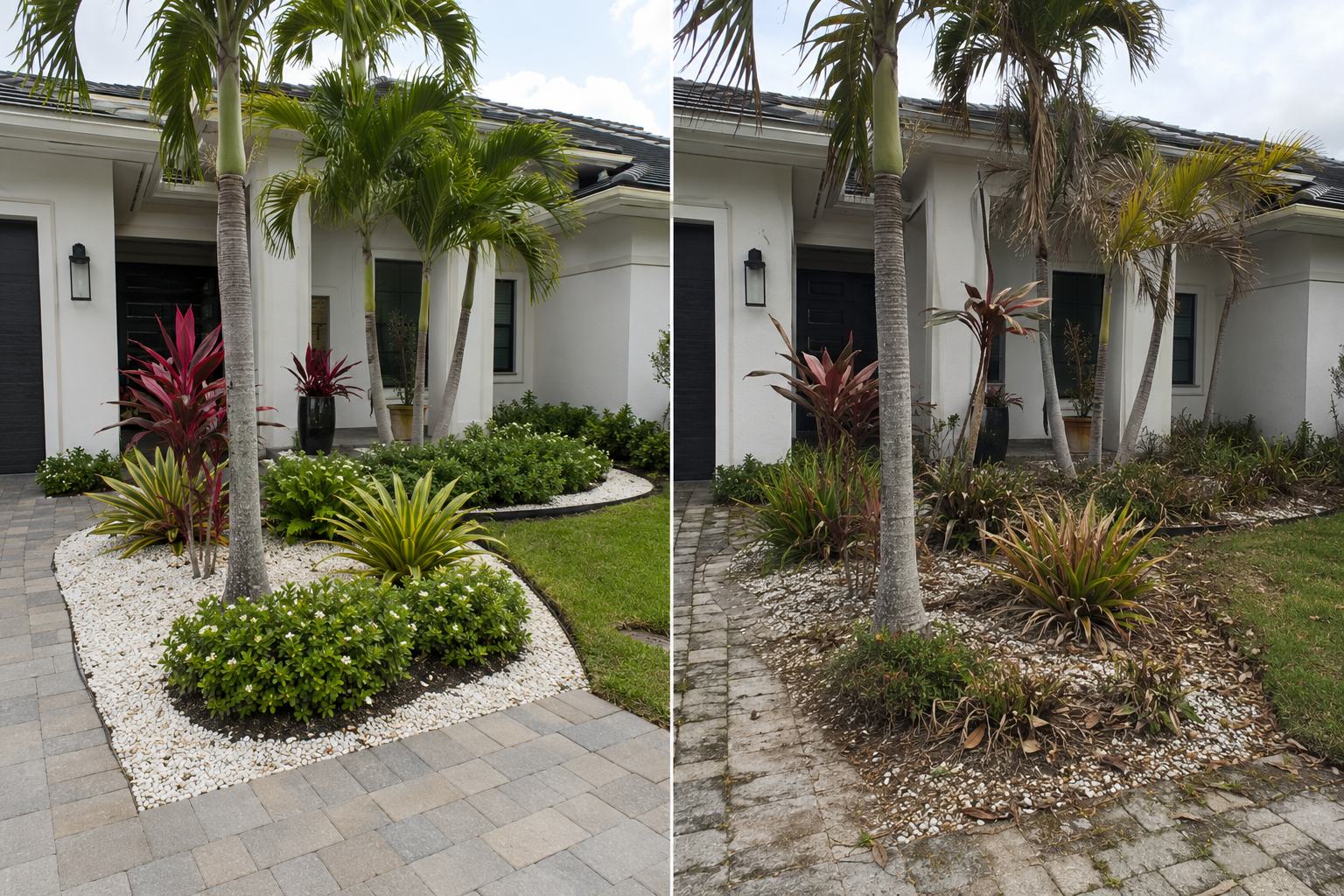
One of the biggest disconnects with AI-generated landscape designs is that they treat landscapes like finished images. Florida landscapes are never finished. Roots expand. Drainage shifts. Canopies close in. Shade changes. Irrigation heads drift out of alignment. One wet summer can completely change how a property behaves.
A design that looks balanced on installation day can become a maintenance nightmare two years later. That matters more in Florida than people realize because growth here is aggressive. Heat plus rain plus humidity can turn “perfect spacing” into a jungle surprisingly fast, especially when someone installs Areca palms 24 inches apart because the rendering looked lush.
It always looks lush at first. Then nobody can walk between them.
AI Cannot Read a Site
This is where AI starts running into problems that are difficult to solve digitally. AI sees images. Humans read sites. Those are not the same thing.
An experienced Florida landscape contractor can walk a property for five minutes and start noticing issues that never appear in photos:
- The back corner stays wet three days after rain.
- The left side of the house gets cooked by reflected heat.
- The St. Augustine is thinning because the live oaks matured years ago.
- The irrigation pressure is terrible.
- The gutter downspout is dumping into the planting bed.
- The “good soil” is actually six inches of builder fill over compacted sand.
AI cannot feel any of that.
Honestly, some Florida properties barely make sense even when you are physically standing there. One side of the yard drains beautifully while the other side turns into a retention pond every August. And this gets worse when the design is being generated from a single real estate listing photo that was taken in February during a dry week.
Most Landscape Failures Are Water Failures
People think the nursery sold bad material or the plant was difficult or the installer messed something up. Sometimes that is true. But a huge percentage of failures come back to water movement.
Too much water. Too little water. Water staying too long. Water concentrating where it should not. The crotons are not dying because crotons are difficult. They are dying because the roof valley dumps hundreds of gallons into that corner every summer storm and the roots never get oxygen.
That is not a plant problem anymore. That is drainage.
Florida BMP guidance heavily focuses on irrigation and stormwater behavior because water movement controls almost everything else happening in the landscape. The problem is that drainage is not always visual. Some of the worst drainage issues are subtle until the rainy season starts. A yard can look completely fine in March and become biologically hostile by August.
Florida Soil Is Stranger Than People Think
People outside Florida underestimate this constantly.
Florida does not have one soil profile. Some properties are beach sand. Some are shell fill. Some are compacted construction debris pretending to be soil. Some are anaerobic soup. Sometimes you can dig one hole and hit multiple soil conditions.
AI tools tend to recommend plants based on generalized compatibility. Real installations are far messier than that.
A plant that technically “works in Florida” may absolutely hate:
- alkaline shell fill
- constantly wet soil
- reclaimed water
- compacted root zones
- reflected pavement heat
And then everyone blames the plant. Palm deficiencies are a great example.
Florida palm care guidance repeatedly stresses that deficiencies can take years to visually recover from because damaged foliage remains until replaced naturally. Meanwhile people are dumping random fertilizer blends onto stressed palms planted too deeply and expecting instant recovery.
Irrigation Systems Are Usually Worse Than People Assume
AI-generated concepts quietly assume irrigation systems actually function correctly. Which is optimistic. A shocking number of residential systems:
- spray sidewalks
- mist into the wind
- hit fences instead of turf
- have terrible coverage uniformity
- run far too often
- have broken heads nobody noticed for months
Then sensitive plant material gets installed into this mess and people are surprised when decline patterns start appearing. Usually the irrigation map tells the story immediately.
Florida BMP guidance spends a huge amount of time discussing irrigation calibration and distribution uniformity for a reason. Irrigation problems cascade into everything else: fungus, nutrient leaching, root decline, turf stress, weed pressure, and disease.
St. Augustine under mature oak shade plus inconsistent irrigation is practically a permanent Florida case study at this point.
The Rendering Is Not the Hard Part
Another thing AI completely ignores is installation sequencing.
Landscapes are construction projects. Sequence matters.
If grading is wrong before sod goes down, the sod may fail no matter how healthy it was initially. If irrigation gets installed before hardscape adjustments, somebody usually cuts lines later. If trees go in before drainage corrections, root systems can end up buried or exposed after rework.
None of this is glamorous, but this is the difference between a landscape surviving five years versus becoming a repair project in twelve months.
Florida nursery standards exist because plant handling, root quality, and transplant conditions materially affect long-term survivability.
People underestimate how much damage can happen during installation alone, especially with palms. A palm can look perfectly fine during install and still be effectively doomed because of planting depth or handling damage.
The rendering was never the difficult part.
Spacing Gives Fake Designs Away Immediately
One of the fastest ways to identify fake Florida landscape designs is spacing. Everything looks incredible initially because all the plants are basically touching each other.
Big tropical fullness. Immediate impact. Great renderings. Then two rainy seasons happen. Now airflow disappears, maintenance costs explode, fungus moves in, root competition starts, and hedges need trimming constantly. The homeowner says:
“Wow these plants grew faster than expected.”
No. The spacing was wrong.
Experienced Florida designers mentally fast-forward landscapes years into the future. AI tends to design for installation photos. Those are very different goals.
AI Is Still Useful — Just Not Sufficient
To be clear, AI absolutely has value in the industry. It is excellent for:
- rapid concept exploration
- helping homeowners communicate preferences
- generating visual references
- testing planting styles quickly
That is useful. But there is a major difference between:
“This looks good.”
and:
“This will still function properly in five Florida summers.”
That gap is where professional judgment still matters.
The future probably is not AI replacing landscape professionals. It is more likely landscape professionals using AI as another tool while still applying real site judgment, horticultural knowledge, drainage understanding, irrigation experience, installation sequencing, and maintenance forecasting. Because the difficult part of Florida landscaping was never generating ideas.
The difficult part is interpreting reality correctly. Florida landscapes are not static images. They are living systems operating inside one of the harshest and strangest landscape environments in the country, and that reality tends to humble overly confident designs pretty quickly.
The Goal Is Not to Avoid AI
The goal is to avoid building landscapes based on incomplete assumptions.
AI can generate ideas quickly. Sometimes very good ones. But landscapes still require real-world interpretation, especially once drainage, irrigation, soil behavior, mature growth, and long-term maintenance enter the equation.
That is where experienced site judgment still matters.
The most successful projects over the next decade will probably not come from people avoiding AI entirely. They will come from people using it appropriately while still grounding decisions in how properties actually behave over time.
A rendering can suggest possibilities. A functioning landscape requires reality.
If you already have an AI-generated landscape concept, Pennate can help evaluate whether the design actually makes sense once drainage, irrigation, mature growth, soil conditions, and real-world site behavior enter the equation.
That may involve:
- drainage and grading review
- irrigation evaluation
- mature plant spacing adjustments
- establishment and soil considerations
- installation feasibility
- phased implementation planning
- plant sourcing and refinement
Some projects can be reviewed remotely. Others are best evaluated on-site where the property can be interpreted in real conditions rather than through photos alone.
Because in many cases, the expensive mistake is not the rendering itself.
It is confidently installing a system that was never going to function correctly in the first place.