
Green Iguanas in Florida Landscapes:
Plant Damage, Deterrence, and Design for High-Pressure Properties
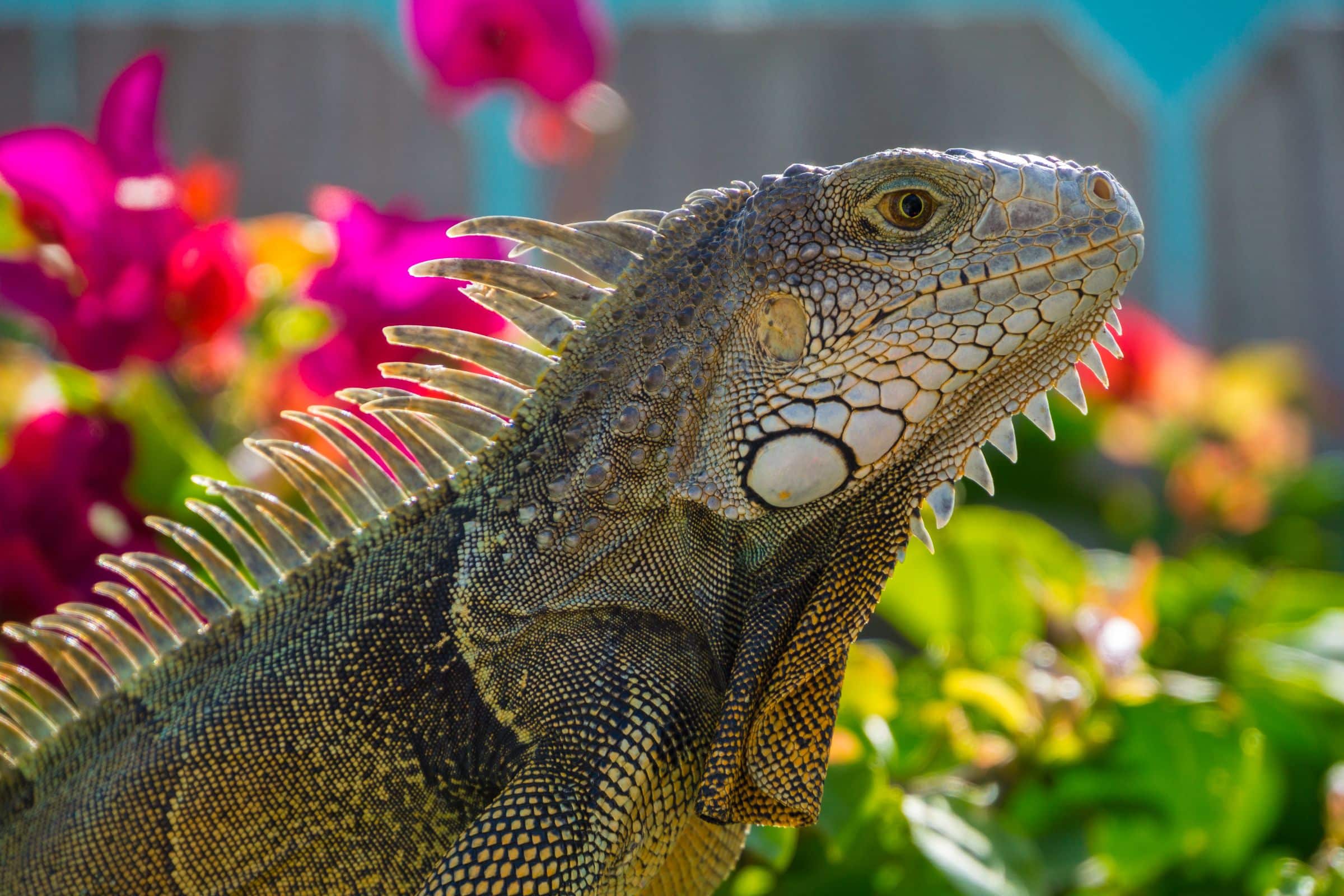
Green iguanas are easy to misread.
A homeowner spots one stretched across the pool deck, notices missing blooms on a hibiscus, finds droppings on the pavers, and immediately starts searching for an “iguana-proof” plant, a spray, or some device that promises to make the problem disappear.
That reaction is understandable. Unfortunately, it usually starts too far downstream.
The hibiscus did not create the problem. It simply made an already useful property a little more rewarding.
A green iguana may come into a landscape looking for food, but food is rarely the whole story. The same property may provide warm places to bask, dense planting for cover, trees to climb, loose soil for nesting, easy access to water, and a reliable escape route. Once all of those uses overlap, the question is no longer whether a particular plant is attractive. The real question is whether the property has become part of the animal’s routine.
That distinction matters, especially in South Florida and other warm coastal areas where a typical residential landscape already offers almost everything an iguana needs. Mature palms and shade trees provide climbing structure. Dense hedges and hidden corners offer shelter. Pool decks, pavers, docks, seawalls, and sidewalks absorb heat throughout the day, creating dependable basking sites. Fruit trees, flowering shrubs, vegetables, tender new growth, and fallen fruit provide food, while canals, lakes, marina edges, golf-course ponds, and drainage corridors connect one property to the next. Even loose mulch, sandy beds, and disturbed soil can become suitable places to dig or nest.
None of this requires an overgrown or neglected yard. In fact, some of the landscapes people invest the most time and money into can be the most attractive to iguanas. A clean, irrigated, waterfront landscape with mature planting often checks every box.
That is why replacing a few damaged plants rarely solves the problem. A homeowner may remove the hibiscus, install something described online as “iguana resistant,” and still see the same animals every day. The menu changed. The habitat did not.
That leads to a better question than, “What plants won’t iguanas eat?” There is no reliable answer to that.
A more useful question is, “What is this property allowing an iguana to do, and which of those uses are unacceptable here?”
That shift in thinking changes everything. It separates a minor nuisance from a genuine site condition. It helps explain why some landscapes experience only occasional browsing while others see constant activity. It also shows why protecting valuable plants often has less to do with the plants themselves and more to do with access, shelter, movement, and how the landscape functions as a whole.
Not every sighting calls for a defensive landscape, and not every canal-front property needs to look like a fortress. But when iguanas become regular visitors, the landscape has to acknowledge that pressure instead of pretending it is temporary.

Why Green Iguanas Became a Florida Landscape Problem
Green iguanas, Iguana iguana, are native to tropical and subtropical regions of Central and South America, along with parts of the Caribbean. They are not native to Florida.
Their presence here is closely tied to the exotic pet trade. For decades, juvenile iguanas were sold as small, colorful pets, but many eventually outgrew the homes they were purchased for. Escapes and intentional releases allowed breeding populations to become established, particularly in South Florida, where the climate proved remarkably similar to their native range. Green iguanas were documented around Miami decades ago, and since then their distribution has expanded through a combination of warm urban microclimates, connected waterways, abundant vegetation, and the sheer amount of suitable habitat created by development.
Simply calling them an invasive species, however, does not explain why they have been so successful.
Green iguanas are excellent climbers and capable swimmers. They readily move between natural areas and developed landscapes, using trees, walls, fences, docks, seawalls, and even patio furniture as part of a connected travel route. A fence that stops a person from cutting across the yard may mean very little to an animal that can climb a palm, walk a fence line, drop from a roof, and disappear into a nearby canal within seconds.
That is one reason waterfront properties often feel as though they never stop attracting iguanas. Removing the animal does not remove the route. The basking surfaces are still there. The shelter is still there. The food is still there. Another iguana does not even have to come from the neighboring yard—it may simply be the next animal moving through the same canal corridor or shoreline. A beautifully maintained landscape can become a regular stop along that route without the homeowner realizing it.
Weather can interrupt this pattern, but usually only temporarily.
Like all reptiles, green iguanas are ectothermic, relying on external temperatures to regulate their activity. During significant cold snaps they become sluggish, may lose their grip in trees, and sometimes appear in places where they would normally stay hidden. Severe freezes can reduce local populations, particularly near the northern edge of their range, but cold weather should not be mistaken for a long-term management strategy. South Florida’s coastal climate, dense urban development, and countless protected microclimates allow many animals to survive and populations to recover over time. A cold winter may create a lull, but it does not change the underlying conditions that made the property attractive in the first place.
Homeowners often ask how many green iguanas there are in Florida, but there is no reliable statewide population estimate. More importantly, that number would not tell you much about the property in front of you.
The questions that matter are much more local. Is the property connected to a canal, seawall, lake, pond, marina, golf-course water feature, or drainage corridor? Are iguanas seen once a month, once a week, or every day? Are there active burrows, repeated basking sites, droppings, damaged plants, or well-established travel routes? Are neighboring properties leaving fallen fruit on the ground, maintaining dense unmanaged vegetation, or creating easy access from one yard to the next?
Those answers reveal far more about the level of pressure on a landscape than any statewide population estimate ever could.
Reading Iguana Pressure Before Planting
Not every iguana sighting deserves the same response.
A single animal crossing an open lawn is very different from daily activity around a pool deck, recurring damage to flowering shrubs, or fresh burrows appearing beside a seawall. One of the biggest mistakes homeowners make is treating every sighting as though it represents the same level of risk. Before choosing plants, installing barriers, or buying deterrents, it helps to understand what kind of pressure the property is actually experiencing.
Some properties see only occasional visitors. An iguana may pass through every few weeks, leave little or no visible damage, and continue on its way. There are no regular basking sites, no recurring droppings, no burrows, and no obvious pattern beyond the occasional sighting. A landscape like this rarely needs an elaborate defense. Good housekeeping is usually enough. Pick up fallen fruit, avoid creating unnecessary food sources, and pay attention to how the property changes over time before investing in solutions for a problem that has not truly developed.
Other properties begin showing a pattern. Iguanas appear regularly near the same fence line, canal edge, pool deck, or tree. A few plants may be browsed from time to time, and droppings or tracks begin showing up in familiar places. This is often the point where relatively small changes make the biggest difference. Moving a large planter away from a wall, pruning a low branch that has become a bridge, cleaning up fallen fruit, or avoiding high-risk plants directly along a canal edge may not eliminate iguanas altogether, but it can prevent the property from becoming even more attractive over time.
High-pressure sites are usually much easier to recognize. Iguanas are seen almost every day. More than one animal may be present at the same time, plants are repeatedly damaged, and the same hardscape areas become regular basking sites. Hedges, palms, walls, fences, furniture, and waterfront edges begin functioning as a connected access system rather than isolated landscape features. At that point, the animals are no longer just passing through—they are actively using the property.
That changes the design approach. Vulnerable plants cannot remain scattered throughout exposed areas and hope for the best. The landscape needs to separate durable outer planting from the spaces that contain valuable or sensitive plants. More importantly, those sensitive areas need real protection rather than relying on deterrents alone.
The highest level of concern is structural pressure. This occurs when repeated burrowing develops near a seawall, canal bank, retaining wall, sidewalk, dock, drainage structure, foundation, or another engineered element. Here, the problem extends beyond landscape damage. A visible hole may be little more than a shallow excavation, or it may be the entrance to a much larger tunnel system. It could indicate active nesting, repeated refuge, soil movement, erosion, or another condition that deserves closer investigation before the landscape is disturbed.
The value of these categories is not the labels themselves. They provide perspective.
A homeowner who spots one iguana crossing the backyard does not need to panic. A homeowner with an active burrow beside a seawall does not need another list of “iguana-resistant” plants. Likewise, a waterfront property seeing daily activity is unlikely to be solved with a single motion sprinkler or repellent.
The response should always match the level of pressure on the site—not the level of frustration.
Iguanas Do Not Cause One Kind of Damage
Most homeowners notice the damage before they notice the pattern.
Chewed hibiscus, missing flowers, damaged vegetables, or droppings on the patio are obvious, so it is natural to assume the problem is simply feeding. In reality, feeding is only one way green iguanas use a landscape. Looking at every issue through that single lens usually leads to disappointing results. A different plant may reduce browsing but do nothing about climbing. A fence may interrupt movement at ground level while leaving an easy route overhead. A motion sprinkler may discourage basking in one location while doing nothing about burrows developing near a seawall.
The landscape has to be understood by behavior, not just by damage.
Feeding is the easiest behavior to recognize because it leaves visible evidence behind. Adult green iguanas are largely herbivorous and commonly feed on leaves, flowers, tender new growth, vegetables, fruit, and other soft plant material. Preference certainly plays a role, but access is just as important. Flowers are exposed, new growth is tender, fruit provides an easy source of calories, and young plants often place their entire canopy within reach. Even when very little is actually eaten, an iguana may still snap stems, flatten smaller plants, overturn containers, or damage fresh installations simply by climbing through them.
Edible gardens deserve special consideration because they combine almost everything an iguana finds attractive into one concentrated space. Vegetables, herbs, berries, and young fruit trees offer an abundant food source, while loose soil invites digging and nearby structures often provide convenient access. One of the most common mistakes is treating a raised bed as protection. It is not. A raised bed may make gardening easier for people, but it does nothing to stop an animal that can climb fences, railings, furniture, walls, or nearby trees. Many homeowners wait until damage begins before draping netting over the garden. By then the animals have already learned there is food available. On high-pressure properties, productive gardens should be designed as protected growing spaces from the beginning rather than retrofitted after repeated losses.
Not every problem involves feeding. Warm, open surfaces become predictable basking areas, especially seawalls, docks, pavers, pool decks, sidewalks, retaining walls, and other hardscape that absorbs heat throughout the day. Those same places often become recurring droppings sites. While this is rarely a structural concern, it can become a maintenance issue that affects patios, outdoor kitchens, seating areas, docks, and other places where people actually spend time. A homeowner may not care if an iguana spends the afternoon on a distant seawall, but the same animal becomes much harder to ignore when it chooses the pool deck every morning.
Climbing is another behavior that is easy to underestimate because the route is rarely obvious from ground level. The problem usually is not a single tree or a single fence. It is the connection between them. A palm reaches a roofline. A fence leads to a raised planter. A planter sits beside a wall. A hedge connects the waterfront to the patio. Patio furniture becomes the final step. An iguana does not need to leap across large gaps; it only needs a series of reachable surfaces. That is why experienced designers look for travel routes rather than isolated obstacles. Interrupting one connection is often more effective than trying to defend the destination itself.
Shelter works much the same way. Dense hedges, stacked materials, spaces beneath decks, unused corners, storage areas, and overgrown planting beds can all provide places where iguanas remain hidden during the day. This does not mean dense landscaping is a mistake. Privacy, shade, wildlife habitat, and layered planting are all legitimate design goals. The problem arises when those same features create permanent refuge immediately beside food, water, and basking sites. A landscape can remain lush while still allowing maintenance crews to inspect it, identify burrows, and see what is happening behind the planting.
Burrowing and nesting deserve the greatest attention on waterfront properties because the consequences extend well beyond damaged plants. Loose, well-drained soil near canals, seawalls, embankments, retaining walls, sidewalks, docks, and drainage structures can provide suitable places for digging. The visible opening is only part of the concern. Repeated excavation can create voids, encourage erosion, and disturb soil supporting nearby structures. A shallow hole in an ordinary planting bed may be little more than a nuisance. The same hole beside a seawall or retaining wall deserves a very different response. At that point the issue is no longer just landscaping—it is protecting the long-term stability of the site.
Waterfront Landscapes Need a Different Standard
A waterfront property should never be viewed as just another yard with water behind it.
Whether the property borders a canal, lake, marina, golf-course pond, seawall, or drainage corridor, the water changes both the level of iguana pressure and the way the landscape should be designed. Water provides more than scenery. It gives iguanas a travel corridor, an escape route, and a way to move between neighborhoods without ever crossing a road. It also creates a place where ordinary landscape work can intersect with drainage systems, seawalls, utilities, ownership boundaries, and structural elements that are largely hidden below the surface.
The first area to think about is the edge itself.
The seawall, canal bank, dock interface, retaining wall, drainage outlet, utility corridor, and the ground immediately surrounding those features should not be treated as ordinary planting space. Digging holes for large shrubs, installing fence posts, pouring concrete, changing grades, or altering drainage without understanding what lies below the surface can create problems that extend well beyond landscaping. A seawall may appear perfectly stable from the backyard while concealing tiebacks, utilities, or other structural components beneath the soil. Depending on the property, responsibility for those systems may rest with the homeowner, a homeowners association, a municipality, or another governing entity.
Just inland from that structural edge, every waterfront property benefits from an area that remains easy to inspect.
This does not mean leaving an unattractive strip of bare soil or exposed sand along the water. Instead, the landscape should allow someone to see what is happening before small problems become expensive ones. Burrows, soil movement, erosion, irrigation leaks, cracks, droppings, and changes in plant health should all be visible without crawling through a dense hedge. Low planting, open groundcovers, maintained pathways, or carefully spaced shrubs can all accomplish this while still creating an attractive landscape.
The goal is simple: never allow the seawall or canal edge to disappear completely behind dense vegetation.
Beyond that inspection zone, the landscape can begin doing what it does best. This is where screening, shade, texture, and layered planting belong. The emphasis shifts away from constant inspection and toward creating an attractive outdoor environment, but durability still matters. Plants should be selected for their mature size, maintenance requirements, salt tolerance where appropriate, drainage conditions, and their ability to recover from occasional browsing. This is rarely the right place for rows of hibiscus, exposed orchids, vegetable gardens, or other plants that cannot tolerate repeated feeding. Instead, this portion of the landscape should provide resilient structure that continues performing even when wildlife pressure is present.
Farther inland, the property transitions into spaces intended primarily for people rather than wildlife.
Patios, pools, outdoor kitchens, seating areas, children’s play spaces, specimen gardens, vegetables, herbs, orchids, fruit trees, and container collections all belong here whenever possible. These are the parts of the landscape that deserve the highest level of protection because they represent the greatest investment or the least tolerance for damage. Rather than relying entirely on outer planting to keep iguanas away, these spaces should have their own level of protection. A screened garden room, enclosed side garden, courtyard, or protected patio may be entirely appropriate when valuable plants or edible gardens are involved.
A useful rule of thumb is that the closer something sits to the water, the more capable it should be of tolerating occasional wildlife pressure. The farther inland an asset is located, the more deliberate its protection should become.
None of this makes waterfront landscaping restrictive. If anything, it makes it more successful.
A waterfront landscape can still be lush, layered, tropical, and visually rich. It simply recognizes that the canal edge is more than a property line – it is part of an active wildlife corridor. Designing with that reality in mind leads to landscapes that are easier to maintain, more resilient over time, and far less likely to surprise the homeowner when wildlife inevitably becomes part of the equation.
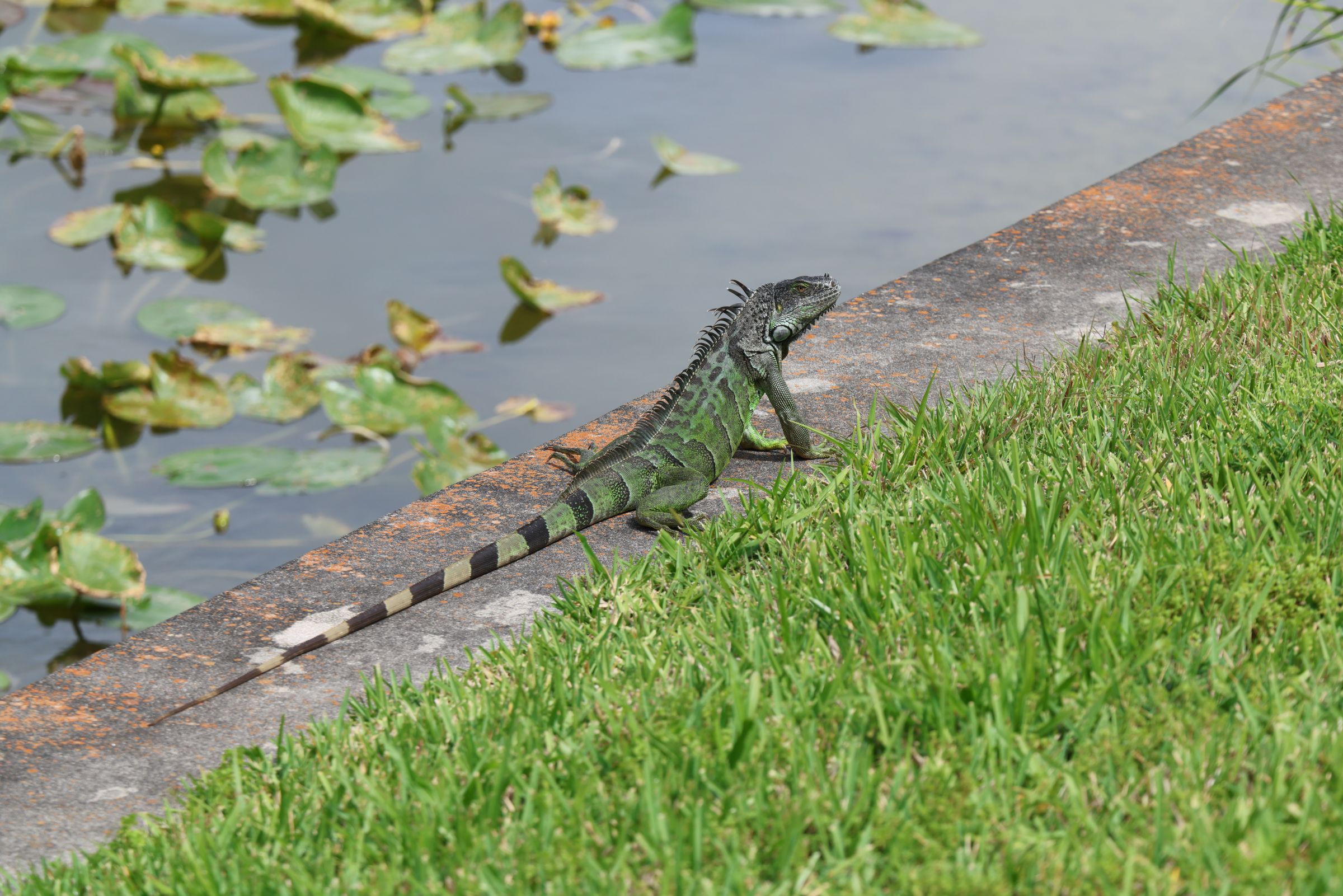
Plant Selection Is About Risk, Not Guarantees
One of the first claims this guide rejects is the idea that there is a definitive list of plants green iguanas will never eat.
There isn’t.
Florida gardeners have been sharing “iguana-resistant” plant lists for years, and many of them are based on honest observations. A particular shrub may have gone untouched for several seasons, while another homeowner reports that the same plant was stripped almost overnight. Neither person is necessarily wrong. Landscapes are different, food sources change, local populations behave differently, and what works in one neighborhood may fail completely in another.
An iguana may ignore a plant because easier food is available nearby. Remove that preferred food source, and the same plant may suddenly become part of its diet. A property with the occasional passing iguana will also experience very different browsing pressure than a canal-front landscape where animals are present every day. For that reason alone, no responsible designer should promise that any plant is completely iguana-proof.
Even so, broad patterns do exist.
Plants with soft foliage, tender new growth, flowers, fruit, or edible leaves are consistently more vulnerable than plants with thicker, tougher foliage. Hibiscus is probably the best-known example. Its tender shoots and flowers make it one of the first plants homeowners notice being damaged. Roses, orchids, impatiens, leafy vegetables, herbs, young fruit trees, berries, tomatoes, melons, squash, and many annual flowers should all be considered high-risk choices where iguana pressure is already established.
That does not mean they should never be planted.
It simply means they belong in the right part of the landscape.
A specimen hibiscus tucked inside a protected courtyard is very different from a row of hibiscus lining a canal bank. Likewise, a vegetable garden enclosed within a screened structure is a completely different situation than open raised beds beside a seawall. Good design is usually less about eliminating desirable plants than placing them where they have a realistic chance of succeeding.
Bougainvillea is another plant that deserves a little skepticism. Homeowners often assume the thorns are enough to discourage browsing, but the evidence is mixed. Thorns make the plant unpleasant to handle, not impossible to eat. Iguanas may still browse foliage, flowers, and tender growth, particularly when the plant is easy to reach or competing food sources are limited. They may also climb through the plant or use it as cover. Bougainvillea can perform well, but it should never be marketed as an iguana-proof solution.
Pentas tell a similar story. Ask ten Florida gardeners and you may get ten different answers. Some report little or no damage, while others watch them disappear almost as quickly as they are planted. Differences in cultivar, season, local food availability, plant condition, and overall iguana pressure can all influence those outcomes. Rather than trying to decide which opinion is correct, it is more useful to treat uncertain plants as field trials. Plant a few, watch how they perform over time, and let the site tell you whether they belong in the larger landscape.
In general, plants with thick, leathery, fibrous, bitter, or chemically defended foliage tend to experience less browsing than soft ornamentals and edible crops. That characteristic can be useful, but it should never become the only criterion for selection. A shrub that survives iguanas but struggles with salt exposure, poor drainage, shade, wind, mature size, or maintenance demands is still the wrong shrub. Likewise, choosing a toxic plant simply because wildlife avoids it may create unnecessary risks for children, pets, or maintenance crews.
Plant selection should always begin with function.
Ask what the plant is supposed to accomplish. Is it providing privacy, shade, erosion control, seasonal color, structure, or screening? Once that role is understood, decide how much wildlife pressure the location is likely to receive. Reserve the highest-risk plants for protected areas, use more resilient species where exposure is unavoidable, and be willing to test uncertain plants before committing them to an entire project.
That process produces better landscapes than chasing the next viral list of supposedly “iguana-resistant” plants.
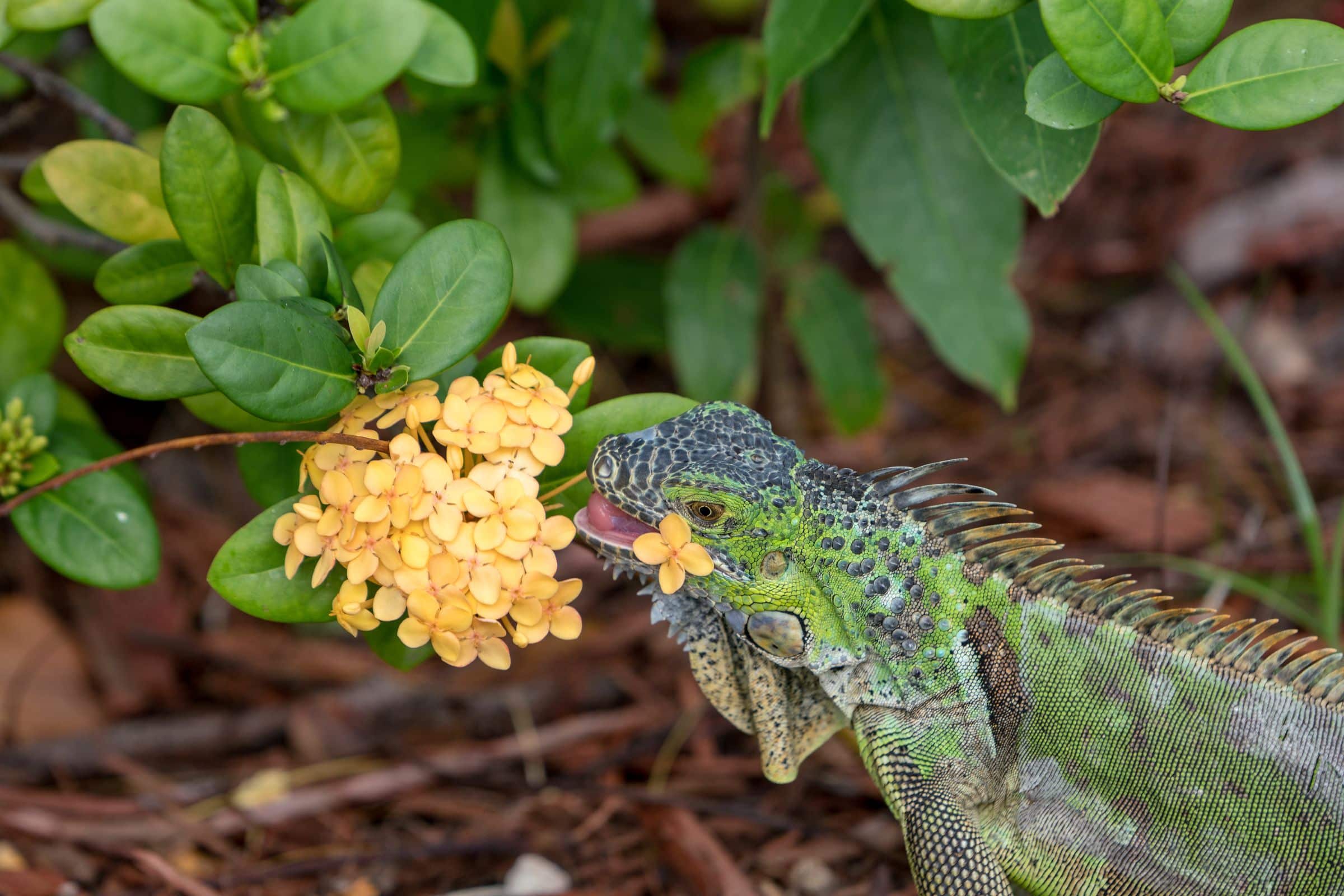
Place Plants According to Exposure
Plant selection is only part of the equation. Where a plant is located is often just as important as the species itself.
A hibiscus behind a screened patio is a completely different proposition than the same hibiscus planted beside a canal. An orchid growing inside a protected courtyard faces different pressures than one mounted to a dock-side wall. Even a young fruit tree can be a reasonable choice when it grows inside a protected garden, while the same tree may struggle if it becomes the first thing an iguana encounters after leaving the water.
Context changes everything.
The areas closest to the water, known travel routes, or recurring basking sites should be treated as the landscape’s first line of contact. These spaces need plants that can tolerate occasional browsing, recover from incidental damage, and remain easy to inspect. The goal is not to create a barren strip beside the canal. A waterfront landscape can still be lush and visually rich. It simply should not rely on tender flowering plants, edible crops, expensive specimen material, or other high-value plants that are unlikely to thrive under constant wildlife pressure.
As the landscape moves farther from the water, it can become more layered and more intentional. This is where screening, shade, texture, and privacy begin to take over. Palms, structural shrubs, and durable planting can create a beautiful transition while still leaving enough room for maintenance, irrigation repairs, burrow inspections, and routine observation. Dense planting is not the enemy. Dense planting that prevents anyone from seeing what is happening behind it is.
The spaces closest to the home deserve a different level of protection altogether.
Vegetable gardens, herbs, orchids, specimen plants, container collections, fruit trees, children’s play areas, outdoor dining spaces, and other high-value landscape features should be concentrated where access can actually be controlled. Sometimes that means a screened garden room. Sometimes it is a courtyard, an enclosed side garden, or simply arranging the landscape so that climbing routes become much more difficult. The goal is not to fence off the entire property. It is to reserve the strongest protection for the parts of the landscape that matter most.
Thinking about planting this way changes how individual plant choices are made. Instead of asking whether a hibiscus is an appropriate plant, the better question becomes whether this is an appropriate location for a hibiscus. The same question applies to orchids, vegetables, fruit trees, annual flowers, and nearly every other plant that experiences browsing pressure.
That shift in thinking also explains why sacrificial planting rarely works as well as people hope.
At first glance, planting a favorite food source along the edge of the property seems logical. If the iguanas stop there, perhaps they will leave everything else alone. In practice, the opposite often happens. A dependable food source teaches animals that the property is worth visiting. Instead of protecting the landscape behind it, the sacrificial plant can become the first stop on a route that is repeated day after day.
There are situations where intentionally attracting animals to one location may support a carefully managed removal program, but that is a very different objective from residential landscape design. For most homeowners, the better strategy is not to redirect feeding. It is to make the property less rewarding in the first place.
Protecting Valuable Plants Requires Real Exclusion
Physical exclusion is the most reliable way to protect plants that cannot tolerate repeated browsing, but it is also one of the most misunderstood approaches. Homeowners often think of exclusion as a single product—a fence, a raised bed, a piece of netting, or a decorative barrier. In reality, effective exclusion is a system. It succeeds or fails based on how an iguana is likely to approach the space, whether it can climb over, dig beneath, squeeze through, or simply walk around the obstacle.
That distinction explains why so many well-intentioned barriers fail.
A raised bed is not automatically protected simply because it sits above ground. A decorative fence may discourage people without slowing wildlife. Even a carefully screened enclosure can become ineffective if a tree branch hangs overhead, a gate does not close properly, or a nearby planter creates an easy bridge. Green iguanas are surprisingly capable climbers, and they often exploit connections that homeowners never considered. A bench beside a raised bed, a fence meeting a wall, or a shrub growing into a neighboring tree can all become part of the route.
For that reason, the best place to begin is not with the barrier itself but with the approach.
Stand where an iguana is most likely to enter the property and work forward. Follow the path from a canal edge, seawall, fence line, tree, drainage corridor, or neighboring landscape toward the area you are trying to protect. Along the way, look for anything that creates a continuous route: overhanging branches, furniture, trellises, planters, railings, walls, stacked materials, grills, or gates that no longer latch correctly. More often than not, a failed barrier is the result of a missed access route rather than poor construction.
For individual specimen plants, a dedicated plant cage can be an excellent solution. Orchids, newly installed trees, container specimens, seasonal color, and other high-value plants are often easier to protect individually than by redesigning the surrounding landscape. A well-designed cage does not need to look temporary or improvised. It can become part of the garden, provided it allows room for maintenance and future growth while remaining isolated from nearby trees, fences, walls, or other climbing aids that would allow an iguana to bypass it entirely.
Edible gardens usually call for a different approach. Where iguana pressure is consistently high, especially on waterfront properties, a screened garden room often makes more sense than trying to protect each plant individually. That should not be viewed as admitting defeat.
Vegetables, herbs, and young fruit trees represent some of the most vulnerable and valuable plants in the landscape, and protecting them from the outset is usually more practical than replacing them season after season. A screened structure can be incorporated into the overall design of the property, whether as part of a patio, a courtyard, a side garden, or a freestanding garden pavilion. Like any structure, however, it still needs to account for drainage, irrigation, airflow, maintenance access, storm exposure, and the possibility of nearby climbing routes.
Perimeter fencing can certainly play a role, but it is rarely a complete solution on its own. Chain-link fencing can be climbed. Solid privacy fencing may stop movement at ground level while allowing access from overhanging trees or adjoining structures. Decorative aluminum fencing often leaves openings that are large enough for juveniles or provides convenient horizontal members for climbing. A perimeter fence becomes effective only when the entire system has been considered, including the bottom edge, gates, corners, adjacent vegetation, nearby structures, and the routes leading toward it. Protecting a patio or garden room is usually a much more realistic objective than trying to exclude every iguana moving through an entire waterfront neighborhood.
Research from agricultural production supports the same basic conclusion. Physical barriers consistently outperform chemical deterrents when the goal is protecting valuable crops. Residential landscapes are obviously different from commercial farms, but the principle remains the same. A barrier succeeds because it changes access, not because it temporarily makes an area uncomfortable. Like every other part of the landscape, it also requires maintenance. Buried edges can become exposed after heavy rain, vegetation can create new climbing routes, gates eventually need adjustment, and minor gaps have a way of becoming major entry points if they are ignored.
Exclusion is not a product that can be installed once and forgotten. It is part of the long-term management of the landscape, evolving as the property, the plants, and the wildlife around it continue to change.
Deterrents Have a Narrow Role
Deterrents are popular for a simple reason: they are easy to buy, relatively inexpensive, and promise a quick solution. A homeowner can install a motion sprinkler in an afternoon, hang reflective tape from a tree, spread a scented repellent around a flower bed, or order an ultrasonic device online with the expectation that the problem will disappear.
Sometimes those products help.
The problem is not that every deterrent is ineffective. The problem is that they are often expected to solve a landscape problem that is much larger than they were designed to address.
If a property continues providing food, shelter, climbing routes, basking sites, and easy access, no single deterrent is likely to produce lasting results. At best, it changes one small part of the animal’s experience. At worst, it simply encourages the iguana to move a few yards away.
Motion-activated sprinklers are a good example. They can work surprisingly well when the goal is discouraging repeated use of one particular location. A sprinkler protecting a favorite basking spot beside a pool, a dock corner, or a specific planting bed may convince an iguana to spend less time there. Used this way, the device reinforces a larger management strategy by making one predictable location less comfortable.
What it does not do is create a barrier.
An iguana can approach from another direction, learn the limits of the spray pattern, or simply shift its activity to another part of the property. If the landscape continues providing everything else it needs, the sprinkler becomes an inconvenience rather than a solution. It is best viewed as one layer of a larger management plan, particularly in locations where additional moisture will not create problems for the surrounding landscape.
Sound and visual deterrents follow much the same pattern. Reflective tape, spinning devices, flashing objects, wind-driven movement, and intermittent noise can all create temporary avoidance, especially where animals have not yet become accustomed to them. The difficulty is that wildlife adapts remarkably well to predictable disturbances. A reflective object that never moves eventually becomes part of the background. A motion device that activates from the same distance every time quickly loses its surprise. Even loud noises tend to become less effective as animals learn they are not associated with real danger.
These products may be useful for making one resting area less attractive, but they should not be expected to protect vegetable gardens, orchids, specimen plants, or other high-value landscape features by themselves.
Ultrasonic devices deserve even more skepticism.
Many products are marketed on the assumption that frequencies outside human hearing must also be unpleasant for wildlife. That assumption is rarely supported with meaningful field evidence. The fact that a device emits ultrasonic sound does not demonstrate that green iguanas perceive it as threatening, that the sound reaches them effectively in an outdoor environment, or that they will continue avoiding the area after repeated exposure. Until consistent, species-specific research demonstrates durable results under real landscape conditions, ultrasonic devices should be viewed more as a marketing category than a dependable management tool.
Chemical repellents and homemade remedies occupy a similar space. Garlic sprays, hot pepper mixtures, cinnamon, citrus peels, essential oils, soap solutions, predator scents, commercial granules, and countless other recipes circulate through gardening forums every year. Some undoubtedly create an unpleasant taste or odor for a short period of time. That does not necessarily translate into meaningful long-term control.
Florida’s climate is particularly unforgiving to products that rely on scent or surface coatings. Rain washes them away, irrigation dilutes them, sunlight breaks them down, and vigorous plant growth quickly produces fresh, untreated foliage. Some homemade mixtures can also burn leaves, stain hardscape, or create problems around edible crops. The word “natural” should never be mistaken for “harmless.” Many naturally derived products can still affect desirable plants, beneficial insects, pets, or people if used improperly.
A useful way to judge any repellent is to ask a simple question:
Will it still be working after several days of Florida heat, rain, irrigation, and repeated visits by the same animal?
For most products marketed as repellents, the honest answer is probably not.
Electrical deterrents deserve special caution. Systems that may have a place in carefully controlled agricultural settings are not automatically appropriate around seawalls, docks, pools, public access, shared property lines, irrigation systems, or residential landscapes where children and pets are present. Electrical safety, local regulations, property ownership, structural attachments, and long-term maintenance all become part of the discussion. Those issues extend well beyond ordinary landscape design.
Ultimately, deterrents work best when they support an already well-designed landscape rather than attempting to compensate for a poorly designed one. They may make one location less comfortable, reduce repeated use of a particular feature, or reinforce other management practices, but they cannot replace thoughtful planting, protected growing spaces, route interruption, habitat modification, or physical exclusion.
That is why the most successful landscapes rarely rely on deterrents alone. They use deterrents where they make sense, while solving the larger problem through design.
Burrows, Nesting, and the Boundary Between Landscaping and Structure
One of the most important skills in managing iguana damage is recognizing when the problem has moved beyond landscaping.
A chewed shrub, flattened annuals, or recurring droppings on a patio may be frustrating, but those are still landscape issues. A burrow developing beside a seawall, canal bank, retaining wall, dock, foundation, sidewalk, or drainage structure deserves a different level of attention. At that point, the discussion is no longer just about plants—it may involve the long-term stability of the site itself.
A visible hole rarely tells the whole story.
It may be a shallow surface excavation, an active refuge tunnel, a nesting burrow, the reopening of an older tunnel, or the visible entrance to a much larger underground void. Filling the opening with soil may hide it temporarily, but it does not confirm that the underlying condition has been resolved. If the hole repeatedly reappears, grows after heavy rain, develops near cracks or settlement, or is located immediately beside an engineered structure, it should be documented rather than simply filled and forgotten.
Good records are surprisingly valuable.
Photographs taken from the same location over time often reveal gradual changes that are difficult to notice day by day. A simple reference point—a fence post, seawall cap, tree, or landscape edge—can make it much easier to determine whether a burrow is stable, expanding, migrating, or changing after rainfall. Notes describing the approximate size, date first observed, nearby structures, visible animal activity, soil movement, erosion, irrigation leaks, or signs of settlement can also help establish whether the condition is evolving or remaining relatively unchanged.
This is also where landscape contractors need to recognize the limits of landscape work.
Installing buried mesh beneath a garden enclosure may discourage future digging, but it is not a seawall repair. Setting fence posts in ordinary yard soil is routine work; installing those same posts near a seawall, retaining wall, drainage system, or structural tieback may be an entirely different matter. Likewise, decorative stone edging or fresh mulch may hide a disturbed area without addressing what caused the disturbance in the first place.
The presence of a burrow does not automatically mean a seawall or retaining structure is failing. It does, however, eliminate the assumption that everything below the surface is functioning normally.
Where waterfront structures, engineered slopes, retaining systems, foundations, drainage infrastructure, or public ownership are involved, further evaluation may be appropriate before additional landscape work continues. Depending on the property, that could involve the homeowner, a homeowners association, the municipality, a seawall contractor, or another qualified professional with responsibility for the structure.
Occasionally, homeowners ask whether providing an alternative nesting area is a good solution. The idea is understandable: if iguanas have a more attractive place to dig, perhaps they will stay away from vulnerable structures. In practice, that approach only makes sense as part of an active management program. Simply placing a pile of sand or loose mulch elsewhere on the property may do little more than create another location that attracts wildlife. It should never be viewed as a substitute for protecting structures or addressing active burrowing where it already exists.
The safest approach is also the simplest. Treat repeated burrowing near engineered structures as more than a landscape nuisance. Document it, monitor it over time, and resist the temptation to assume that covering the opening has solved the underlying problem.
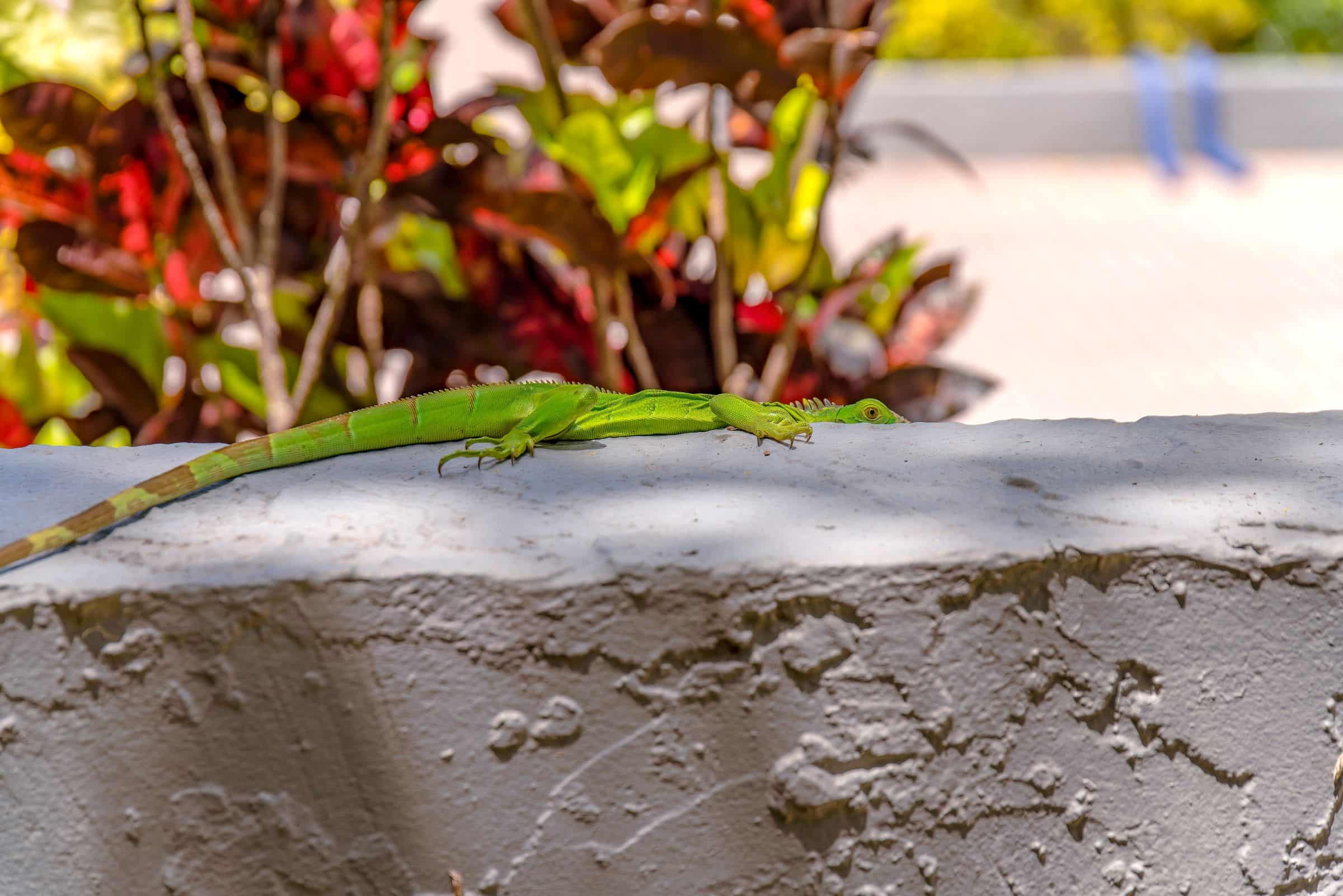
Monitoring Is What Makes the Design Durable
A landscape is not finished the day it is installed, especially where iguana pressure is high.
Like any living system, it changes over time. Plants grow, sightlines disappear, climbing routes develop, irrigation is modified, and wildlife adapts. A successful landscape should make those changes easier to recognize, not harder to see. That is one reason dense, inaccessible planting can become a liability along waterfronts and known travel corridors. A homeowner does not need to inspect every shrub each morning, but the landscape should make recurring problems visible before they become expensive ones.
The most useful observations are usually patterns rather than isolated events.
A single chewed leaf rarely means much. The same burrow reopening after every heavy rain does. Droppings appearing in the same corner of the pool deck every morning tell a different story than one isolated incident. A hedge that gradually grows into a bridge between two trees may explain why activity suddenly increases in one part of the property. Likewise, a fruit tree dropping ripe fruit beside a canal can quietly become the reason iguanas begin spending more time in the yard.
When something changes, ask why.
Has a barrier been compromised after a storm? Has furniture been rearranged to create a new climbing route? Has irrigation encouraged dense new growth that provides better cover? Has one particular group of plants become the focus of browsing while nearby planting remains untouched? Small observations like these often reveal the underlying pattern much sooner than simply replacing damaged plants.
Monitoring does not need to become a formal inspection program. A simple site sketch, a few photographs taken from the same locations, and occasional dated notes are usually more than enough. Their purpose is not to create paperwork. They help replace vague frustration with useful information.
“It seems like the iguanas are everywhere” is a common reaction, but careful observation often tells a different story. There may actually be two or three repeat travel routes, one preferred basking site, a single food source, and one area where burrowing occurs consistently. Once those patterns become visible, the response becomes much more targeted.
Perhaps more importantly, good observation prevents expensive overreactions.
A homeowner might be ready to remove a mature hedge because several plants have been damaged, when the real problem is a single low branch that now connects the hedge to a nearby tree. On another property, someone may continue replacing flowers year after year while overlooking an active burrow developing beside a seawall. Both situations are solved more effectively by understanding the pattern than by reacting to the most obvious symptom.
The goal of monitoring is not to watch for every iguana. It is to understand how the landscape is being used so that future decisions are based on evidence rather than frustration.
Removal Is a Management Tool, Not a Substitute for Design
Removing iguanas can reduce immediate pressure on a landscape, but it rarely solves the underlying problem by itself.
If the next animal arrives to find the same food sources, climbing routes, basking areas, shelter, and access to water, the property remains just as attractive as it was before. In that situation, removal becomes an ongoing maintenance activity rather than a lasting solution. The landscape has not changed—only the individual animal has.
That is especially true along canals, lakes, and other waterfront corridors.
Properties connected to larger waterways should assume that new animals may continue moving through the area over time. Expecting to create a landscape that never sees another iguana is unrealistic in many parts of South Florida. A more practical objective is to make the property less rewarding to use. Reducing easy access to food, shelter, basking areas, nesting opportunities, and protected assets often has a much greater long-term impact than repeated removal alone.
From a landscape perspective, removal is most effective when it supports a broader management strategy. Protecting valuable plants, reducing attractive food sources, interrupting climbing routes, monitoring burrows, improving visibility, and modifying habitat all work together to reduce the likelihood that the next animal will settle into the same routine.
Property owners should also remember that iguanas do not recognize property lines.
One homeowner may remove food sources and improve maintenance, while a neighboring property continues providing fruit, dense cover, unmanaged vegetation, or easy access along a canal. Waterfront neighborhoods, marinas, golf-course communities, condominium developments, and homeowners associations often experience this shared pressure. In those settings, coordinated management across multiple properties can be far more effective than isolated efforts on a single lot.
The objective does not have to be complete eradication. In many situations, success simply means reducing repeated use of the most sensitive parts of the landscape.
Current Florida wildlife regulations are an important part of that process. Green iguanas are invasive nonnative reptiles, and their management is subject to rules established by the Florida Fish and Wildlife Conservation Commission. Those regulations can change over time, particularly with respect to possession, transport, relocation, and handling. Property owners should always consult current guidance before taking action.
This guide focuses on landscape design and property management. It does not provide instructions for trapping, transporting, handling, or euthanizing wildlife. Where persistent populations require direct removal, especially on larger or more complex properties, qualified assistance and current regulatory guidance are the appropriate next steps.
What a Durable Iguana-Aware Landscape Looks Like
A well-designed landscape in a high-pressure iguana area should still feel like a Florida landscape. It does not need to be barren, heavily fortified, or stripped of the plants that make outdoor living enjoyable. The difference is that the landscape has been organized with an understanding of how iguanas actually use the property.
Along the waterfront, the seawall or canal edge remains visible enough to inspect without disappearing behind an impenetrable hedge. The plants closest to the water are chosen because they can tolerate occasional exposure and recover from incidental damage, not because someone claimed they were completely iguana-proof. As the landscape moves inland, screening, shade, and ornamental planting become more prominent, while valuable plants and outdoor living spaces receive progressively greater protection.
Vegetable gardens, herbs, orchids, and other high-value plants are located where access can be controlled rather than left exposed beside known travel routes. Furniture, planters, fences, walls, trees, and trellises are viewed as part of a connected landscape, making it easier to identify climbing routes before they become a problem. Burrows are documented when they appear, particularly near waterfront structures, and deterrents are used to reinforce specific weak points instead of carrying the entire management strategy.
The result is not a landscape that attempts to eliminate every possible interaction with wildlife. In many parts of Florida, that simply is not realistic. Instead, the landscape is designed so that occasional browsing in one area is acceptable while access to more sensitive areas is intentionally limited. A homeowner may tolerate activity along a distant canal edge while expecting the pool deck, outdoor kitchen, vegetable garden, or orchid collection to remain protected. Likewise, a privacy hedge may still be the right design decision, provided it does not prevent inspection of the seawall or create an uninterrupted travel route through the property.
Ultimately, successful design is less about finding a single plant or product that solves the problem and more about understanding how different parts of the property function. Once that relationship is understood, it becomes much easier to decide where occasional wildlife activity is acceptable, where it is not, and how the landscape should respond to both.
Common Questions About Iguanas in Florida Landscapes
Do Iguanas Eat Bougainvillea?
Homeowners often assume bougainvillea is a safe choice because of its thorns. Unfortunately, that is not always the case. Thorns make the plant unpleasant to handle, but they do not necessarily prevent browsing. Iguanas may still feed on the foliage, flowers, and tender new growth, particularly where the plant is easy to reach or more desirable food sources are limited. Bougainvillea can certainly have a place in a Florida landscape, but it should not be considered iguana-proof simply because it is thorny.
Do Iguanas Eat Hibiscus?
Not necessarily. Hibiscus is not a poor choice for Florida landscapes—it is simply a poor choice in the wrong location. A specimen growing inside a screened patio, courtyard, or protected garden can perform beautifully. The same plant lining a canal bank or established travel route is much more likely to experience repeated browsing. In most situations, placement matters far more than the plant itself.
Do iguanas eat Clusia?
Clusia is generally considered a lower-risk shrub than many flowering ornamentals, but it should not be described as iguana-proof. The thick, leathery leaves are usually less attractive than hibiscus, vegetables, or other tender plants, which is one reason Clusia is widely used for Florida privacy screens. Even so, young growth may still be browsed, especially where iguana pressure is high or preferred food sources are limited. Large, established Clusia hedges often tolerate occasional browsing with little visible impact, making them a practical structural plant for many Florida landscapes.
Do motion-activated sprinklers keep iguanas away?
They can help, but they should be viewed as reinforcement rather than a complete solution. Motion-activated sprinklers are most effective around predictable basking areas or known access routes where they repeatedly interrupt normal behavior. Iguanas often learn the limits of a spray pattern, approach from another direction, or simply begin using another part of the property. They work best after food sources, climbing routes, and habitat have already been addressed.
Do garlic sprays, pepper sprays, and other homemade repellents work?
They may produce a temporary response, but they are rarely durable landscape solutions. Garlic sprays, pepper mixtures, cinnamon, citrus peels, essential oils, predator scents, and similar remedies are quickly affected by Florida’s climate. Rain, irrigation, heat, sunlight, and new plant growth all reduce their effectiveness over time. They may be worth experimenting with on a single ornamental plant, but they should not become the primary strategy for protecting vegetable gardens, expensive specimen plants, waterfront landscapes, or commercial properties.
Are raised beds enough to protect vegetables?
No. Raising vegetables off the ground makes them easier for people to tend, but it does not create a barrier for an animal that climbs as well as a green iguana. If a raised bed is located beside a fence, wall, railing, tree, or large planter, it may actually become easier to reach. On properties with consistent iguana pressure, vegetables should be treated as protected crops rather than exposed landscape plants. Screened growing spaces and properly designed exclusion systems are generally much more successful.
Will natural predators eventually control the population?
Not in most residential landscapes. Eggs and small juveniles may be eaten by raccoons, snakes, birds, fish, and other opportunistic predators, but large adult green iguanas have relatively few dependable predators in developed areas of Florida. Relying on dogs, alligators, or other wildlife is not a practical or responsible residential management strategy.
Can I completely iguana-proof my landscape?
Probably not, especially on waterfront properties or in areas with established populations. The objective is usually not to create a landscape that no iguana ever enters. Instead, the goal is to make the property less rewarding to use and to protect the areas that matter most. A well-designed landscape can greatly reduce damage by limiting access to valuable plants, removing predictable food sources, interrupting climbing routes, protecting edible gardens, and making recurring problems easier to identify before they become established.
What is the most important question to ask before changing my landscape?
Instead of asking, “What plant should I buy?”, start by asking, “What problem am I actually trying to solve?”
Is the issue repeated feeding? A climbing route? A favorite basking location? Shelter within dense planting? Burrowing near a seawall? Or is it several of those behaviors working together?
Once the underlying behavior has been identified, the landscape solution usually becomes much clearer. A homeowner trying to solve a feeding problem should not necessarily install fencing. Someone dealing with burrowing may not need different plants. Likewise, replacing a browsed hibiscus will accomplish very little if the property still provides easy access, shelter, and reliable food. Understanding how iguanas are using the landscape almost always leads to better decisions than focusing on the damaged plant alone.
Final Principle
Green iguanas are not managed through a single plant, one fence, a spray, a sound device, or one removal event. Long-term success comes from understanding how they use a property and designing around those behaviors.
Where do they enter? Where do they climb? Where do they bask? Where do they find shelter? Where are they feeding? Where are they digging? Which parts of the landscape are acceptable for occasional wildlife use, and which parts deserve a higher level of protection?
Answering those questions changes the way a property is designed.
A canal becomes more than a view; it becomes a travel corridor. A seawall edge becomes an area that should remain visible for inspection rather than hidden behind dense planting. A hedge is evaluated not only for privacy but also for the cover and climbing opportunities it may provide. A hibiscus is no longer viewed as a “bad plant,” but as a plant that may belong in a protected courtyard instead of along a waterfront edge. A vegetable garden is designed as a protected growing space instead of an exposed planting bed waiting for temporary netting.
Ultimately, successful landscapes are built around realistic expectations. The objective is rarely to create a property that no iguana ever visits, particularly in established waterfront communities. Instead, the goal is to reduce the reasons they choose to stay. By limiting easy access to food, shelter, basking areas, and sensitive planting, while protecting the features that matter most, homeowners can significantly reduce damage without sacrificing the character of the landscape.
Perhaps the most important lesson is that every property is different. The same planting strategy that performs well in an inland subdivision may struggle along a canal. A solution that works for occasional visitors may fail completely where iguanas are part of the daily landscape. Good design recognizes those differences and responds to the conditions that actually exist rather than searching for a universal answer.
This guide has intentionally focused on landscape planning, design, and long-term property management. It is not structural engineering advice, legal advice, or instruction for trapping, handling, transporting, or removing wildlife. Active burrows located near seawalls, foundations, retaining structures, drainage infrastructure, docks, sidewalks, or other engineered features should be documented and evaluated through the appropriate professional and regulatory channels before work proceeds.
You must be logged in to post a comment.