

Atala Butterflies in Florida: Lifecycle, Seasonal Behavior, and the Coontie Connection
The Atala was once common in parts of South Florida, then became so scarce that it was believed lost from the state. Its decline and later recovery are closely tied to the history of coontie, the native cycad required by its caterpillars.
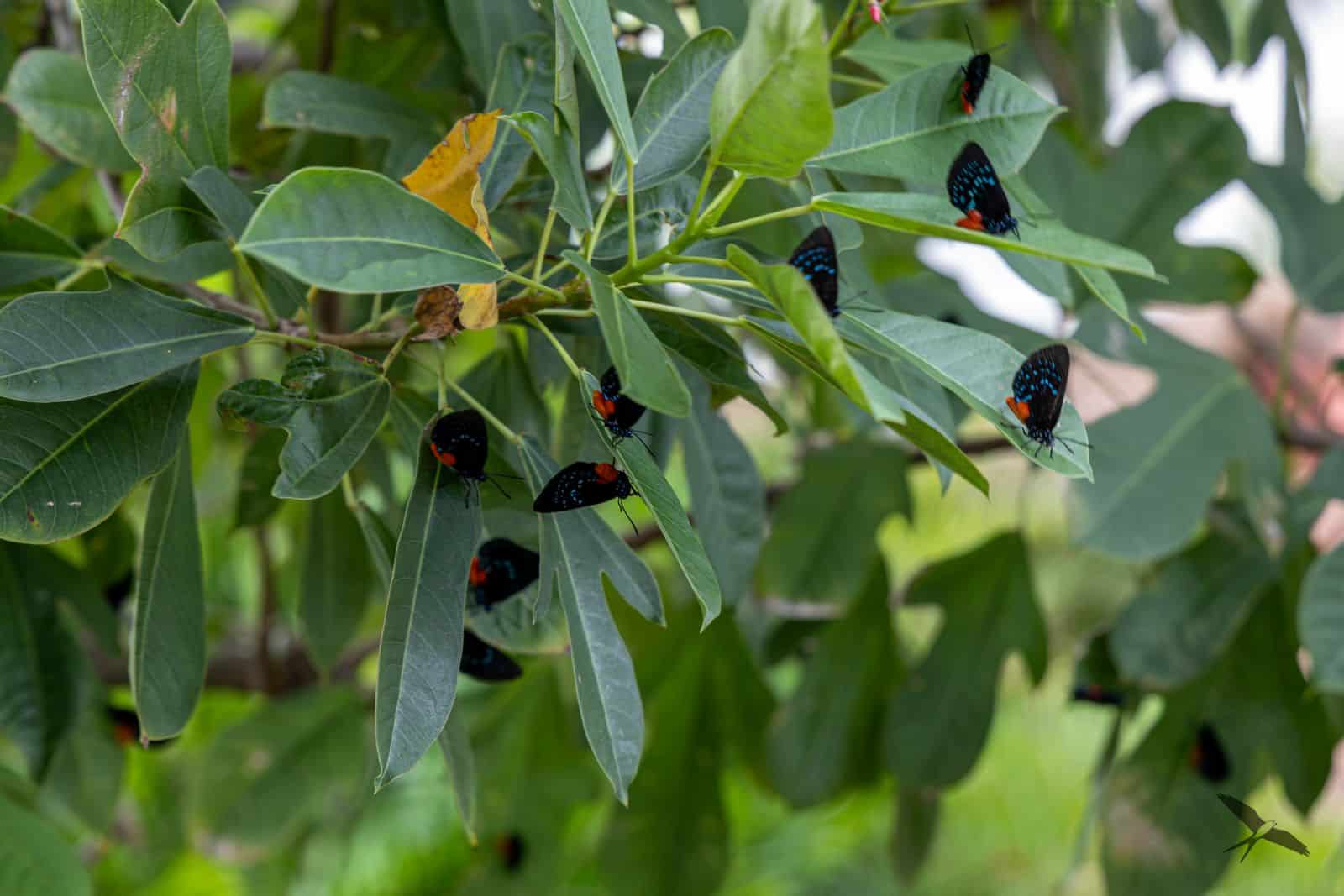
Adult Atalas are conspicuous when several gather on a flowering jatropha or firebush, but nectar feeding is only one part of their relationship with a landscape. In Florida, Atala larvae develop on cycads, principally the native coontie (Zamia integrifolia). Eggs are placed on suitable host plants, caterpillars consume their foliage, and pupation often occurs on the host or nearby vegetation. Adults, by contrast, can move among a much broader range of flowering plants. UF/IFAS describes this separation between larval host plants and adult nectar resources in detail.
The different stages of the Atala lifecycle reveal distinct relationships with plants. Caterpillars feed on coontie, late-stage larvae may remain nearby as they prepare to pupate, and chrysalises can occur within the same vegetation. Adults use a broader range of plants, including flowering jatropha and firebush for nectar, while other vegetation may simply provide a place to perch. Seeing an Atala on a plant does not necessarily mean that plant serves as food or a host.
Historical Decline and Rediscovery
Early accounts describe an Atala population in South Florida that was considerably more abundant than the remnant populations known later in the twentieth century. In a 1961 paper, George W. Rawson reviewed records indicating that Atalas had been common around Miami and portions of the Lower Keys into the late 1920s. By the 1930s, those records had largely ceased. UF/IFAS notes that the butterfly was believed extinct in Florida from 1937 until its rediscovery in 1959.
The decline occurred alongside a severe reduction in coontie. The plant’s underground stem contains starch, and commercial starch production harvested wild coontie extensively in South Florida. Development and clearing removed additional stands. Rawson considered the loss of the host plant an important factor in the butterfly’s decline, and later researchers have continued to identify host-plant depletion as a major part of the Atala’s Florida history. The evidence supports a strong relationship between the two declines without requiring coontie harvesting to be treated as the only pressure affecting the butterfly.
Rawson documented the first authenticated rediscovery on February, 1959, when several butterflies were collected from a small South Florida colony whose location was intentionally withheld. He later raised Atalas from that population and participated in attempts to establish another colony in Everglades National Park. Adults from one release were liberated shortly before Hurricane Donna crossed South Florida in September 1960, and the experimental population could not be found afterward. A later release also failed to produce a detectable established colony.
The Atala’s rediscovery did not immediately lead to a stable recovery. A small population found on a Miami-Dade barrier island in 1979 is thought to be the source of current Florida populations. As cultivated cycads became more common in developed landscapes, Atalas spread across several southeastern Florida metropolitan areas. A 2024 analysis documents their long-term persistence within this highly urbanized and fragmented landscape.
Eggs and Larval Development
Female Atalas normally lay their eggs in clusters on suitable cycads. On coontie, new foliage is frequently used, and UF/IFAS reports clusters containing up to 60 or more eggs. During periods when fresh leaf growth is limited, females may also place eggs on coontie cones. The eggs are cream-colored and are often covered with red-orange scales transferred from the female’s abdominal tuft.
Atala larvae are gregarious, meaning they tend to remain and feed in groups through much of their development. Young caterpillars often feed side by side before older larvae consume progressively larger portions of the leaflets.
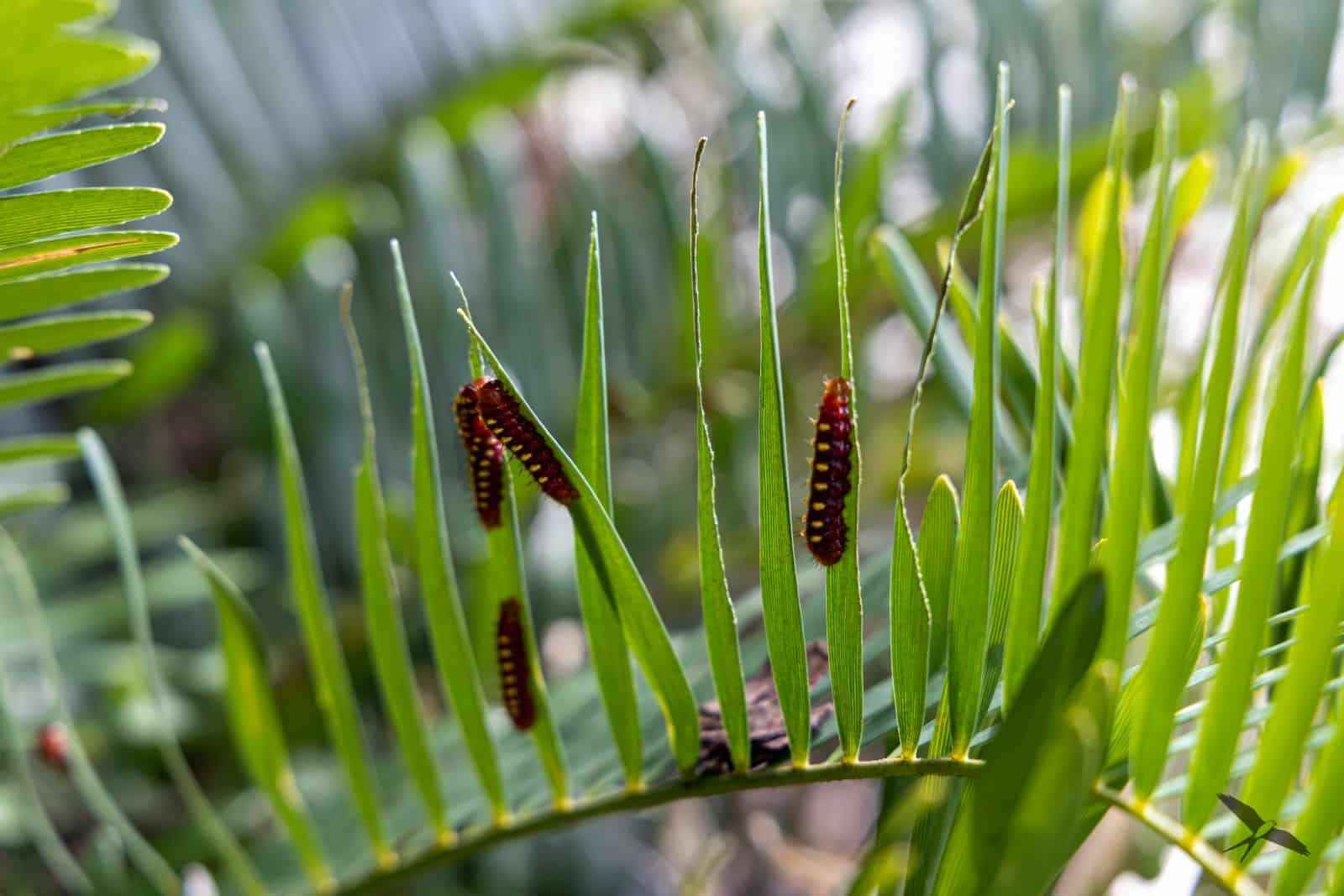
The visual sequence begins after hatching. Newly emerged caterpillars are extremely small and initially pale. Within a day or two they develop the red body and yellow dorsal spots characteristic of later instars. Larvae remain gregarious through much of their development, with young caterpillars often feeding side by side before older larvae consume progressively larger portions of the leaflets.
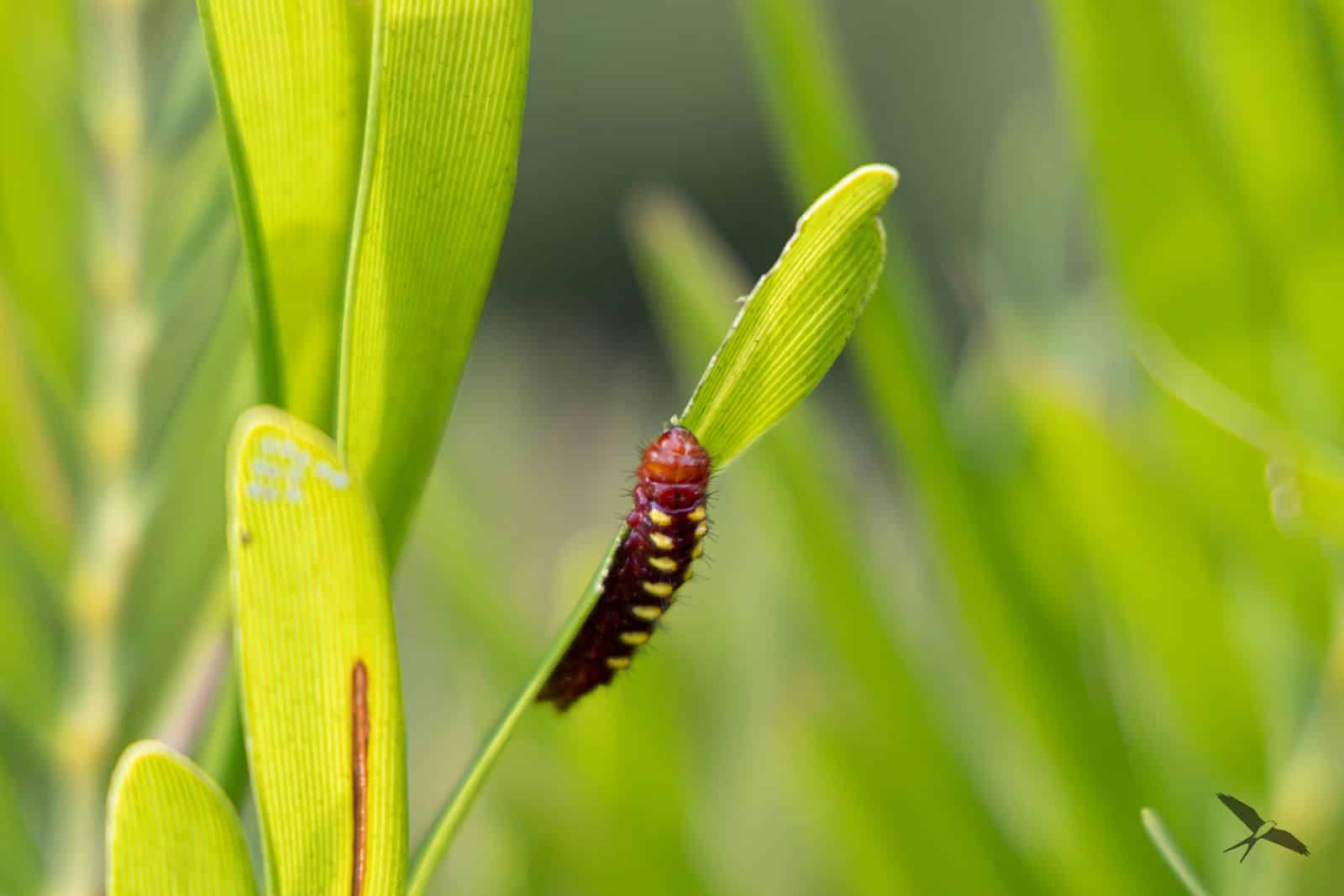
A large group can remove substantial amounts of coontie foliage. Rawson described younger larvae skeletonizing portions of the leaf surface before later stages consumed entire sections, and contemporary observations document heavy or complete defoliation where larval numbers are high. Established coontie can often recover, although the effect becomes more consequential on recently installed, stressed, small, or repeatedly defoliated plants.
Larval feeding also supplies the chemical compounds associated with the Atala’s defensive biology. Cycads contain cycasin and related compounds that the caterpillars sequester from their food. Research has documented these compounds in later life stages, including the eggs. The bright red and yellow larval coloration and the conspicuous coloration of adults are treated in the literature as aposematic, or warning, signals associated with this chemical defense. The precise response of every potential predator cannot be inferred from coloration alone, but the connection between cycad chemistry, sequestration, and warning coloration is well established.
From Feeding Caterpillar to Chrysalis
Late in larval development, feeding stops and the caterpillar begins searching for a pupation site. Atala larvae may move away from the foliage on which they had been feeding and can regroup before pupation. They produce silk that anchors them to the selected surface and can form substantial silk deposits where several individuals use the same area.
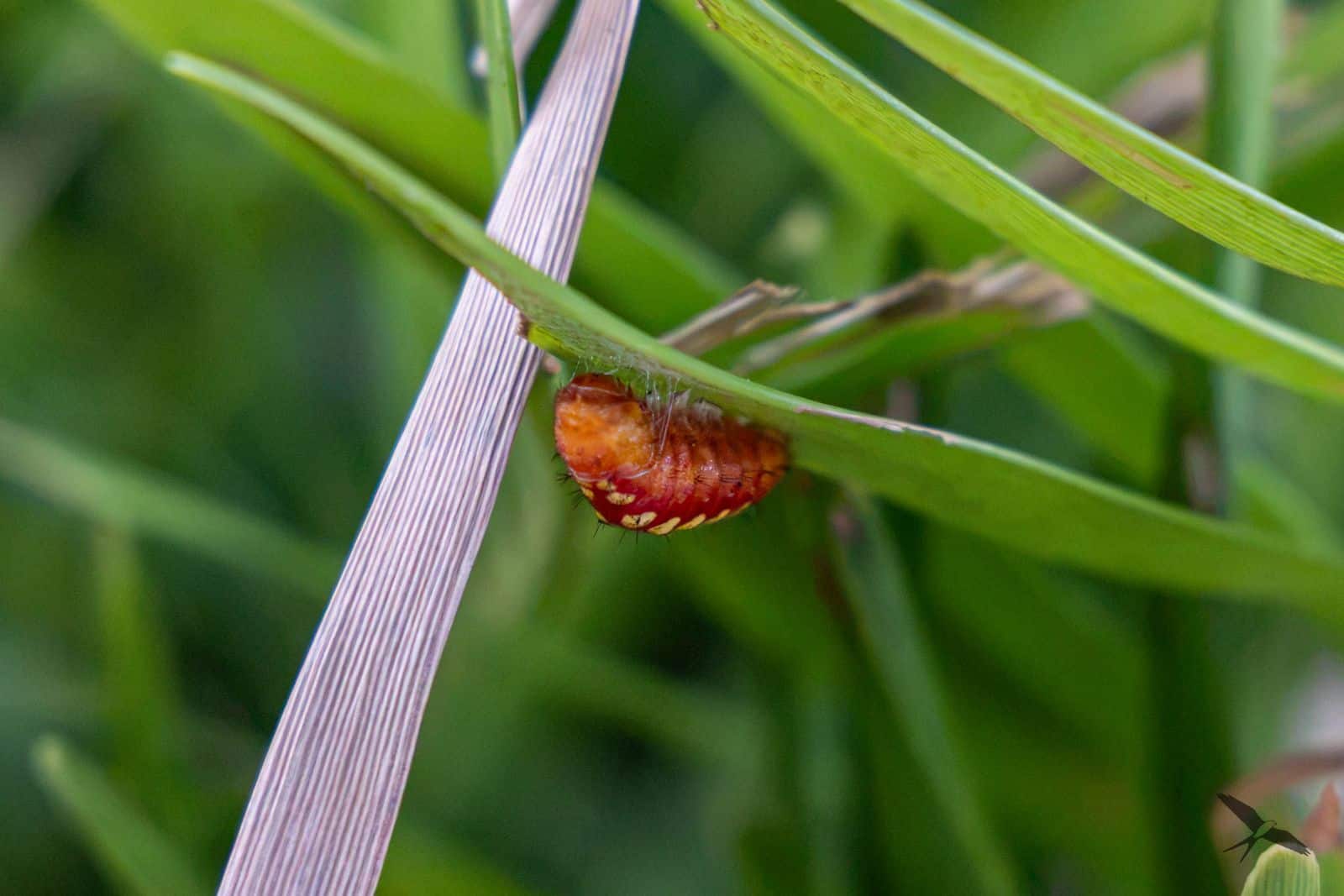
The visible fibers in this photograph are therefore silk rather than part of the chrysalis. This distinction is useful because the transition can otherwise look ambiguous in the field: the caterpillar has stopped behaving like an actively feeding larva but has not yet become a pupa.
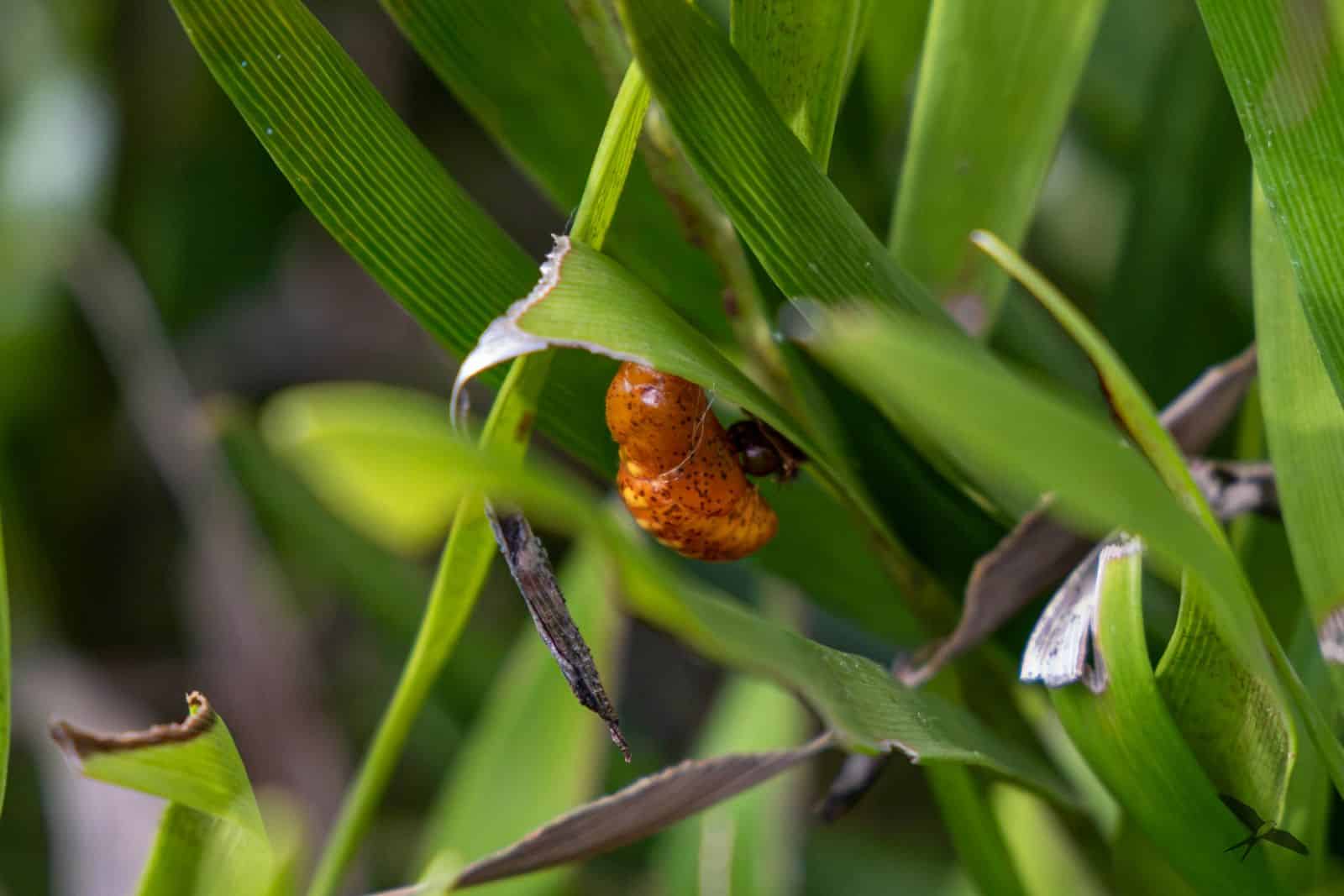
Atala pupae are generally brown with dark spotting, becoming darker under cooler conditions and more golden-brown under warmer conditions. Cooler conditions also slow development, changes documented as seasonal polyphenism in a 2017 study by Sandy Koi and Jaret Daniels.
Pupation often occurs in groups on the host plant or nearby vegetation. Larvae may form broad silk mats at repeatedly used pupation sites, and pupae are commonly found relatively close to the ground, although higher sites have also been recorded. Older pupae have been documented producing brief low-frequency sounds, or stridulations, but the function of those sounds in Atalas remains unresolved.
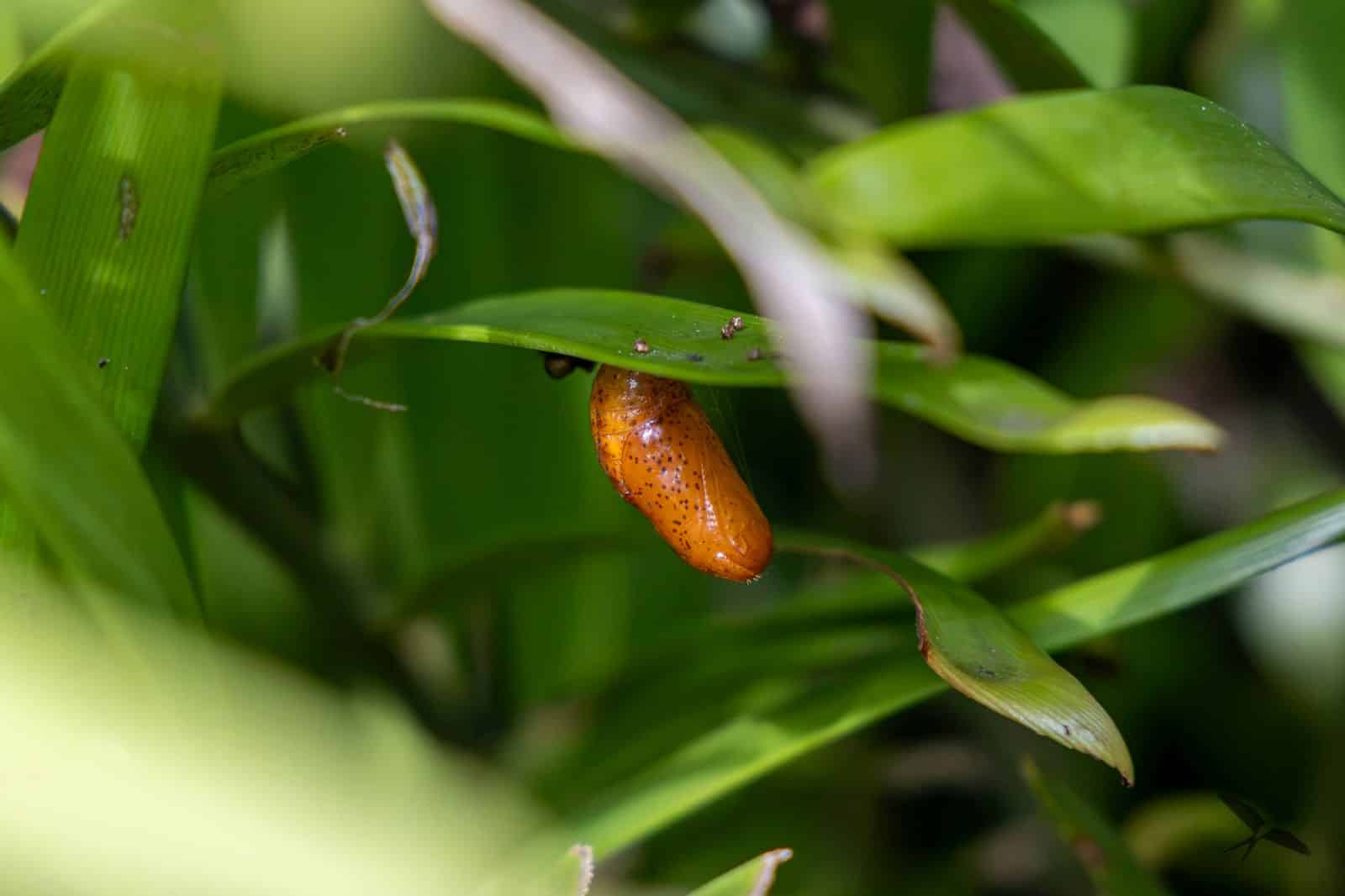
Frass is the fecal material produced during the larval feeding stage. It is different from meconium, the waste expelled by an adult butterfly shortly after it emerges from the chrysalis. That distinction matters when interpreting residue around a pupation site: material present among feeding larvae or accumulated beneath host foliage should not automatically be described as evidence of adult emergence.
Adult Feeding and Plant Use
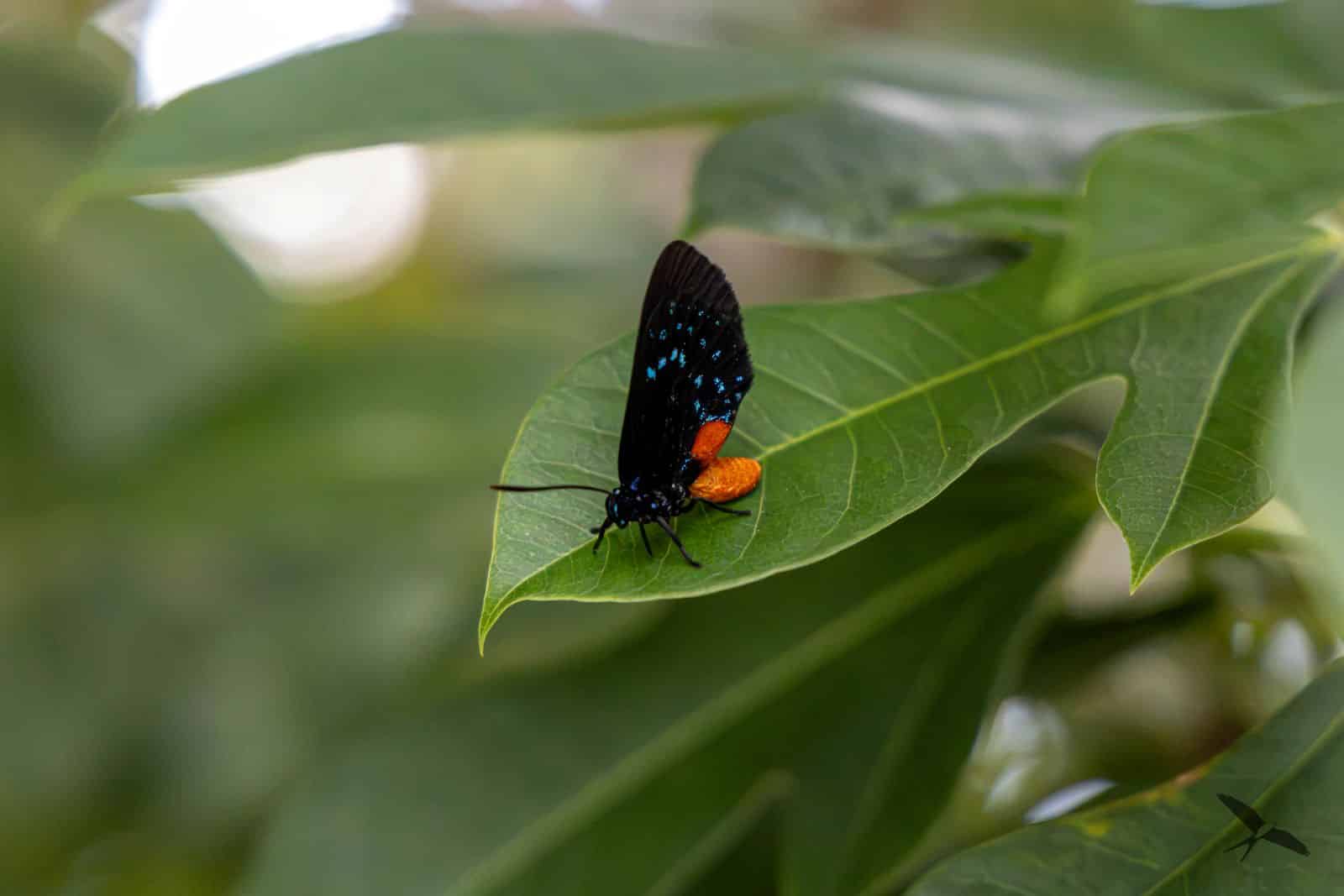
Metamorphosis changes the Atala’s relationship with plants. Caterpillars specialize on cycads, while adults feed on nectar from a much broader range of flowering plants. Sandy Koi’s 2008 study documented numerous native and ornamental nectar sources used by adult Atalas, illustrating the distinction between plants that provide adult food and the cycads required for larval development.
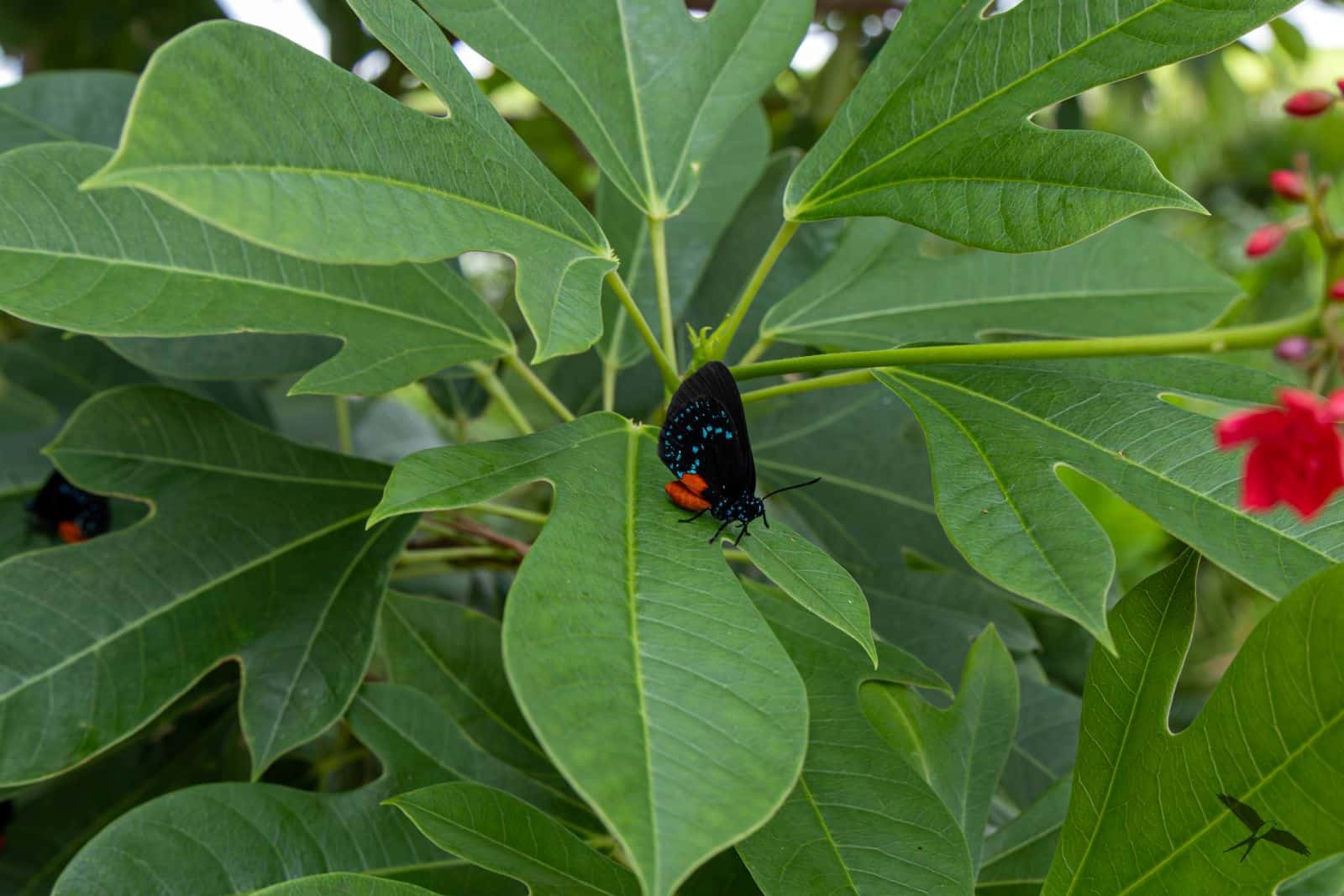
Jatropha integerrima is among the documented adult nectar sources. Several adults using the same flowering jatropha can therefore be understood as feeding activity associated with a productive nectar resource. The observation says nothing, by itself, about where those adults developed as caterpillars. Suitable cycads remain necessary for reproduction.

Where nectar plants and host plants occur near one another, adults can remain relatively localized. UF/IFAS describes both sexes as fairly sedentary when those resources are available, although their movements are not identical and females may disperse while searching for suitable host plants. Adults therefore need not remain physically on coontie even when a nearby coontie planting is sustaining reproduction.
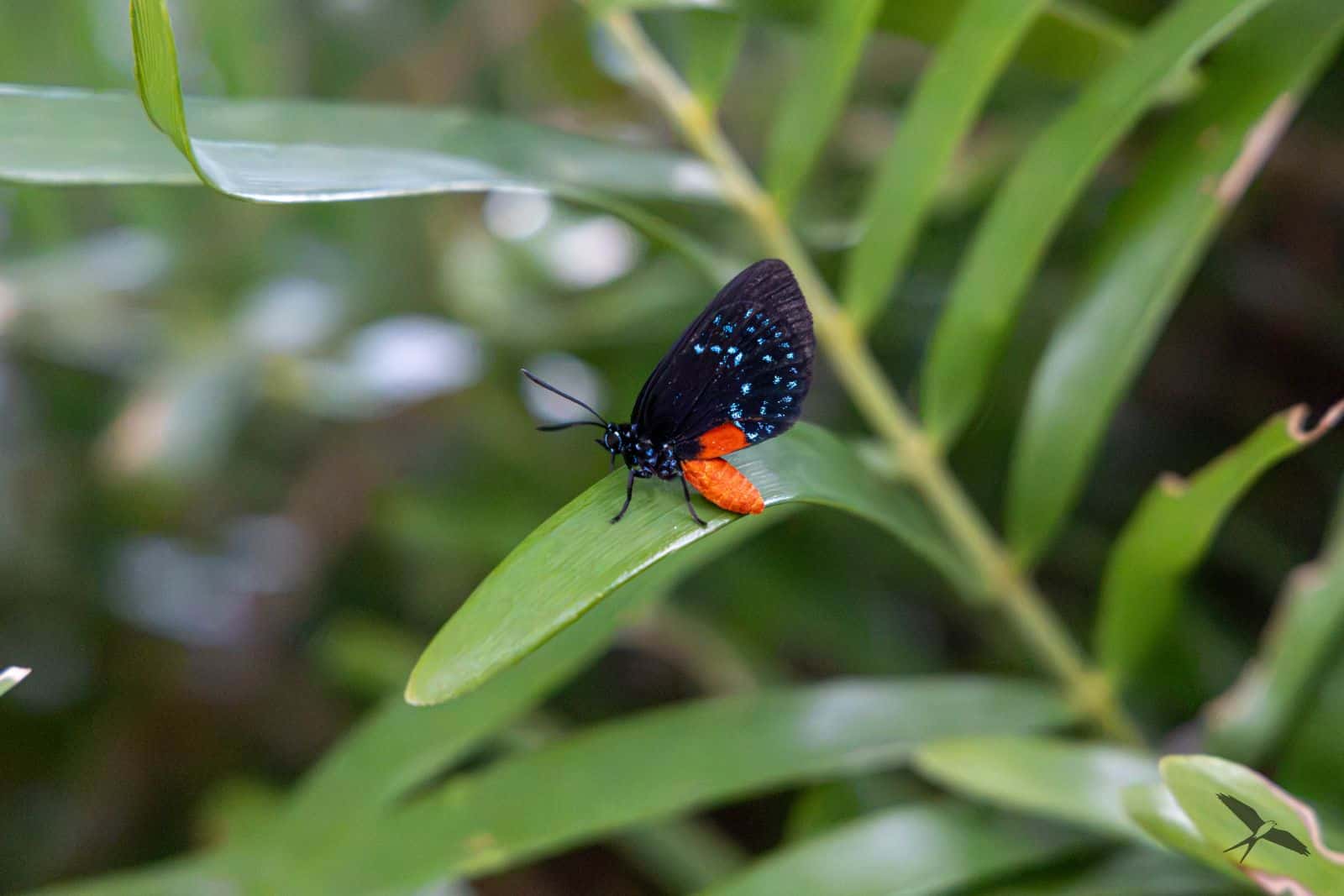
An adult on coontie may be perching, moving through the host planting, interacting with other adults, or, in the case of a female, evaluating a potential oviposition site. A still photograph cannot reliably distinguish among those behaviors unless the behavior itself is visible. The biological importance of coontie is nevertheless clear from the lifecycle: it supports the larval stage and provides the surface on which females commonly lay eggs.
The fern photograph illustrates a third type of plant use. Vegetation can provide a perch, shelter, or simply a temporary landing surface without functioning as either a nectar source or larval host. Separating those roles prevents observations of adult butterflies from being interpreted too broadly.
Atalas can also be remarkably tolerant of close observation. Around this population, adults often remain in place as people approach, making them particularly engaging butterflies for children to watch at close range.
Seasonal Behavior, Winter, and Dispersal
Atalas are not known to conduct a regular seasonal migration comparable to monarch butterflies. Koi’s University of Florida research notes that species in the genus Eumaeus are not known to migrate, although an observation from the Bahamas has been discussed as possible directed flight. Females can disperse in search of host plants, and populations can spread into newly suitable areas, but dispersal and range expansion should not be described as evidence of an annual migration.
This means Florida Atalas do not have a known winter destination to which the population routinely departs. In southeastern Florida the species is multivoltine, with breeding possible through the year when conditions and plant resources allow it. Population numbers still vary considerably by season and location. UF/IFAS reports lower counts in some colonies during March and December and higher counts during January and June, while longer-term monitoring shows pronounced local cycles of decline and recovery.
Winter behavior is also more complicated than simply saying that Atalas become dormant. Diapause is a programmed developmental arrest that allows many insects to pass through a predictable unfavorable season. Koi’s work found that what had sometimes been described as diapause in the Atala appeared more consistent with quiescence—an environmentally induced slowing or suspension of activity rather than a fixed obligate winter stage. The later controlled-season experiments by Koi and Daniels likewise showed continued development under simulated Miami winter and spring conditions, although development took longer than under warmer treatments.
Cool conditions therefore alter the pace of the lifecycle without establishing a single overwintering stage for the species. Seasonal conditions also affect appearance. Koi and Daniels documented darker cool-season pupae and changes in male wing iridescence associated with temperature, humidity, and photoperiod. These responses indicate developmental plasticity rather than seasonal movement to another region.
Atalas can survive some short periods of unusual cold, but the available observations should not be interpreted as general freeze-hardiness. Koi recorded adults entering chill coma after a night near 28°F in a Gainesville research colony and recovering as daytime temperatures rose. The significance of that observation is limited by the conditions under which it occurred: exposure duration, shelter, daytime recovery temperature, life stage, host condition, and other site factors affect survival.
Exceptional cold can still reduce local populations severely. The seasonal literature and subsequent population research describe Atala numbers as capable of declining sharply after unfavorable conditions and later rebuilding where host plants and adults remain available. Winter in Florida is therefore better understood as a period in which development, activity, plant growth, and local survival may change rather than a season during which Atalas routinely migrate away or enter a universal dormant stage.
Coontie and the Modern Florida Population
The modern distribution of Atalas cannot be separated from the increasing use of cycads in cultivated landscapes. Coontie became a widely propagated native ornamental, while other suitable cycads also became common in nurseries and developed landscapes. UF/IFAS now describes local colonies associated with coontie used in butterfly gardens and ornamental plantings, and the Florida Museum notes populations in residential landscapes, commercial nurseries, and botanical gardens.
These plantings are not replacements for the pine rockland communities in which Atalas historically occurred. Pine rockland includes a much broader set of soils, disturbance patterns, plants, animals, and ecological relationships than an ornamental bed containing coontie. A developed landscape can nevertheless restore one specific biological resource that had become scarce: a host plant on which a female Atala can lay eggs and its caterpillars can complete development.
The 2024 analysis by Koi, Adrian Figueroa, and Hong Liu documents long-term persistence of Atalas in three metropolitan centers and associates the species’ recovery with the increased availability of nursery-grown host plants in urban landscapes. The resulting population remains fragmented and capable of substantial fluctuations, but its persistence demonstrates that developed landscapes can contribute usable reproductive habitat when the appropriate host plants are present.
The Pennate photographs document those plant roles at close range. Coontie carries the feeding caterpillar, the silk-producing transition into pupation, and the chrysalis. Adults occur both on the host planting and elsewhere in the surrounding vegetation, including flowering jatropha and firebush. Fern foliage can be occupied without evidence that it is supplying either nectar or larval food.
That sequence also places the Atala’s historical decline in clearer context. Adult nectar plants support feeding, but cycads determine whether a site can support the larval stage. The severe reduction of wild coontie removed an important reproductive resource at the same time the Atala was disappearing from Florida. Decades later, widespread cultivation of cycads created additional places in developed landscapes where the lifecycle could be completed. That change does not recreate the original pine rockland ecosystem, but it does restore a plant function on which the butterfly directly depends.
Sources
Rawson, George W. 1961. “The Recent Rediscovery of Eumaeus atala (Lycaenidae) in Southern Florida.” Journal of the Lepidopterists’ Society 15: 237–244.
Read the original paper — Yale Peabody Museum (ask.ifas.ufl.edu)
Koi, Sandy E. 2013. Ecology and Conservation of Eumaeus atala Poey 1832 (Lepidoptera: Lycaenidae). Master’s thesis, University of Florida.
University of Florida thesis (ufdcimages.uflib.ufl.edu)
Koi, Sandy, and Jaret C. Daniels. 2015. “New and Revised Life History of the Florida Hairstreak Eumaeus atala (Lepidoptera: Lycaenidae) with Notes on its Current Conservation Status.” Florida Entomologist 98(4): 1134–1147.
Primary research article (bioone.org)
Koi, Sandy, and Jaret Daniels. 2017. “Life History Variations and Seasonal Polyphenism in Eumaeus atala (Lepidoptera: Lycaenidae).” Florida Entomologist 100(2): 219–229.
Primary research article (journals.flvc.org)
Koi, Sandy. 2008. “Nectar Sources for Eumaeus atala (Lepidoptera: Lycaenidae: Theclinae).” Florida Entomologist 91(1): 118–120.
Primary research article (bioone.org)
Koi, Sandy, Adrian Figueroa, and Hong Liu. 2024. “Citizen Science Engagement Reveals Patterns of Long-Term Persistence of an At-Risk Butterfly in Three Metropolitan Centers.” Journal for Nature Conservation 81: 126689.
Primary research article (sciencedirect.com)
Koi, Sandy, Donald W. Hall, and Elena M. Rhodes. “Atala Butterfly, Atala Hairstreak, Coontie Hairstreak, Eumaeus atala Poey 1832.” University of Florida IFAS Extension, Featured Creatures.
UF/IFAS species reference (ask.ifas.ufl.edu)
Florida Museum of Natural History — Daniels Lab. “Atala Butterfly.” McGuire Center for Lepidoptera and Biodiversity.
Florida Museum Atala conservation profile (floridamuseum.ufl.edu)
You must be logged in to post a comment.