
Butterfly Lifecycles in Florida: Timing, Heat, and Survival
Most Butterflies Do Not Reach Adulthood
In Florida, only a small fraction of butterflies reach adulthood. This outcome reflects climate, exposure, and predation operating at every stage. From May through September, extended heat, alternating wet and dry cycles, and dense predator communities shape survival outcomes. What emerges as an adult has moved through those conditions, not around them. Florida’s climate patterns described here are consistent with regional research published by the University of Florida IFAS Extension.
A landscape that hosts butterflies is not automatically producing them. Adults can feed wherever nectar is available. Reproduction requires successful passage through four stages—egg, larva, pupa, and adult—within Florida’s long warm season and fragmented urban structure. Each stage faces different constraints.
The Egg: Surface Exposure and Thermal Limits
The lifecycle begins when a female deposits an egg on a specific host plant. That placement is chemically guided. Nectar plays no role at this stage; leaf chemistry and surface conditions determine whether development begins.
Eggs are immobile and subject to the microclimate of the leaf surface. In Florida summers, leaf temperatures often exceed ambient air readings, and during high heat index days can surpass 110–120°F. Eggs cannot relocate or regulate temperature. Prolonged heat increases desiccation risk, particularly during dry intervals between rain events.
Humidity complicates survival. High moisture can reduce desiccation but introduces fungal and microbial stress, especially during extended wet periods. Eggs persist within a narrow band between excessive dryness and excessive moisture.
Predation begins immediately. Ants, including fire ants, consume eggs opportunistically. Small parasitoid wasps may oviposit into eggs, ensuring that what hatches will not complete development. Egg losses are substantial and vary widely across species and microhabitats.
The Larva: Rapid Growth Under Continuous Risk
If the egg survives, the larva enters its most vulnerable phase. Caterpillars must grow quickly, converting host foliage into body mass over days or weeks. Nutritional quality of leaves directly affects development speed and pupal viability. During drought stress or late-summer heat, foliage can become tougher and less nutritious, slowing growth when predator density is already elevated.
Predation intensifies during this stage. Paper wasps patrol foliage visually and remove caterpillars to provision nests. Their impact can be significant in suburban landscapes, though intensity varies by site and season. Parasitoid wasps and tachinid flies operate differently: they lay eggs on or inside the caterpillar. The larva may continue feeding for some time, and parasitism may only become evident when metamorphosis fails.
Ants target early instars. Anoles hunt by sight and movement, particularly in simplified plantings with limited cover. Birds increase foraging activity during nesting season, when protein demand rises. These forces overlap rather than occur in sequence.
Heat remains a limiting factor. In exposed beds during August and September, leaf-surface temperatures can exceed tolerance thresholds, especially in urban heat island conditions where hardscape elevates ambient warmth. Caterpillars can reposition along the plant, but movement increases visibility.
Humidity adds another layer. During prolonged rainy cycles, dense foliage with limited airflow can increase fungal and bacterial stress. Larval losses are therefore shaped by overlapping predation, parasitism, thermal stress, and infection. The relative influence of each factor differs among species and seasons.
Why Caterpillars “Disappear” in Florida Gardens
Caterpillars often seem to vanish. This pattern reflects multiple mechanisms operating at once.
Some are removed quickly by predators. Others continue feeding while carrying parasitoid eggs that will prevent successful transformation. In extreme heat, desiccation can halt development. During extended wet periods, fungal pathogens increase.
What appears as disappearance is usually the visible result of overlapping predation, parasitism, heat stress, and microbial pressure acting on exposed stages.
The Pupa: Stillness in a Dynamic Climate
The pupal stage is transformation without mobility. Once attached, the chrysalis cannot relocate or feed. Survival depends on concealment and environmental stability.
Excessive heat can desiccate exposed pupae, particularly during late-summer heat waves. Cold snaps in winter, especially in northern portions of Central Florida, slow development and increase losses for temperature-sensitive species. Florida’s rapid wet–dry oscillations also influence pupal viability; high moisture reduces desiccation but may promote fungal growth.
Predation continues at this stage. Birds and opportunistic insects locate and consume pupae where visibility is high. Landscapes with limited structural complexity provide fewer attachment sites and increase vulnerability.
The Adult: Energy Intake Without Reproductive Certainty
The adult butterfly is the visible phase, sustained by nectar intake. Nectar availability influences longevity and egg production, but it does not ensure that the next generation will persist.
Attracting adults and producing butterflies are separate outcomes. A flowering landscape can host frequent visitation yet remain reproductively empty if host plants are absent, stressed, or spatially isolated. Adults are capable of flight; eggs and larvae are not. Fragmented habitat allows feeding while interrupting developmental progression.
Adults are also constrained by climate. During Florida’s extended warm season, midday heat reduces activity and increases water loss. Brief winter cold events suppress movement and can shorten lifespan. By the time a butterfly is visible, it has already passed through the most vulnerable stages.
Mortality Distribution Across Stages
Losses are not evenly distributed. Egg and early larval stages typically account for the greatest reduction in numbers due to desiccation, predation, and parasitism. Later instars may benefit from increased size or chemical defenses derived from host plants, though they remain at risk. Pupae experience concentrated losses tied to visibility and environmental stability. Adults face environmental stress but comparatively fewer lethal factors.
Across stages, survival functions as a probabilistic filter. Each phase reduces numbers further, and only individuals that pass through multiple layers of constraint emerge as adults.
The distribution of losses varies among specialists, generalists, and migratory species. Specialists are tightly linked to host availability and phenology. Generalists draw from broader plant resources and often persist more reliably in fragmented settings. Migratory species may pass through seasonally, feeding locally without completing development.
High reproductive output compensates for early-stage losses. The system produces more eggs than can realistically mature.
Seasonal Timing of Butterfly Lifecycles in Florida
Florida’s climate intensifies stage-specific vulnerability rather than distributing it evenly. From late spring through early fall, prolonged heat, high humidity, and elevated predator densities overlap. Urban heat islands can extend thermal stress into evening hours, compressing feeding windows.
Late summer represents a recurrent bottleneck. Leaf-surface temperatures peak. Predator populations are established. Heavy rainfall increases microbial stress, while intermittent drought reduces foliage quality. Winter cold events, even brief ones, interrupt development in temperature-sensitive species. Spring provides a narrower interval of moderated temperatures and host flush before summer heat accumulates.
Timing is therefore species-dependent. Specialists align closely with host growth cycles. Generalists exploit broader seasonal windows. Migratory species may appear independent of local reproductive success.
Urban Fragmentation and Predation Density
Suburban landscapes often concentrate predators while dispersing host plants. Stable ant colonies, wasp nesting sites, and consistent bird presence create dense hunting zones. Nectar resources may cluster in ornamental beds, while host plants remain isolated or absent. Urban predator densities and insect population dynamics in Florida are monitored and documented by the Florida Department of Agriculture and Consumer Services.
Adults can traverse these gaps. Eggs and larvae cannot. Fragmentation lowers the likelihood that oviposition results in successful development. Connectivity influences generational persistence as a structural reality rather than an aesthetic preference.
The Atala: Specialization and Host Dependency
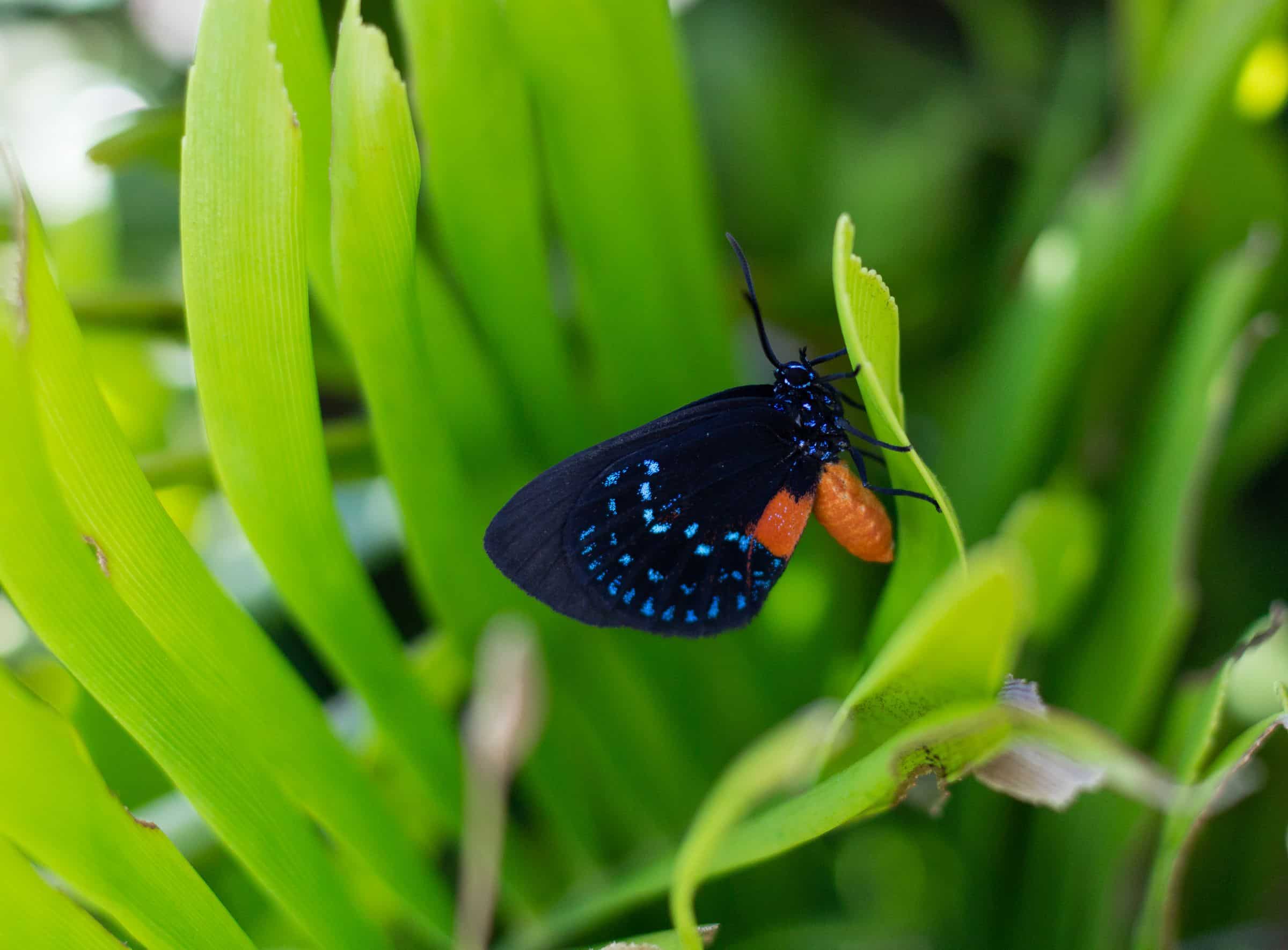
The Atala butterfly illustrates host specificity with clarity. Its larvae feed exclusively on coontie (Zamia integrifolia). Without that host, reproduction does not occur, regardless of nectar abundance.
Atala larvae sequester defensive compounds from cycads, reducing some forms of predation. This shifts, but does not eliminate early-stage losses. Reproductive timing aligns with new host growth, demonstrating the tight coupling between plant phenology and insect development.
Where coontie is present in sufficient density, Atala populations can stabilize. Where it is absent, adults may appear transiently but cannot establish sustained generations. Host presence governs generational persistence.
Nectar Feeding and Larval Survival
Nectar fuels adults. Leaves build butterflies.
A landscape rich in flowers may generate visible activity while producing no subsequent generation. Conversely, host-dense plantings may experience defoliation yet represent active reproduction. These roles are biologically distinct.
Removing host plants while maintaining nectar sources converts reproductive habitat into feeding space. The lifecycle requires both energy intake and developmental substrate, and they are not interchangeable.
Structural Reality of Survival
Butterfly lifecycles in Florida unfold within extended heat, fluctuating moisture, concentrated predator communities, and fragmented urban structure. No landscape removes these forces. It can only alter exposure to them.
Development proceeds when thermal limits, host condition, predator encounters, and seasonal timing align long enough for transformation to occur. Visible butterflies represent individuals that have passed through multiple stages of climatic and ecological constraint.
You must be logged in to post a comment.