
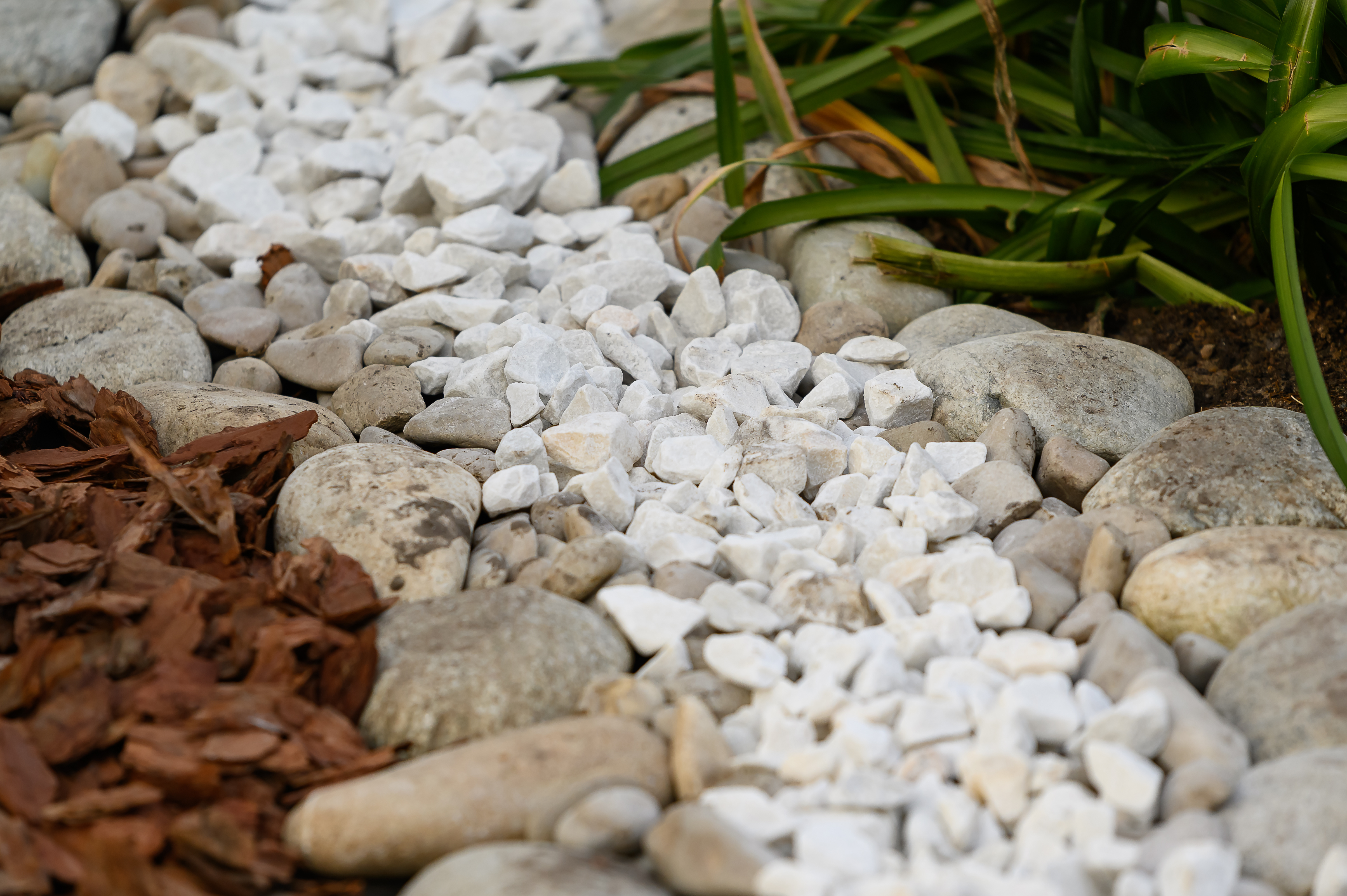
Rock vs Mulch in Florida: 11 Key Facts Before You Decide
When Is Rock Better Than Mulch in Florida Landscaping?
Not sure whether to use rock or mulch? Here’s what to know before you decide — from performance in Florida’s heat to long-term maintenance.
Rock beds are trending across Florida — they look clean, seem low-maintenance, and promise a “set it and forget it” alternative to organic mulch. But before you ditch mulch for gravel, it’s worth taking a closer look at how these materials actually perform in Florida’s sandy soils, storm-prone climate, and plant-heavy landscapes. Below, we break down 11 key considerations—from soil health and weed control to installation tricks and long-term performance—to help you make an informed, Florida-smart choice.
Table of Contents
Benefits of Rock vs Mulch in Florida Yards
- Long-Term Durability and Minimal Upkeep
- Fire- and Pest-Resistant
- Clean, Modern Aesthetic
- Great for Drainage and Erosion Control
- Washed Shell as a Coastal Alternative
Problems with Rock vs Mulch in Florida Landscapes
- Rocks Get Hot—Really Hot
- Mulch Builds Soil, Rock Doesn’t
- Hard to Clean Under Debris-Dropping Plants
- Weeds Still Happen—and Rock Makes It Worse
- Cost, Settlement, and Why Your Rock Bed Might Disappear
- Potential pH Issues with Certain Rock Types
Our Take: Design with Intention
Benefits of Rock vs Mulch in Florida Yards
1. Long-Term Durability and Minimal Upkeep
Rocks don’t rot, float away, or decompose like mulch. Once installed correctly with proper grading and edging, a rock bed can last for years—sometimes decades—without needing seasonal replenishment. That kind of staying power makes rock an appealing option for areas that are hard to access or don’t need frequent reworking.
Mulch, on the other hand, naturally breaks down over time. While that’s great for soil health (more on that later), it also means you’re signing up for a recurring task: re-mulching every 6 to 12 months, especially after Florida’s heavy summer rains fade that fresh-dyed look to gray.
For homeowners who want low-intervention solutions—especially in low-traffic zones or between permanent landscape features—rock can be a one-and-done choice. Just remember: good installation matters. Without proper weed barrier and edging, even rock beds will shift, settle, or sprout weeds over time.
2. Fire- and Pest-Resistant
Unlike wood mulch, rocks don’t ignite during dry spells or create a food source for termites. That’s especially important in Florida, where subterranean termites are widespread and mulch piled against foundations is a known entry risk. Gravel or stone can act as a buffer strip to reduce both fire and pest hazards—particularly within the first 12–18 inches around the home.
In fact, the Florida Building Code (FBC) recommends avoiding wood-based mulch directly against structures in termite-prone areas, favoring inorganic alternatives like gravel to create a termite inspection zone and reduce moisture retention at the base of exterior walls.
FBC-Residential R318.4 – Physical Barriers
“In areas where subterranean termites are known to be a problem, a minimum 6-inch inspection space must be maintained between exterior wall coverings and the finished grade. In addition, any use of cellulose-based mulch (such as wood chips or bark) in this inspection area is discouraged, as it may provide a food source and conceal termite activity.”
This isn’t a direct ban on mulch, but it reinforces the principle of keeping organic materials (like mulch) away from structures to allow inspection and reduce termite risk.
3. Clean, Modern Aesthetic
Rocks offer a sharp, finished look that pairs well with modern architecture, minimalist landscapes, and drought-tolerant plant palettes. Whether you’re framing agaves in a desert-style bed or using gravel to border pavers and stepping stones, the texture and color range of rock opens up design possibilities mulch can’t match.
It’s especially useful as a visual contrast—cool-toned stones can make warm-toned plants pop, and vice versa. You can also use boulders or sculptural rock groupings as focal points, something mulch just isn’t built for.
That said, the aesthetic isn’t for every space. Large expanses of stone can feel stark or uninviting if not broken up with greenery. If you’re going for a Florida-friendly look with layered planting and wildlife habitat, stone should act as a supporting element—not the star.
4. Great for Drainage and Erosion Control
Rock is a go-to material for managing water in Florida landscapes—especially around areas with poor drainage or heavy roof runoff. Many Florida homes don’t have gutters, which means water sheets off rooflines and erodes soil at the dripline. Placing gravel or river rock under these edges helps slow the water, reduce splash erosion, and protect your foundation.
Rocks also shine in functional features like:
- Dry creek beds that direct water through the landscape during storms
- Rain gardens where stone prevents plant beds from washing out
- Downspout basins that reduce erosion and help recharge soil moisture
Just make sure to choose the right size stone for the job. Smaller gravel tends to shift more, especially on slopes, while larger river rock stays put but is harder to clean and walk on.
Used well, rock is more than a decorative mulch—it’s a tool for stormwater control and site longevity.
5. Washed Shell as a Coastal Alternative
Washed shell—made from cleaned, crushed seashells—is a uniquely Florida material that offers a more natural look than gravel. It’s especially popular in coastal landscapes, beach towns, and xeriscape designs where a “Florida native” aesthetic is the goal.
It shares many of the pros and cons of rock:
- Doesn’t decompose or enrich the soil
- Offers good drainage
- Won’t attract pests or ignite
- Can reflect heat into nearby plant beds
But there are a few extras to keep in mind. Shell is often more affordable per yard than decorative gravel, but it’s lighter, so it tends to shift with heavy rain or foot traffic. It also can develop odor if mixed with organic debris, especially under trees that drop fruit or leaves. And while it looks great in low-traffic beds or accent zones, it’s not always comfortable for bare feet or pets.
Pro tip: Shell pairs well with stepping stones or flagstone walkways—you get the look without having to tread directly on the sharp edges.
Problems with Rock vs Mulch in Florida Landscapes
6. Rocks Get Hot—Really Hot
If you’ve ever walked barefoot on a gravel path in July, you already know: rocks trap and radiate heat. Inorganic materials like gravel, shell, and river rock absorb sunlight and bounce that energy right back into nearby plant beds, walls, and patios.
This can create mini heat islands in your yard, especially in full sun or on the west and south sides of a home. For tender or shade-loving plants, this added stress can be the difference between thriving and barely surviving.
You might notice:
- Leaf scorch or wilting on nearby plants
- Faster water evaporation from soil
- Uncomfortable temperatures on patios or walkways
- Higher indoor cooling costs when heat reflects onto exterior walls or windows
If you plan to use rock near plants, stick to heat-tolerant species like agave, dwarf yaupon holly, or silver saw palmetto. And always balance with cooler zones that use mulch, dense plantings, or groundcovers to keep the overall yard more livable—for plants and people alike.
7. Mulch Builds Soil, Rock Doesn’t
Mulch might break down and fade—but that’s not a flaw. That’s the feature.
As organic mulch decomposes, it adds nutrients, improves soil structure, and supports beneficial microbes. It’s one of the simplest ways to build healthier soil naturally, especially in Florida’s sandy landscapes that struggle to hold moisture or nutrients on their own.
Rocks, on the other hand, do nothing for soil health. They don’t decompose, they don’t feed anything, and over time they can even contribute to problems like:
- Soil compaction in sandy or silty areas
- Depletion of organic matter
- Weaker, shallow root systems
- Reduced water retention and soil life
If you’re using rock in larger planting beds, you’ll likely need to manually amend the soil or top-dress around key plants—especially natives or edibles that depend on living, active soil to thrive.
Quick tip: Use mulch where plant health is a priority—like in pollinator zones, new installations, or moisture-sensitive areas. Save gravel for purely decorative beds, foundation buffers, or spots where durability matters more than growth.
The bottom line? What’s happening beneath the surface matters just as much as how it looks on top.
8. Hard to Clean Under Debris-Dropping Plants
Rocks might seem like the clean, modern choice—but under the wrong plants, they quickly turn into a mess.
In Florida, many popular landscape trees and palms (like Queen Palms [Syagrus romanzoffiana], Areca Palms, Live Oaks, Mahogany, Tabebuia, bottlebrush, and bougainvillea) drop a constant stream of leaves, flowers, seeds, or fruit. And when that debris hits your rock bed, two things happen:
- It starts to break down on top of the rocks, creating a layer of damp organic sludge.
- It works its way between the stones, eventually burying your decorative gravel in compost-in-progress.
Cleaning it out isn’t easy. Smaller gravel gets blown away with a leaf blower. Larger rocks trap debris in the gaps that has to be raked or picked out by hand. If you’re handling maintenance yourself, it’s frustrating. If you’re paying a crew, expect higher cleanup costs over time.
💡 Design tip: Rock works best under plants that don’t shed often—think structural accents, succulents, or low-litter species. For areas under trees or palms that regularly drop debris, mulch or dense groundcovers will be far easier to manage and much more forgiving.
9. Weeds Still Happen—and Rock Makes It Worse
Let’s bust a common myth: rock doesn’t prevent weeds. At best, it slows them down temporarily. But once weeds show up—and they will—they’re harder to manage than in a mulched bed.
Here’s what actually happens:
- Wind-blown seeds settle in the dust, leaf litter, and organic bits that collect between the stones.
- Weeds germinate right on top, especially under trees or messy plants.
- Landscape fabric doesn’t stop them for long. Roots punch through it, and when they do, pulling them is like trying to untangle wires from duct tape.
- Over time, the fabric itself starts to shift or tear, trapping organic debris and creating a hidden compost layer that practically invites weeds in.
The result? You’re stuck with a patchy rock bed, tangled roots, and no easy way to clean it up—especially if the rock is heavy or wedged into edging.
Our take: If you’re using rock, we do recommend a proper weed barrier—not to stop weeds, but to help prevent gravel from sinking into the soil over time (see #10). Just know it won’t keep weeds out forever.
If you’re using mulch, skip the fabric. It interferes with natural decomposition, traps organic debris, and does nothing to stop weeds long-term. A thick layer of mulch or living groundcover is more effective, healthier for the soil, and much easier to maintain.
💡 Want more info? We’ll be publishing a separate guide soon: “Should I Use Weed Barrier in My Landscape?” Stay tuned for real-world insight from our installs.
10. Cost, Settlement, and Why Your Rock Bed Might Disappear
Rock isn’t just more expensive than mulch—it behaves differently once it’s installed.
Florida’s sandy soil and frequent rain mean that gravel and shell can shift, settle, and eventually sink. What looks tidy in year one can turn patchy by year three.
This happens due to a process called substrate infiltration—where heavy materials like gravel slowly sink into softer subsoils over time, especially after repeated storms or foot traffic.
🪨 What it looks like in real life: The rocks that started flush with your walkway now sit lower, or you notice patches where they’ve vanished altogether. Some stones wash off the edge, while others seem to just “disappear.”
To avoid this, rock beds need:
- Proper subgrade prep
- Landscape fabric or stabilization mesh
- Solid edging
- Periodic top-ups
Without these steps, your “low maintenance” solution can quietly turn into a long-term hassle.
11. Potential pH Issues with Certain Rock Types
Not all rocks are chemically neutral. Some aggregates — especially limestone-based materials like crushed coral or coquina — can slowly raise the soil pH over time. That may sound harmless, but many Florida landscape plants (including azaleas, ixora, and coontie) prefer slightly acidic soil to thrive.
When pH rises too high, nutrient uptake suffers. You may notice yellowing leaves, stunted growth, or increased fertilizer needs — all of which cost time and money to fix.
If you’re set on using rock, choose inert or pH-neutral options like granite, river rock, or recycled tumbled glass. And if you’ve already got limestone gravel in place, consider regular soil testing and occasional acidifying amendments to keep your planting zones in balance.
In short? The wrong rock can mess with your plants in invisible ways.
Our Take: Design with Intention
Rock vs Mulch in Florida? Rock has its place — but it’s not a silver bullet. Florida landscapes are diverse, and your mulch strategy should be too.
Use rock strategically for:
- Drainage zones under rooflines or downspouts
- Hardscape accents like dry creek beds, patio borders, or walkways
- Areas with heavy leaf or fruit drop where mulch breaks down too quickly
- Foundation buffers to help reduce termite risk and erosion
Use mulch where:
- Soil needs improvement or moisture retention
- You’re growing young, shallow-rooted, or moisture-loving plants
- You want to support pollinators, soil life, and long-term plant health
- You prefer a cooler, more buffered environment around roots
That said — if your heart is set on gravel beds throughout the property, we can absolutely make that work. It just takes thoughtful design, extra prep, and a bit more budget. We’ll engineer solutions to help control erosion, manage drainage, reduce maintenance headaches, and keep things looking sharp over time.
At Pennate, we design with intention — and adjust with reality. Whether you lean gravel-heavy or mulch-forward, we’ll help you create a landscape that performs in Florida’s unique conditions and aligns with your long-term vision.
👉 Book a Landscape Consultation
👉 Browse Our Plant Shop
👉 Read More Landscape Design Tips
Need mulch delivered instead of hauling it yourself?
We offer bagged mulch delivery with clean curb stacking across the Tampa Bay area.
→ Shop Mulch Delivery
